Loading
Form preview
  • US Legal Forms
  • Other Templates
  • More Forms
  • More Multi-State Forms
  • Worksheet 2 2 To Be Or Not To Be Proportional

Get Worksheet 2 2 To Be Or Not To Be Proportional

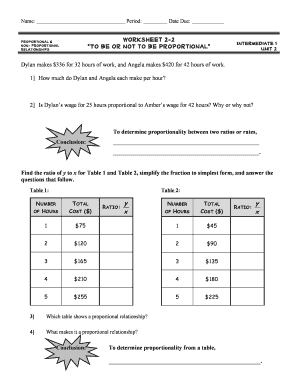
Name: Period: Date Due: Worksheet 22 To be or not to be proportional Proportional & non Proportional relationships Intermediate 1 Unit 2 Dylan makes $336 for 32 hours of work, and Angela makes.

How it works

  1. Open form

    Open form follow the instructions

  2. Easily sign form

    Easily sign the form with your finger

  3. Share form

    Send filled & signed form or save

How to use or fill out the Worksheet 2 2 To Be Or Not To Be Proportional online

Filling out the Worksheet 2 2 To Be Or Not To Be Proportional can help clarify the concepts of proportional and non-proportional relationships. This guide will walk you through the process of completing the form online effectively and accurately.

Follow the steps to complete the worksheet online.

  1. Click the ‘Get Form’ button to obtain the worksheet and open it in your preferred editor.
  2. Begin by filling in your name, period, and the due date at the top of the worksheet. Ensure this information is accurate as it helps identify your submission.
  3. In the first section, read the scenarios for Dylan and Angela’s earnings. Calculate their hourly wages by dividing their total pay by the number of hours worked. Insert your findings in the provided spaces.
  4. For the second question regarding proportionality between Dylan and Angela, provide a reasoned explanation based on the hourly wages you calculated. Write your conclusion in the corresponding space.
  5. Proceed to Table 1 and Table 2. Input the data for the number of hours and total cost as stated in the tables. Then, calculate the ratio of total cost to hours, simplifying where necessary.
  6. Answer the questions related to the tables, specifying which table shows a proportional relationship and why. Include your answers in the conclusion fields provided.
  7. Next, repeat the process with the graphs provided for each table. Analyze them to determine which graph represents a proportional relationship and document your reasoning.
  8. At the end of the form, review the final questions. Determine the proportional relationships from the additional tables and graphs, circling your answers clearly.
  9. Once you have completed the worksheet, review all your entries for accuracy. You may then save the changes, download the file, print it, or share it as needed.

Start filling out the Worksheet 2 2 To Be Or Not To Be Proportional online today to enhance your understanding of proportional relationships.

Get form

Experience a faster way to fill out and sign forms on the web. Access the most extensive library of templates available.
Get form

Related content

Form 8582 - Internal Revenue Service
2. Is conducted in anticipation of starting a trade or business, or. 3. Involves...
Learn more
8 Grade Proportional And Nonproportional...
Proportional Versus Non Proportional. Exercises [EBOOK] 8 Grade Proportional And...
Learn more
Similar Figures - Glencoe
2. Write each ratio in simplest form. The notation AB means the measure of segment AB. a...
Learn more

Related links form

WI F-44243 2017 WI Form 1960 2012 WI Form 4500-113 2011 WI GMPS Registration 2012

Questions & Answers

Get answers to your most pressing questions about US Legal Forms API.

Contact support

To figure out if a table is proportional, examine the ratios of the values in the table. If you find that the ratio of the output value to the input value is the same for all pairs, the table represents a proportional relationship. Utilizing the Worksheet 2 2 To Be Or Not To Be Proportional can provide you with structured guidance to confirm this relationship easily.

To determine if an equation is proportional, you can check if it can be expressed in the form y = kx, where k is a constant. If the ratio of y to x remains constant for all points on the line, then the equation is proportional. Additionally, using the Worksheet 2 2 To Be Or Not To Be Proportional can help you visualize and analyze these relationships effectively.

To establish a proportional relationship, ensure that you maintain a constant ratio between the two quantities. In Worksheet 2 2 To Be Or Not To Be Proportional, you can create a table of values or plot them on a graph to visualize the relationship. By confirming that all ratios are equal, you validate the proportional connection. Utilizing tools from uslegalforms can simplify this process, providing structured guidance.

Writing an equation for a non-proportional relationship involves identifying the variables and their relationship. In Worksheet 2 2 To Be Or Not To Be Proportional, you may start with the general form of a linear equation, y = mx + b, where b represents the y-intercept. By including a constant term, you indicate that the relationship does not pass through the origin, thus confirming it is nonproportional. This method allows you to express various relationships effectively.

To determine if a relationship is proportional, you can check if the ratio between two variables remains constant. In the context of Worksheet 2 2 To Be Or Not To Be Proportional, look for a straight line that passes through the origin on a graph. If the line does not pass through the origin or the ratio changes, the relationship is nonproportional. This understanding is crucial for solving problems correctly.

To write a proportional statement, start by identifying the two quantities that you want to compare. You can use phrases like 'is proportional to' to express the relationship. For example, you might say, 'The distance traveled is proportional to the time spent walking.' This emphasizes the constant ratio between the two quantities. For practical exercises, refer to the Worksheet 2 2 To Be Or Not To Be Proportional for examples and practice problems.

When the points are plotted on a graph, the points form a straight line and they pass the origin as well. This means that the graph is proportional.

Ratios are proportional if they represent the same relationship. One way to see if two ratios are proportional is to write them as fractions and then reduce them. If the reduced fractions are the same, your ratios are proportional.

Two quantities that are in direct proportion will always produce a straight-line graph that passes through the origin. If the constant of proportionality is positive, the graph will have a positive gradient. If the constant is negative, the graph will have a negative gradient.

0:20 4:59 Here's 12 over 3 which is equal to 4.. And so you can actually use this information the ratio theMoreHere's 12 over 3 which is equal to 4.. And so you can actually use this information the ratio the ratio between y and x is this constant. 4 to express the relationship between y and x. As an equation.

Get This Form Now!

Use professional pre-built templates to fill in and sign documents online faster. Get access to thousands of forms.
Get form
If you believe that this page should be taken down, please follow our DMCA take down processhere.
Get Worksheet 2 2 To Be Or Not To Be Proportional
Get form
  • Adoption
  • Bankruptcy
  • Contractors
  • Divorce
  • Home Sales
  • Employment
  • Identity Theft
  • Incorporation
  • Landlord Tenant
  • Living Trust
  • Name Change
  • Personal Planning
  • Small Business
  • Wills & Estates
  • Packages A-Z
  • Affidavits
  • Bankruptcy
  • Bill of Sale
  • Corporate - LLC
  • Divorce
  • Employment
  • Identity Theft
  • Internet Technology
  • Landlord Tenant
  • Living Wills
  • Name Change
  • Power of Attorney
  • Real Estate
  • Small Estates
  • Wills
  • All Forms
  • Forms A-Z
  • Other Templates
  • Legal Hub
  • About Us
  • Help Portal
  • Legal Resources
  • Blog
  • Affiliates
  • Contact Us
  • Delete My Account
  • Site Map
  • Industries
  • Forms in Spanish
  • Localized Forms
  • State-specific Forms
  • Forms Kit
  • Real Estate Handbook
  • All Guides
  • Notarize
  • Incorporation services
  • For Consumers
  • For Small Business
  • For Attorneys
  • USLegal
  • FormsPass
  • pdfFiller
  • signNow
  • altaFlow
  • DocHub
  • Instapage
Form Packages
  • Adoption
  • Bankruptcy
  • Contractors
  • Divorce
  • Home Sales
  • Employment
  • Identity Theft
  • Incorporation
  • Landlord Tenant
  • Living Trust
  • Name Change
  • Personal Planning
  • Small Business
  • Wills & Estates
  • Packages A-Z
Form Categories
  • Affidavits
  • Bankruptcy
  • Bill of Sale
  • Corporate - LLC
  • Divorce
  • Employment
  • Identity Theft
  • Internet Technology
  • Landlord Tenant
  • Living Wills
  • Name Change
  • Power of Attorney
  • Real Estate
  • Small Estates
  • Wills
  • All Forms
  • Forms A-Z
  • Other Templates
Customer Service
  • Legal Hub
  • About Us
  • Help Portal
  • Legal Resources
  • Blog
  • Affiliates
  • Contact Us
  • Delete My Account
  • Site Map
  • Industries
  • Forms in Spanish
  • Localized Forms
  • State-specific Forms
  • Forms Kit
Legal Guides
  • Real Estate Handbook
  • All Guides
Prepared for you
  • Notarize
  • Incorporation services
Our Customers
  • For Consumers
  • For Small Business
  • For Attorneys
Our Sites
  • USLegal
  • FormsPass
  • pdfFiller
  • signNow
  • altaFlow
  • DocHub
  • Instapage
Social Media
Call us now toll free:
+1 833 426 79 33
As seen in:
© Copyright 1999-2026 airSlate Legal Forms, Inc. 17 Station Street, Ste. 203, Brookline, MA 02445
  • Your Privacy Choices
  • Terms of Service
  • Privacy Notice
  • Content Takedown Policy
  • Bug Bounty Program