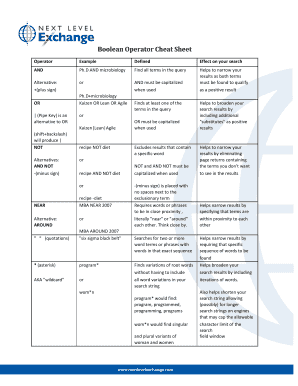
Boolean Operator Cheat Sheet OperatorExampleDefinedEffect on your searchANDPh.D AND microbiologyFind all terms in the queryAlternative:orAND must be capitalizedHelps to narrow your results as both.
Open form follow the instructions
Easily sign the form with your finger
Send filled & signed form or save
How to fill out the Boolean Operator Cheat Sheet online
The Boolean Operator Cheat Sheet provides essential tools for refining your searches online. This guide will walk you through the process of filling out the form effectively, ensuring you can utilize Boolean operators to enhance your information retrieval.
Follow the steps to complete the Boolean Operator Cheat Sheet online.
- Click the ‘Get Form’ button to access the Boolean Operator Cheat Sheet and open it in the online editor.
- Begin by reviewing the various Boolean operators listed on the sheet, such as AND, OR, and NOT. Ensure you understand how each operator functions in search queries.
- Select the appropriate example queries provided in the sheet to better visualize how to apply each operator. Take notes if necessary.
- Fill in your desired search terms according to the structure presented in the cheat sheet. Make sure to capitalize operators like AND and OR, as indicated.
- Utilize the defined effects of the operators to refine your searches. For instance, if you aim to narrow down your results, incorporate the NOT operator as needed.
- Consider using additional functions presented in the cheat sheet, such as proximity searches and file type restrictions, to maximize the relevance of your search results.
- After completing the form and finalizing your entries, ensure to either save your changes, download the document, print it for future reference, or share it with others who may benefit from this resource.
Start filling out your Boolean Operator Cheat Sheet online today to enhance your search effectiveness!
Experience a faster way to fill out and sign forms on the web. Access the most extensive library of templates available.
Related content
You can include Boolean operators with the search terms to perform advanced ... "How Do...
Jul 8, 2019 — Boolean Operators. McMaster University Library. (2015). Boolean cheat...
Use lowercase 'true' or 'false' for boolean values in dictionaries if you want to be...
Get answers to your most pressing questions about US Legal Forms API.
What are the three basic Boolean operators?
The three basic Boolean operators are AND, OR, and NOT. AND narrows your search by including all specified terms, OR broadens it by including any of the terms, and NOT excludes terms you don't want. Understanding these operators is crucial for effective searching. The Boolean Operator Cheat Sheet provides a handy overview of these fundamental tools.
How to properly use Boolean operators?
Properly using Boolean operators means knowing when and how to apply them in your searches. Always consider your keywords and how they relate to each other. Use the Boolean Operator Cheat Sheet as your guide, as it clarifies how to combine these operators for optimal results. This approach will enhance your search efficiency and accuracy.
How to use Boolean operators correctly?
To use Boolean operators correctly, start by clearly defining your search objectives. Combine keywords with AND for more specific results, use OR for broader results, and apply NOT to exclude unwanted terms. For a concise guide, the Boolean Operator Cheat Sheet is an excellent resource. It ensures you implement these operators effectively in your search.
How to use bool operator?
Using Boolean operators involves applying AND, OR, and NOT to connect your search terms. For instance, using AND will show results that include both terms, while OR will display results that contain either term. A well-structured Boolean search can save you time and yield better results. Refer to the Boolean Operator Cheat Sheet for a quick reference to these operators.
How to properly Boolean search?
To conduct a proper Boolean search, start by identifying the keywords relevant to your topic. Use the Boolean operators AND, OR, and NOT to combine or exclude terms, which narrows down your results. For more detailed instructions, check out the Boolean Operator Cheat Sheet. This resource offers practical tips to enhance your search strategy.
Do you use == for Boolean?
In Boolean logic, you do not use '==' as you might in programming. Instead, you work with operators like AND, OR, and NOT to refine your searches. For a clear understanding of these operators, refer to the Boolean Operator Cheat Sheet. This cheat sheet simplifies the rules and helps you navigate your searches effectively.
Does Google not use Boolean operators anymore?
Google still recognizes Boolean operators, but it has evolved to incorporate a more natural language processing approach. While you can still use operators like AND and OR, Google's algorithm often interprets your queries in a user-friendly way. The Boolean Operator Cheat Sheet remains a valuable resource for those needing precision in their searches, especially in legal contexts. Understanding these operators can still enhance your search effectiveness.
How to format a Boolean search?
To format a Boolean search, you should use parentheses to group terms and operators effectively. For example, you might write (lawyer OR attorney) AND (contract OR agreement) to get more precise results. Following the guidelines in the Boolean Operator Cheat Sheet will ensure your search is both efficient and effective. Proper formatting allows you to navigate complex legal queries with ease.
What is P -> Q in Boolean?
In Boolean logic, P -> Q represents an implication where if P is true, then Q must also be true. This concept helps in structuring logical arguments and can be particularly useful in legal research. The Boolean Operator Cheat Sheet can clarify how implications work in your searches, making it easier to find the information you need. Familiarizing yourself with this can strengthen your understanding of legal terms.
How do I use Boolean operators?
To use Boolean operators, start by deciding what information you need and then select the appropriate operators to connect your keywords. For example, if you want information about wills but not trusts, you would use 'wills NOT trusts' in your search. This targeted approach saves time and increases the relevance of your results. For a complete guide, refer to our Boolean Operator Cheat Sheet.
Use professional pre-built templates to fill in and sign documents online faster. Get access to thousands of forms.
If you believe that this page should be taken down, please follow our DMCA take down process here.