Loading
Form preview
  • US Legal Forms
  • Other Templates
  • More Forms
  • More Multi-State Forms
  • Records Inventory Form

Get Records Inventory Form

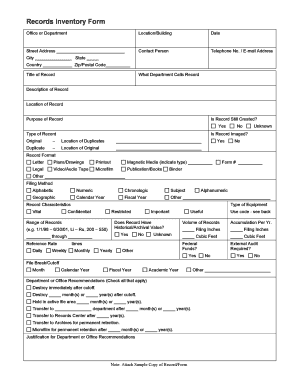
Records Inventory Form Office or Department Location/Building Date Street Address Contact Person Telephone No. / Email Address City State Country Zip/Postal Code Title of Record What Department Calls.

How it works

  1. Open form

    Open form follow the instructions

  2. Easily sign form

    Easily sign the form with your finger

  3. Share form

    Send filled & signed form or save

How to fill out the Records Inventory Form online

Completing the Records Inventory Form is essential for effective document management. This guide provides clear, step-by-step instructions to assist users in filling out the form online with confidence.

Follow the steps to accurately complete the Records Inventory Form.

  1. Click the ‘Get Form’ button to access the Records Inventory Form and open it for editing.
  2. Fill in the office or department name where the records are maintained. This identifies the managing entity.
  3. Enter the date on which you are filling out the form. This ensures that the information is current.
  4. Provide the street address, along with the city, state, country, and zip/postal code. Accurate details improve location identification.
  5. Identify the contact person. This is a representative who can provide further information about the records.
  6. List their telephone number and email address for any necessary follow-up.
  7. Insert the title of the record. This should succinctly represent the content of the records.
  8. Specify what department names the record. This provides clarity on ownership and responsibility.
  9. Provide a description of the record. This should offer sufficient detail for understanding the content's relevance.
  10. Indicate the location of the record. This could be a physical or digital space.
  11. State the purpose of the record, explaining why it is maintained.
  12. Specify whether the record is still created, choosing 'Yes,' 'No,' or 'Unknown.'
  13. Indicate if the record is imaged. Choose 'Original,' 'Duplicate,' or 'Unknown' as applicable.
  14. Describe the record format by selecting from the available options such as 'Letter,' 'Legal,' or 'Video/Audio Tape.'
  15. Choose the filing method among options like 'Alphabetic,' 'Numeric,' or 'Geographic.'
  16. List any relevant record characteristics, such as 'Vital' or 'Confidential.'
  17. Indicate if the record has historical or archival value, specifying the relevant date ranges.
  18. Provide the reference rate applicable to how often the record is used (e.g., 'Daily', 'Weekly').
  19. Detail the volume of records and the accumulation per year, using filing inches or cubic feet for measurement.
  20. Answer questions regarding federal funds and whether an external audit is required.
  21. Select the file break/cutoff month or year for record retention management.
  22. Check recommendations regarding the records, such as destruction timelines or transfers, as necessary.
  23. Provide justification for the department or office recommendations as required.
  24. Note to attach a sample copy of the record/form if applicable.
  25. Once all information is completed and reviewed, save changes to the form. You may also download, print, or share the completed form as needed.

Start completing your Records Inventory Form online today to enhance your document management process.

Get form

Experience a faster way to fill out and sign forms on the web. Access the most extensive library of templates available.
Get form

Related content

Records Inventory - Data Elements | National...
Jun 6, 2019 — Records Inventory - Data Elements · Introduction Agency records are most...
Learn more
Records Inventory Worksheet | MTAS
Home / MORe / Open Government / Records Management for Municipal Governments / Public...
Learn more
Gross domestic product - Wikipedia
Gross domestic product (GDP) is a monetary measure of the market value of all the final...
Learn more

Related links form

SSA-3033 2011 SSA-308 2012 SSA-3885 2011 SSA-4164 1991

Questions & Answers

Get answers to your most pressing questions about US Legal Forms API.

Contact support

The inventory form is used to systematically record all items in stock or possession. This form assists businesses in tracking inventory levels, managing supplies, and ensuring accurate records for audits. Implementing a Records Inventory Form can enhance efficiency and accuracy in your inventory management process.

The inventory record form is a structured document designed to collect and organize information about items in inventory. This form typically includes categories such as item name, description, quantity, and location. Using a Records Inventory Form simplifies the process of tracking assets and helps maintain organization.

An inventory record is a detailed account of items owned by an organization, including their quantity and location. It serves as a crucial tool for managing assets effectively. By using a Records Inventory Form, you can create a structured method for maintaining this vital information.

Conducting a records inventory involves systematically reviewing and documenting all records you have. Start by gathering all records in one place, then use a Records Inventory Form to track each item’s details. This approach helps identify what you have, what you need, and what can be disposed of or archived.

To create a Google Form for inventory, log into your Google account and open Google Forms. Begin with a blank form, then add fields for item names, descriptions, quantities, and any other details you need. By using a Records Inventory Form template, you can save time and ensure you include all essential data.

The purpose of the inventory record is to maintain a detailed account of all records managed by an organization. This record helps ensure compliance, improves access to information, and supports efficient retrieval. By keeping an up-to-date records inventory form, you can better navigate your organization’s information landscape and enhance operational effectiveness.

The three forms of inventory typically include physical inventory, which refers to tangible items; digital inventory, which consists of electronic records; and compliance inventory, focused on regulatory and legal documents. Each type plays a critical role in an organization's overall record-keeping strategy. Utilizing a records inventory form can help streamline the management of all three forms effectively.

Filling an inventory form requires careful attention to detail. Start by entering the record title, type, and relevant dates. Then, include information about the storage location and any applicable retention guidelines. By following these steps on your records inventory form, you can create an organized and useful resource for managing your records.

The purpose of a records inventory is to provide a comprehensive overview of all records held by an organization. It helps identify what records exist, where they are stored, and how long they should be retained. By maintaining a clear records inventory form, you can improve compliance, reduce risks, and enhance operational efficiency.

Creating an inventory record involves identifying the essential details of the record you want to catalog. Use a records inventory form to input information like the title, date created, and storage location. Once completed, this form becomes a vital tool for managing your records efficiently and supporting future retrieval efforts.

Get This Form Now!

Use professional pre-built templates to fill in and sign documents online faster. Get access to thousands of forms.
Get form
If you believe that this page should be taken down, please follow our DMCA take down processhere.
Get Records Inventory Form
Get form
  • Adoption
  • Bankruptcy
  • Contractors
  • Divorce
  • Home Sales
  • Employment
  • Identity Theft
  • Incorporation
  • Landlord Tenant
  • Living Trust
  • Name Change
  • Personal Planning
  • Small Business
  • Wills & Estates
  • Packages A-Z
  • Affidavits
  • Bankruptcy
  • Bill of Sale
  • Corporate - LLC
  • Divorce
  • Employment
  • Identity Theft
  • Internet Technology
  • Landlord Tenant
  • Living Wills
  • Name Change
  • Power of Attorney
  • Real Estate
  • Small Estates
  • Wills
  • All Forms
  • Forms A-Z
  • Other Templates
  • Legal Hub
  • About Us
  • Help Portal
  • Legal Resources
  • Blog
  • Affiliates
  • Contact Us
  • Delete My Account
  • Site Map
  • Industries
  • Forms in Spanish
  • Localized Forms
  • State-specific Forms
  • Forms Kit
  • Real Estate Handbook
  • All Guides
  • Notarize
  • Incorporation services
  • For Consumers
  • For Small Business
  • For Attorneys
  • USLegal
  • FormsPass
  • pdfFiller
  • signNow
  • altaFlow
  • DocHub
  • Instapage
Form Packages
  • Adoption
  • Bankruptcy
  • Contractors
  • Divorce
  • Home Sales
  • Employment
  • Identity Theft
  • Incorporation
  • Landlord Tenant
  • Living Trust
  • Name Change
  • Personal Planning
  • Small Business
  • Wills & Estates
  • Packages A-Z
Form Categories
  • Affidavits
  • Bankruptcy
  • Bill of Sale
  • Corporate - LLC
  • Divorce
  • Employment
  • Identity Theft
  • Internet Technology
  • Landlord Tenant
  • Living Wills
  • Name Change
  • Power of Attorney
  • Real Estate
  • Small Estates
  • Wills
  • All Forms
  • Forms A-Z
  • Other Templates
Customer Service
  • Legal Hub
  • About Us
  • Help Portal
  • Legal Resources
  • Blog
  • Affiliates
  • Contact Us
  • Delete My Account
  • Site Map
  • Industries
  • Forms in Spanish
  • Localized Forms
  • State-specific Forms
  • Forms Kit
Legal Guides
  • Real Estate Handbook
  • All Guides
Prepared for you
  • Notarize
  • Incorporation services
Our Customers
  • For Consumers
  • For Small Business
  • For Attorneys
Our Sites
  • USLegal
  • FormsPass
  • pdfFiller
  • signNow
  • altaFlow
  • DocHub
  • Instapage
Social Media
Call us now toll free:
+1 833 426 79 33
As seen in:
© Copyright 1999-2026 airSlate Legal Forms, Inc. 17 Station Street, Suite 303, Brookline, MA 02445
  • Your Privacy Choices
  • Terms of Service
  • Privacy Notice
  • Content Takedown Policy
  • Bug Bounty Program