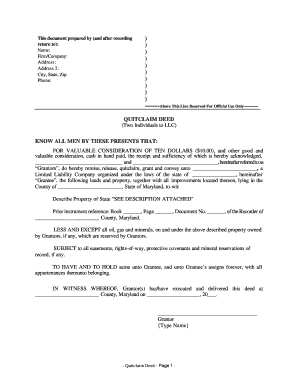
This document prepared by (and after recording return to): Name: Firm/Company: Address: Address 2: City, State, Zip: Phone: ) ) ) ) ) ) ) ) ) ) --------Above This Line Reserved For Official Use Only-------------.
Open form follow the instructions
Easily sign the form with your finger
Send filled & signed form or save
How to fill out the Quitclaim Deed Maryland online
Filling out a Quitclaim Deed in Maryland can seem daunting, but understanding the components and steps involved simplifies the process. This guide will provide clear instructions to help you complete the form online with confidence.
Follow the steps to complete your Quitclaim Deed online
- Click ‘Get Form’ button to obtain the Quitclaim Deed Maryland form and open it in your preferred editing tool.
- Start by filling in the names of the parties involved. In the section labeled 'Grantors', enter the names of the individuals transferring ownership of the property. You will need to fill in the full legal names.
- In the 'Grantee' section, input the name of the Limited Liability Company (LLC) receiving the property. Ensure you include the full legal name.
- Specify the property being transferred by providing the required details. In the designated area, write 'SEE DESCRIPTION ATTACHED' to indicate more information is provided elsewhere, or describe the property succinctly.
- Complete the 'Prior instrument reference' by noting the book and page numbers pertaining to previous ownership records. This information helps connect the new deed to past documents.
- If applicable, note any exceptions to the deed, such as oil, gas, and mineral rights that are retained by the Grantors.
- Finalize the deed detail by entering the date of execution and the county in Maryland where the deed is executed.
- Both Grantors should sign the deed in the spaces provided. Type their names beneath their signatures to ensure clarity for record-keeping.
- Select one of the certification options based on who prepared the document and obtain the necessary signature.
- Have the deed notarized, ensuring all parties are present for the process. The Notary Public will then complete their section of the form.
- Once all the sections are filled out, review the document to ensure accuracy. Save your changes, and download, print, or share the completed Quitclaim Deed as needed.
Complete your Quitclaim Deed online today and take the step towards transferring property ownership with ease.
Experience a faster way to fill out and sign forms on the web. Access the most extensive library of templates available.
Related content
In a quitclaim deed, the grantor makes no promises that they have a good title to the...
Part of the Property Law and Real Estate Commons ... B., 1893, University of Maryland;...
A covenant, in its most general sense and historical sense, is a solemn promise to engage...
Get answers to your most pressing questions about US Legal Forms API.
Who benefits the most from a quit claim deed?
Family members often benefit the most from a quitclaim deed Maryland, especially during property transfers among relatives. This deed simplifies the transfer process, allowing quick asset distribution without hefty legal fees. Additionally, individuals seeking to clear up title issues can find this option useful. Using a service like USLegalForms can make the creation and filing of a quitclaim deed seamless and efficient.
How does a quit claim deed work in Maryland?
In Maryland, a quitclaim deed transfers ownership from one party to another without any warranties. This process is straightforward; the grantor signs the deed, and it gets recorded with the local land records office. Essentially, you receive whatever interest the grantor has, which may or may not be complete. If you're unsure about how this applies to your situation, exploring the USLegalForms platform can provide necessary forms and guidance.
What are the disadvantages of a quit claim deed?
A quitclaim deed Maryland may not provide the level of protection you expect. This type of deed offers no warranties or guarantees regarding property ownership, which means you could inherit legal problems tied to the property. Additionally, if a title dispute arises, you're responsible for resolving it without the safety net of legal backup. Thus, it's essential to consider these factors before proceeding.
What are the risks of a quitclaim?
The primary risks associated with a Quitclaim Deed Maryland include potential loss of property rights and undisclosed title issues. Since a quitclaim does not guarantee clear ownership, you may inadvertently transfer the property to someone with existing claims. Additionally, if not properly executed or filed, the deed might not hold up in court, leaving you vulnerable. Using reliable services like USLegalForms can help minimize these risks.
Do I need a lawyer to execute a quitclaim deed?
You do not necessarily need a lawyer to execute a Quitclaim Deed Maryland, but it’s advisable in many cases. A lawyer can help ensure the deed meets legal requirements and can provide guidance on the implications of the transfer. If you aren't familiar with legal documents, consulting with a legal professional can save you time and prevent errors.
How to file a quit claim deed in Maryland?
Filing a Quitclaim Deed Maryland involves several key steps. First, you must complete the deed with all required information, including descriptions of the property and the parties involved. Then, both parties should sign the deed in front of a notary. After notarization, you need to submit the deed to your local land records office for recording; this ensures the change in ownership becomes public record.
How do I transfer ownership of a property in Maryland?
To transfer ownership of a property in Maryland, you typically need to complete and file a Quitclaim Deed Maryland. This document allows a property owner to relinquish their interest in a property to another person. After filling out the deed, both the granter and grantee should sign it in the presence of a notary. Finally, you must record the deed with the local land records office to finalize the transfer.
Who benefits the most from a quitclaim deed?
Individuals frequently benefit from a quitclaim deed in Maryland when transferring property within families, such as during inheritance or divorce settlements. It simplifies the process by allowing one party to relinquish claims without formal guarantees. This method is also beneficial for those looking to transfer ownership quickly and efficiently. Consider using platforms like USLegalForms to ensure your transaction adheres to local regulations.
How to file a quitclaim deed in Maryland?
Filing a quitclaim deed in Maryland involves a few straightforward steps. First, draft the quitclaim deed, including the legal description of the property and the names of both parties. Once signed before a notary, you must file the document with your local land records office. For a smooth experience, consider using USLegalForms to navigate the preparation and filing stages.
How do I file a quit claim deed in Maryland?
To file a quitclaim deed in Maryland, you need to first prepare the document, which typically includes the property's legal description and the names of the parties involved. After you complete the quitclaim deed, you must sign it in front of a notary public. Finally, submit the signed document to the local land records office in your county. By using resources like USLegalForms, you can access templates and guides to streamline this process.
Use professional pre-built templates to fill in and sign documents online faster. Get access to thousands of forms.
If you believe that this page should be taken down, please follow our DMCA take down process here.