Loading
Form preview
  • US Legal Forms
  • Other Templates
  • More Forms
  • More Uncategorized Forms
  • How To File A Quit Claim Deed In Alabama

Get How To File A Quit Claim Deed In Alabama

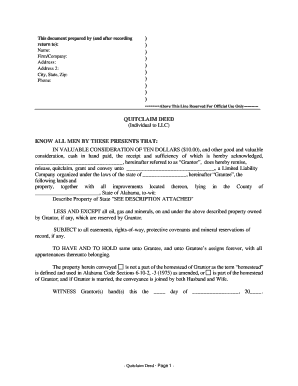
This document prepared by (and after recording return to): Name: Firm/Company: Address: Address 2: City, State, Zip: Phone: ) ) ) ) ) ) ) ) ) ) --------Above This Line Reserved For Official Use Only-------------.

How it works

  1. Open form

    Open form follow the instructions

  2. Easily sign form

    Easily sign the form with your finger

  3. Share form

    Send filled & signed form or save

How to fill out the How To File A Quit Claim Deed In Alabama online

Filing a quit claim deed in Alabama can be a straightforward process when done correctly. This guide will provide you with clear, step-by-step instructions to help you fill out the document online, ensuring that all necessary information is accurately captured.

Follow the steps to complete your quit claim deed online.

  1. Click 'Get Form' button to access the quit claim deed form and open it in your online editor.
  2. Begin filling out the form by providing your name and address in the section designated for the grantor. Make sure to include your legal name as it appears on official documents.
  3. In the 'Grantee' section, input the name of the limited liability company receiving the property along with the state of incorporation. Ensure that this information reflects the company’s legal name.
  4. Describe the property being conveyed in the designated section. You can write 'SEE DESCRIPTION ATTACHED,' but ensure that a detailed description of the property is included in the attached document.
  5. Indicate any reserved rights, such as oil, gas, and minerals owned by the grantor, if applicable. Clearly state any relevant easements or rights-of-way that pertain to the property.
  6. Review the homestead declaration section. Confirm whether the property is part of the grantor’s homestead and, if applicable, ensure that this section is signed by both partners if the grantor is married.
  7. Sign and date the document in the space provided for the grantor. Make sure the signature matches the name written at the top of the form.
  8. Once completed, the document must be notarized. Have a notary public witness the signing and complete their section, including their name and commission expiration date.
  9. Finally, save the completed document. You can download a copy, print it for your records, or share it as needed.

Complete and file your documents online today to ensure a smooth and efficient process.

Get form

Experience a faster way to fill out and sign forms on the web. Access the most extensive library of templates available.
Get form

Related content

Filing Real Estate and Legal Documents | Madison...
Checks should be made payable to: Judge of Probate - Madison County, Alabama. Notice...
Learn more
Heir Property - AUrora: Auburn University...
Existing literature describes heir property, as land held in this form is commonly...
Learn more
Land Rush of 1889 - Wikipedia
The Oklahoma Land Run of 1889 was the first land run into the Unassigned Lands. The area...
Learn more

Related links form

1998 Instructions 1120S (Schedule K-1) Form 6627 (Rev. January 1999) Instructions 8082 (Rev. Feburary 1998 ) Information Return For Publicly Offered Original Issue Discount Instruments

Questions & Answers

Get answers to your most pressing questions about US Legal Forms API.

Contact support

To create a valid quit claim deed in Alabama, you’ll need to provide basic information such as the names of the grantor and grantee, a legal description of the property, and signatures from both parties. When asking how to file a quit claim deed in Alabama, ensure that the deed is notarized and recorded at the local county office. Using US Legal Forms can help you with the necessary templates and guidance to streamline this process.

Quit claim deeds primarily benefit individuals transferring property between trusted parties, such as family members or divorcing spouses. If you are looking into how to file a quit claim deed in Alabama, you should consider this option for a swift transfer without the lengthy process of confirming property titles. However, it's crucial to ensure that both parties trust each other, as there are limited buyer protections with this deed.

The risks associated with a quit claim deed include the lack of title insurance and potential undisclosed property liens. As you explore how to file a quit claim deed in Alabama, keep in mind that this deed does not provide a warranty or guarantees. This means that if any disputes arise later, you might be held liable. Engaging with real estate legal services can help mitigate these risks for you.

One major disadvantage of a quit claim deed is that it offers no guarantees about the property's title. When learning how to file a quit claim deed in Alabama, remember that this type of deed does not protect you from future claims against the property. Also, the grantor retains no liability for any undisclosed issues related to the property. Therefore, it is crucial to conduct a title search before using this form.

To transfer ownership of a property in Alabama, you need to use a quit claim deed. First, download a quit claim deed form from a trusted resource, like US Legal Forms. After filling it out with correct details, sign the document in front of a notary public. Finally, submit it to the local county recorder's office where the property is located to officially record the change.

Yes, a quitclaim deed in Alabama must be notarized for it to be legally binding. The grantor needs to sign the deed in front of a notary public to ensure that the signature is authentic and the document is valid. After notarization, remember to file the deed with the county probate court to complete the process. This step is crucial when learning how to file a quit claim deed in Alabama.

When using a quit claim deed example, take note of how the grantor’s and grantee’s names are presented clearly at the top. The property description should follow, detailing the location and boundaries of the property. Utilize resources like uslegalforms to access sample deeds tailored for Alabama, ensuring you model your document correctly and follow local guidelines.

To file a quit claim deed in Alabama, you must first complete the deed form accurately. After you fill it out, sign it in the presence of a notary public. Lastly, file the notarized deed with the appropriate county probate court to make the transfer official and recognize your actions for the property. Remember, understanding how to file a quit claim deed in Alabama is crucial for property transactions.

Filing a quitclaim deed in Alabama involves several steps. First, complete the deed form with all necessary information, then sign it in the presence of a notary public. After that, you'll submit the completed deed to your local county courthouse for recording. By following these steps, you'll know exactly how to file a quit claim deed in Alabama. If you need help, consider using US Legal Forms for a straightforward experience.

The process for transferring Alabama real estate by deed involves several steps: Find the most recent deed to the property. ... Create the new deed. ... Sign and notarize the deed. ... Record the signed, notarized original deed with the Office of the Judge of Probate.

Get This Form Now!

Use professional pre-built templates to fill in and sign documents online faster. Get access to thousands of forms.
Get form
If you believe that this page should be taken down, please follow our DMCA take down processhere.
Get How To File A Quit Claim Deed In Alabama
Get form

Form categories

Real Estate
  • Home Sale
  • Deeds
  • Leases
  • Landlord Tenant
  • First Refusal Agreement
  • Lis Pendens
  • View all Real Estate
Business & Commercial
  • Small Business
  • Contracts
  • Construction
  • Employment
  • Limited Liability Company
  • Partnerships
  • View all Business & Commercial
Estate Planning
  • Personal Planning
  • Last Will and Testament
  • Living Trust
  • Power of Attorney
  • Living Will (Healthcare Directive)
  • Probate
  • Trusts
  • Small Estate
  • View all Estate Planning

Other Legal Areas

  • Civil Actions
  • Civil Procedure
  • Animals
  • Affidavits
  • Bill of Sale
  • Oil Gas and Minerals
  • Name Change
  • Other
Family Law
  • Divorce
  • Annulment
  • Adoption
  • Marriage
  • Child Justice
  • View all Family Law
  • Forms Catalog
  • Other Templates

Company

  • About Us
  • Pricing
  • Legal Hub
  • Affiliate Program

Knowledge Base

  • Help Portal
  • Legal Resources
  • Blog
  • Industries
  • Legal Guides
  • Sitemap

Services

  • Notarize
  • Form Selector

Support

  • Contact Us
  • Delete My Account

Products

  • USLegal
  • FormsPass
  • pdfFiller
  • signNow
  • altaFlow
  • DocHub
  • Instapage
Social Media
Call us now toll free:
+1 833 426 79 33
As seen in:
© 2026 US Legal Forms. All rights reserved.
  • Your Privacy Choices
  • Terms of Service
  • Privacy Notice
  • Content Takedown Policy
  • Bug Bounty Program