Loading
Form preview
  • US Legal Forms
  • Form Library
  • More Forms
  • More Uncategorized Forms
  • Schedule D 1

Get Schedule D 1

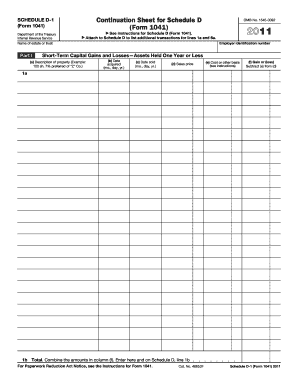
Ion number Short-Term Capital Gains and Losses Assets Held One Year or Less (a) Description of property (Example: 100 sh. 7% preferred of Z Co.) (b) Date acquired (mo., day, yr.) (c) Date sold (mo., day, yr.) (e) Cost or other basis (see instructions) (d) Sales price (f) Gain or (loss) Subtract (e) from (d) 1a 1b Total. Combine the amounts in column (f). Enter here and on Schedule D, line 1b . For Paperwork Reduction Act Notice, see the Instructions for Form 1041. . Cat. No. 4.

How it works

  1. Open form

    Open form follow the instructions

  2. Easily sign form

    Easily sign the form with your finger

  3. Share form

    Send filled & signed form or save

How to fill out the Schedule D 1 online

Filling out the Schedule D 1 online can ensure that your estate or trust's capital gains and losses are accurately reported. This guide provides clear, step-by-step instructions to help you complete this form effectively.

Follow the steps to fill out the Schedule D 1 accurately

  1. Press the ‘Get Form’ button to access the Schedule D 1 form and open it in your browser.
  2. Enter the name of the estate or trust in the designated field at the top of the form. Make sure the name matches the information shown on Form 1041.
  3. Provide the employer identification number in the specified section. Ensure that this number is correct as it ties to the estate or trust.
  4. Move to Part I and begin listing short-term capital gains and losses. For each transaction, fill out the following fields:
  5. At the end of Part I, combine the total gains and losses from column (f) and write the sum in the designated area. This total will be entered on Schedule D, line 1b.
  6. Proceed to Part II for long-term capital gains and losses. Repeat the entry process for assets held more than one year, using the same fields described in step 4.
  7. Combine the totals in column (f) of Part II and enter this total on Schedule D, line 6b.
  8. Once you have completed all sections, review your data for accuracy. Then, save your changes, and choose whether to download, print, or share the completed form as needed.

Start filing your Schedule D 1 online today for an efficient and organized process.

Get form

Experience a faster way to fill out and sign forms on the web. Access the most extensive library of templates available.
Get form

Related content

2010 Form 1040 (Schedule D-1) - Internal Revenue...
For Paperwork Reduction Act Notice, see your tax return instructions. Cat. No. 10424K...
Learn more
Instructions for Schedule D, Capital Gains and...
D-1. Cat. No. 24331I. Instructions for. Schedule D,. Capital Gains and Losses. Additional...
Learn more
[PDF] 2017 Instructions for Form 1045 - Internal...
Dec 6, 2017 · applicable, to Form 1045 for the year of the loss or credit. If you are an...
Learn more

Related links form

MD Comptroller MW506A 2022 FL DR-309638N 2022 FL DR-309634N 2022 FL DR-908N 2022

Questions & Answers

Get answers to your most pressing questions about US Legal Forms API.

Contact support

Filing Schedule D can seem complicated, especially if you've had numerous transactions throughout the year. However, when you have organized records of your sales and purchases, the process becomes much simpler. Utilizing tools or platforms like USLegalForms can streamline the documentation process, guiding you through each step of filing Schedule D.

An example of a Schedule D would include a taxpayer who sold 100 shares of stock at a gain of $2,000 after previously purchasing them for $1,000. This situation is documented in Schedule D to show the realized capital gain. Another example involves the sale of a rental property, where gains and expenses are reported. Understanding how to document these transactions on Schedule D can help you maintain proper tax records.

Schedule D is typically filled out by individuals, including investors and business owners, who have capital gains or losses to report. If you’ve sold stocks, bonds, or real estate, you will likely need to complete this schedule. Additionally, tax professionals will complete Schedule D for clients who have complex transactions. Ensuring proper completion of this schedule is essential to comply with tax regulations.

One major tax mistake involves failing to report all capital gains on Schedule D, which can lead to unexpected tax bills. Another common error is miscalculating basis for assets, resulting in incorrect gain or loss. Additionally, overlooking deductions or credits can significantly increase tax liability. To avoid these issues, consider using reliable resources like uslegalforms to guide your filing process.

A Schedule D on your taxes is a form used to report capital gains and losses incurred during the tax year. It summarizes your financial transactions related to asset sales, ensuring compliance with IRS regulations. By accurately completing Schedule D, you can determine your tax obligations and optimize your financial outcomes.

You cannot skip Schedule D if you need to report capital gains or losses on your tax return. Filing this form is essential to ensure accurate reporting of your financial activities for the year. If you're unsure about your need to file, consider using USLegalForms as a resource to guide you through the requirements.

You do not need to file Schedule D if you did not sell any stocks, bonds, or other capital assets during the tax year. Furthermore, if your only transactions were those reported on Form 8949 and resulted in no net gain or loss, then Schedule D is redundant. Always check with tax regulations or consult a professional if unsure.

Schedule D-1 is a supplementary form used to report additional capital gains or losses not accounted for on the main Schedule D. It typically pertains to specific situations like nonbusiness bad debts or transactions from partnerships. When you have more complex transactions, including Schedule D-1 can streamline your reporting.

Schedule D Case 1 refers to the reporting of short-term capital gains and losses for assets held for one year or less. This section helps you track the sales of these assets, providing a crucial overview for tax calculations. By accurately filling out this part, you ensure that your tax returns reflect your true financial situation.

Schedule D is used to report capital gains and losses to the IRS. If you sold stocks, bonds, or other assets during the tax year, you'll need to include this form in your return. Additionally, it helps determine whether you owe taxes on your gains or if you can deduct losses to offset other income.

Get This Form Now!

Use professional pre-built templates to fill in and sign documents online faster. Get access to thousands of forms.
Get form
If you believe that this page should be taken down, please follow our DMCA take down processhere.

Industry-leading security and compliance

US Legal Forms protects your data by complying with industry-specific security standards.
  • In businnes since 1997
    25+ years providing professional legal documents.
  • Accredited business
    Guarantees that a business meets BBB accreditation standards in the US and Canada.
  • Secured by Braintree
    Validated Level 1 PCI DSS compliant payment gateway that accepts most major credit and debit card brands from across the globe.
Get Schedule D 1
Get form
  • Adoption
  • Bankruptcy
  • Contractors
  • Divorce
  • Home Sales
  • Employment
  • Identity Theft
  • Incorporation
  • Landlord Tenant
  • Living Trust
  • Name Change
  • Personal Planning
  • Small Business
  • Wills & Estates
  • Packages A-Z
  • Affidavits
  • Bankruptcy
  • Bill of Sale
  • Corporate - LLC
  • Divorce
  • Employment
  • Identity Theft
  • Internet Technology
  • Landlord Tenant
  • Living Wills
  • Name Change
  • Power of Attorney
  • Real Estate
  • Small Estates
  • Wills
  • All Forms
  • Forms A-Z
  • Form Library
  • Legal Hub
  • About Us
  • Help Portal
  • Legal Resources
  • Blog
  • Affiliates
  • Contact Us
  • Delete My Account
  • Site Map
  • Industries
  • Forms in Spanish
  • Localized Forms
  • State-specific Forms
  • Forms Kit
  • Real Estate Handbook
  • All Guides
  • Notarize
  • Incorporation services
  • For Consumers
  • For Small Business
  • For Attorneys
  • USLegal
  • FormsPass
  • pdfFiller
  • signNow
  • altaFlow
  • DocHub
  • Instapage
Form Packages
  • Adoption
  • Bankruptcy
  • Contractors
  • Divorce
  • Home Sales
  • Employment
  • Identity Theft
  • Incorporation
  • Landlord Tenant
  • Living Trust
  • Name Change
  • Personal Planning
  • Small Business
  • Wills & Estates
  • Packages A-Z
Form Categories
  • Affidavits
  • Bankruptcy
  • Bill of Sale
  • Corporate - LLC
  • Divorce
  • Employment
  • Identity Theft
  • Internet Technology
  • Landlord Tenant
  • Living Wills
  • Name Change
  • Power of Attorney
  • Real Estate
  • Small Estates
  • Wills
  • All Forms
  • Forms A-Z
  • Form Library
Customer Service
  • Legal Hub
  • About Us
  • Help Portal
  • Legal Resources
  • Blog
  • Affiliates
  • Contact Us
  • Delete My Account
  • Site Map
  • Industries
  • Forms in Spanish
  • Localized Forms
  • State-specific Forms
  • Forms Kit
Legal Guides
  • Real Estate Handbook
  • All Guides
Prepared for you
  • Notarize
  • Incorporation services
Our Customers
  • For Consumers
  • For Small Business
  • For Attorneys
Our Sites
  • USLegal
  • FormsPass
  • pdfFiller
  • signNow
  • altaFlow
  • DocHub
  • Instapage
Social Media
Call us now toll free:
+1 833 426 79 33
As seen in:
© Copyright 1999-2026 airSlate Legal Forms, Inc. 3720 Flowood Dr, Flowood, Mississippi 39232
  • Your Privacy Choices
  • Terms of Service
  • Privacy Notice
  • Content Takedown Policy
  • Bug Bounty Program