Loading
Form preview
  • US Legal Forms
  • Form Library
  • More Forms
  • More Uncategorized Forms
  • Dte Cauv Oh

Get Dte Cauv Oh

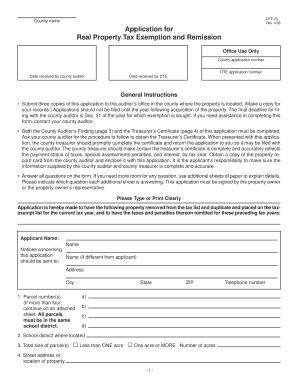
County name DTE 23 Rev. 4/05 Application for Real Property Tax Exemption and Remission Office Use Only County application number DTE application number Date received by county auditor Date received.

How it works

  1. Open form

    Open form follow the instructions

  2. Easily sign form

    Easily sign the form with your finger

  3. Share form

    Send filled & signed form or save

How to fill out the Dte Cauv Oh online

Filling out the Dte Cauv Oh form is a crucial step for individuals seeking real property tax exemption and remission. This guide provides clear instructions to help you navigate each section of the application with ease.

Follow the steps to complete your application with confidence.

  1. Click ‘Get Form’ button to access the application form electronically. This allows you to fill out the form conveniently online.
  2. Begin by filling in the county name at the top of the form. Ensure that this is accurate, as it is essential for processing your application.
  3. Next, provide the applicant's name and any alternative name for correspondence, if applicable. Include the address, city, state, and ZIP code for accurate identification.
  4. Record the parcel number(s) associated with the property. If you have more than four parcels, continue your entry on an attached sheet, ensuring all fall within the same school district.
  5. Indicate the school district where your property is located and state the total size of the parcel(s) by checking the appropriate box for less than one acre or one acre or more.
  6. Enter the street address or location of the property, along with your telephone number for any necessary follow-up.
  7. Identify the owner of the property. If the title holder is different from the applicant, provide an explanation in the specified section.
  8. Complete additional questions regarding the property’s use, its tax history, and any leasing agreements. This section may require attachments if the property has been used for business purposes or income generation.
  9. Confirm the title acquisition date and enclose a copy of the deed with your application. If applicable, also include details about the lease or land contract.
  10. After finishing all sections, ensure the form is signed by either the applicant or their representative. Print the applicant’s name, title, address, and contact information.
  11. Finally, review your application for completeness, save any changes, and prepare to submit the form. You may download, print, or share the completed application as needed.

Start the process of completing your Dte Cauv Oh application online today!

Get form

Experience a faster way to fill out and sign forms on the web. Access the most extensive library of templates available.
Get form

Related content

Current Agricultural Use Valuation Renewal...
an initial application form (DTE 109) even if the previous owner was on the program...
Learn more
Ohio State University Fact Sheet Current...
Current Agricultural Use Value (CAUV) is a differential real estate tax assessment ... It...
Learn more
Michael Stinziano - Michael Stinziano - qaz.wiki
Miembro de Cámara de Representantes de Ohio ... exenciones fiscales en virtud del...
Learn more

Related links form

Picture Of Beauty Salon Licence Who - Family Of International Classifications Network Annual Meeting ... - Who Minor Variation For Registered Pharmaceutical Product In UAE TOEIC - WikipediaToeic4u - Free TOEIC Practice Tests With AnswersToeic4u - Free TOEIC Practice

Questions & Answers

Get answers to your most pressing questions about US Legal Forms API.

Contact support

The CAUV law in Ohio is designed to assess farmland based on its agricultural use rather than its market value, providing tax relief to farmers. This law supports the farming community by ensuring that property taxes are fair and manageable. Familiarizing yourself with the Dte Cauv Oh provisions can help you take full advantage of these benefits.

To qualify for the CAUV in Ohio, your land must be devoted exclusively to agricultural use for at least the previous three years. This includes activities like growing crops or raising livestock. Applying through the Dte Cauv Oh program can simplify this process, and you can often find helpful resources on platforms like uslegalforms.

In Ohio, there is no specific age at which you automatically stop paying property taxes. However, you may qualify for certain property tax exemptions or credits based on your age or income level. It's important to consult local tax regulations and explore options that may be available to you, such as programs associated with the Dte Cauv Oh.

The Ohio Revised Code for CAUV, which stands for Current Agricultural Use Value, outlines the tax assessment process for agricultural properties. This code provides important guidelines for calculating property taxes based on the agricultural use rather than market value, which can significantly reduce the tax burden. Understanding the intricacies of the Ohio Revised Code can help you leverage the Dte Cauv Oh benefits effectively.

To qualify as a century farm in Ohio, your family must have owned the farm for at least 100 years. The Dte Cauv Oh program recognizes the importance of such long-standing agricultural heritage, so documenting your ownership history accurately is essential. Ensure that your farm meets the criteria and apply for the designation to honor your family's legacy in farming.

Filling out an Ohio resale certificate involves identifying yourself as a seller and specifying the property you intend to resell. You should clearly indicate your sales tax number and provide details concerning the items purchased for resale. Using the right forms is critical, and platforms like uslegalforms can guide you in ensuring that your resale certificate is completed correctly.

To qualify as a farm for tax purposes in Ohio, you need to own at least ten acres. This qualification allows you to apply for the Dte Cauv Oh program, which can greatly reduce your property taxes. Remember, the land must be in active agricultural use, so ensure that your land meets all necessary criteria to benefit from these tax advantages.

In Ohio, to be considered for tax exemption under the Dte Cauv Oh program, you typically need at least ten acres of land devoted to agricultural production. This requirement helps ensure that tax benefits go to those genuinely engaged in farming. Additionally, the land must be actively used for agricultural purposes, further proving its usefulness in the farming sector.

Ten or more acres must be devoted exclusively to commercial agricultural use; or. If under ten acres are devoted exclusively to commercial agricultural use, the farm must produce an average yearly gross income of at least $2,500.

3. To qualify for CAUV, you must have a total of at least 10 acres of qualifying property, or, if less than 10 acres, a yearly income of $2,500 or more from sales of marketable products.

Get This Form Now!

Use professional pre-built templates to fill in and sign documents online faster. Get access to thousands of forms.
Get form
If you believe that this page should be taken down, please follow our DMCA take down processhere.

Industry-leading security and compliance

US Legal Forms protects your data by complying with industry-specific security standards.
  • In businnes since 1997
    25+ years providing professional legal documents.
  • Accredited business
    Guarantees that a business meets BBB accreditation standards in the US and Canada.
  • Secured by Braintree
    Validated Level 1 PCI DSS compliant payment gateway that accepts most major credit and debit card brands from across the globe.
Get Dte Cauv Oh
Get form
  • Adoption
  • Bankruptcy
  • Contractors
  • Divorce
  • Home Sales
  • Employment
  • Identity Theft
  • Incorporation
  • Landlord Tenant
  • Living Trust
  • Name Change
  • Personal Planning
  • Small Business
  • Wills & Estates
  • Packages A-Z
  • Affidavits
  • Bankruptcy
  • Bill of Sale
  • Corporate - LLC
  • Divorce
  • Employment
  • Identity Theft
  • Internet Technology
  • Landlord Tenant
  • Living Wills
  • Name Change
  • Power of Attorney
  • Real Estate
  • Small Estates
  • Wills
  • All Forms
  • Forms A-Z
  • Form Library
  • Legal Hub
  • About Us
  • Help Portal
  • Legal Resources
  • Blog
  • Affiliates
  • Contact Us
  • Delete My Account
  • Site Map
  • Industries
  • Forms in Spanish
  • Localized Forms
  • State-specific Forms
  • Forms Kit
  • Real Estate Handbook
  • All Guides
  • Notarize
  • Incorporation services
  • For Consumers
  • For Small Business
  • For Attorneys
  • USLegal
  • FormsPass
  • pdfFiller
  • signNow
  • altaFlow
  • DocHub
  • Instapage
Form Packages
  • Adoption
  • Bankruptcy
  • Contractors
  • Divorce
  • Home Sales
  • Employment
  • Identity Theft
  • Incorporation
  • Landlord Tenant
  • Living Trust
  • Name Change
  • Personal Planning
  • Small Business
  • Wills & Estates
  • Packages A-Z
Form Categories
  • Affidavits
  • Bankruptcy
  • Bill of Sale
  • Corporate - LLC
  • Divorce
  • Employment
  • Identity Theft
  • Internet Technology
  • Landlord Tenant
  • Living Wills
  • Name Change
  • Power of Attorney
  • Real Estate
  • Small Estates
  • Wills
  • All Forms
  • Forms A-Z
  • Form Library
Customer Service
  • Legal Hub
  • About Us
  • Help Portal
  • Legal Resources
  • Blog
  • Affiliates
  • Contact Us
  • Delete My Account
  • Site Map
  • Industries
  • Forms in Spanish
  • Localized Forms
  • State-specific Forms
  • Forms Kit
Legal Guides
  • Real Estate Handbook
  • All Guides
Prepared for you
  • Notarize
  • Incorporation services
Our Customers
  • For Consumers
  • For Small Business
  • For Attorneys
Our Sites
  • USLegal
  • FormsPass
  • pdfFiller
  • signNow
  • altaFlow
  • DocHub
  • Instapage
Social Media
Call us now toll free:
+1 833 426 79 33
As seen in:
© Copyright 1999-2026 airSlate Legal Forms, Inc. 3720 Flowood Dr, Flowood, Mississippi 39232
  • Your Privacy Choices
  • Terms of Service
  • Privacy Notice
  • Content Takedown Policy
  • Bug Bounty Program