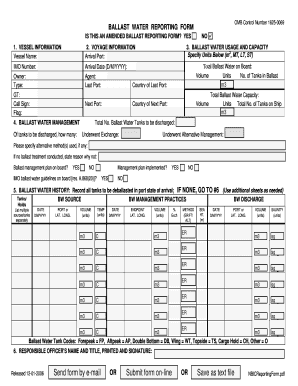
BALLAST WATER REPORTING FORM IS THIS AN AMENDED BALLAST REPORTING FORM? YES 1. VESSEL INFORMATION Vessel Name: IMO Number: Owner: Type: GT: Call Sign: Flag: 4. BALLAST WATER MANAGEMENT Of tanks to.

How it works
  • Open form

    Open form follow the instructions

  • Easily sign form

    Easily sign the form with your finger

  • Share form

    Send filled & signed form or save

How to fill out the Canadian Ballast Water Reporting Form online

The Canadian Ballast Water Reporting Form is a crucial document for ensuring the proper management of ballast water by vessels. This guide provides clear and concise instructions to help users complete the form online effectively.

Follow the steps to accurately complete the reporting form.

  1. Click the ‘Get Form’ button to obtain the Canadian Ballast Water Reporting Form and access it in your preferred format.
  2. Begin with section 1 by entering the vessel information, which includes the vessel name, IMO number, call sign, and the flag state of the vessel. Ensure that all relevant details are accurately filled in.
  3. Proceed to section 2 for voyage information. Input the arrival port, arrival date (in D/M/YYYY format), the name of the owner, type of vessel, and agent details. Also, include the last port of call and gross tonnage (GT).
  4. In section 3, provide information on ballast water usage and capacity. Specify the total ballast water on board, the number of tanks in ballast, and indicate the total ballast water capacity. Also, include the country of the last port and the next port.
  5. In section 4, detail the ballast water management practices. Indicate how many tanks are to be discharged, whether ballast water treatment was conducted, and if alternative management methods were used. You will need to specify any alternative methods, if applicable.
  6. Section 5 is dedicated to ballast water history. Record all tanks to be deballasted in the port state of arrival, including dates, ports, volumes, and management practices used. Use additional sheets if necessary.
  7. Finally, in section 6, provide the responsible officer's name and title, ensuring to print and sign where indicated. This section confirms accountability for the accuracy of the information provided.
  8. Once all sections are correctly completed, you can save the changes, download, print, or share the form as required.

Ensure compliance with local regulations by accurately completing the Canadian Ballast Water Reporting Form online today.

Get form

Experience a faster way to fill out and sign forms on the web. Access the most extensive library of templates available.

Related content

Ballast Water Management Practices Reporting Form

BALLAST WATER MANAGEMENT REPORTING FORM ... of Best Practices for Ballast Water Management...

Learn more
Submit BWM Report - National Ballast Information...

Non-US/non-Canadian flag vessels may complete the St. Lawrence Seaway ballast water...

Learn more
Maritime transport - Wikipedia

Maritime transport (or ocean transport) and fluvial transport, or more generally...

Learn more
Questions & Answers

Get answers to your most pressing questions about US Legal Forms API.

Contact support

Whose approval is needed when a new ballast water management plan is developed?

The approval needed for a new ballast water management plan typically comes from the appropriate regulatory agency overseeing maritime activities. This agency reviews the plan to ensure it aligns with established environmental policies. Utilizing the Canadian Ballast Water Reporting Form can make achieving this approval more efficient.

The implementation of a new ballast water management system requires approval from the local or national maritime authorities. These authorities will assess whether the system complies with environmental standards. Be sure to complete the Canadian Ballast Water Reporting Form to facilitate this approval.

When developing a new ballast water management plan, you will need approval from the designated maritime authority. This process ensures that your plan adheres to current regulations and best practices. Using the Canadian Ballast Water Reporting Form can streamline this approval process.

The ship’s captain holds the primary responsibility for ensuring compliance with the ballast water management plan. It is essential for the captain and crew to understand the procedures outlined in the Canadian Ballast Water Reporting Form. Regular training and adherence to this plan are critical for effective compliance.

The Ballast Water Management (BWM) plan must be approved by the relevant maritime authority in your region. This regulatory body ensures that the plan meets all environmental and safety standards. By submitting the Canadian Ballast Water Reporting Form, you demonstrate your commitment to responsible ballast water management.

A ballast report is a crucial document that outlines the management of ballast water on a ship. It serves to record the volume of water taken on and discharged, ensuring compliance with environmental regulations. When you fill out the Canadian Ballast Water Reporting Form, you provide essential data that helps prevent the introduction of invasive marine species.

International vessels can submit a BWR through the Maritime Arrivals Reporting System (MARS). Vessels that are intending to discharge internationally sourced ballast water must submit a BWR through MARS at least 12 hours prior to arrival.

The D-1 standard requires ships to exchange their ballast water in open seas, away from coastal areas. Ideally, this means at least 200 nautical miles from land and in water at least 200 metres deep.

For any vessel that is equipped with ballast water tanks and bound for ports or places in the United States: Submit a Ballast Water Management Report (BWMR) to the NBIC no later than 6 hours after arrival at the port or place of destination, or prior to departure from that port or place of destination, whichever is ...

There are two ballast water management standards (D-1 and D-2). The D-1 standard requires ships to exchange their ballast water in open seas, away from coastal areas. Ideally, this means at least 200 nautical miles from land and in water at least 200 metres deep.

Get This Form Now!

Use professional pre-built templates to fill in and sign documents online faster. Get access to thousands of forms.

If you believe that this page should be taken down, please follow our DMCA take down process here.

Get Canadian Ballast Water Reporting Form