Have you seen any other health care professional(s) for this condition or reason? If yes whom? Have you ever been involved in any motor vehicle accidents? Have you been involved in any other accidents? Have you ever been knocked unconscious? Yes Yes Yes Yes No No Date: No Date:.

How it works
  • Open form

    Open form follow the instructions

  • Easily sign form

    Easily sign the form with your finger

  • Share form

    Send filled & signed form or save

How to fill out the Case History online

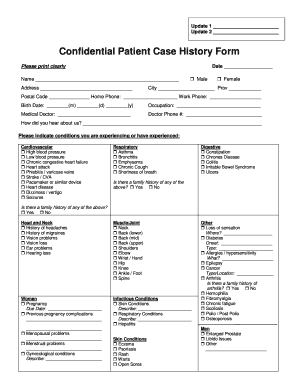
Filling out the Case History online is an important step in ensuring that you receive the appropriate care tailored to your needs. This guide provides clear instructions to help you complete each section of the form accurately and efficiently.

Follow the steps to complete your Case History form.

  1. Click ‘Get Form’ button to retrieve the Case History form and open it in your browser.
  2. Fill in the date at the top of the form, ensuring it is current.
  3. Provide your full name, address, and contact information including home and work phone numbers.
  4. Indicate your birth date and occupation in the designated fields.
  5. List your medical doctor’s name and phone number for reference.
  6. Select how you heard about the service by filling in the appropriate field.
  7. Check all relevant medical conditions you are currently experiencing or have previously experienced in the provided sections.
  8. Answer the questions regarding family history to provide context for your health.
  9. If applicable, provide information about any medical conditions not listed on the form and any internal medical devices.
  10. Indicate the areas of discomfort by circling them on the diagram provided.
  11. Describe the reason for your visit and any previous treatments you have received for this condition.
  12. Complete the satisfaction scale related to your physical, mental, and emotional well-being.
  13. Read and acknowledge the disclaimer regarding the role of the therapist and your responsibility for accuracy.
  14. Sign and date the form, ensuring all entries are accurate before submission.
  15. Once completed, save the changes, and you can choose to download, print, or share the form as needed.

Complete your Case History form online today to ensure your care is personalized to your needs.

Get form

Experience a faster way to fill out and sign forms on the web. Access the most extensive library of templates available.

Related content

Case History - E-Verify

Apr 10, 2018 · To run a Case History report, enter your Social Security number and ... to...

Learn more
1. Case history - Research & Learning Online

Lucy was referred to the Monash Medical Centre by her general practice with a 4-week...

Learn more
SOAP note - Wikipedia

The SOAP note is a method of documentation employed by healthcare providers to write out...

Learn more
Questions & Answers

Get answers to your most pressing questions about US Legal Forms API.

Contact support

How to write a case history example?

When writing a case history example, focus on creating a narrative that captures the circumstances and outcomes effectively. Start with a clear introduction outlining the case's significance and context. Use chronological storytelling to draw the reader in, making sure to highlight critical moments and resolutions along the way.

Taking case history involves conducting thorough interviews and documenting the information collected. Ask open-ended questions to gather comprehensive insights while also noting key facts and relevant background information. Organizations like uslegalforms provide tools to streamline this process and improve the accuracy of your case history.

Filling out a case report means capturing all vital details succinctly. Begin with basic information such as names and dates, then proceed to describe the events chronologically. Use clear terminology and refer to established frameworks to enhance accuracy, ensuring your report reflects the case history effectively.

Writing a summary of case history requires distilling the details into a readable format. Focus on the objectives of the case, significant actions taken, and the outcomes. Aim for clarity and brevity, ensuring that your summary encapsulates the essence without unnecessary detail.

Creating a case history involves gathering all relevant information about a specific situation. Start by interviewing individuals involved, collecting documents, and researching background information. Then, systematically organize your findings to construct a coherent narrative that reflects the essential aspects of the case.

To summarize a case history, condense the main points into concise statements, focusing on critical events and outcomes. Highlight the purpose of the case, the methods used, and the lessons learned. This summary should retain the essence of the original case history while being clear and easy to understand.

A case history typically includes detailed information about the subject, the context of the case, and key events that led to the outcome. It often encompasses data such as relevant dates, actions taken, and challenges encountered. By compiling these elements, a case history offers a comprehensive view that is crucial for understanding the overall impacts.

To write a case story example, start by identifying the core issue you want to address. Clearly outline the context, the characters involved, and the resolution. Incorporate key elements of case history to ensure clarity and logical flow. Remember that a well-structured case story engages the reader and provides valuable insights.

Case history refers to a detailed record that outlines the sequence of events related to a specific case, capturing every important change over time. This record includes information about actions taken, participants involved, and outcomes achieved, providing a complete overview of the case's evolution. Understanding your Case History is vital for analyzing past actions and improving future strategies. By leveraging effective case management tools, you can easily maintain and access this crucial information.

To create a case history, start by documenting each significant change made to a case within your CRM or case management system. Ensure you capture relevant details, such as the actions taken, the individuals involved, and timestamps for each modification. This practice helps build a comprehensive Case History, enabling you to track progress and reflect on past decisions. If you need an efficient way to manage this process, consider using platforms like USLegalForms, which streamline case history tracking.

Get This Form Now!

Use professional pre-built templates to fill in and sign documents online faster. Get access to thousands of forms.

If you believe that this page should be taken down, please follow our DMCA take down process here.

Get Case History