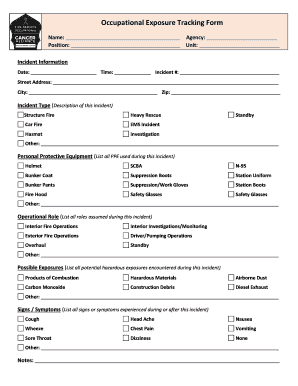
Occupational Exposure Tracking Form Name: Agency: Position: Unit: Incident Information Date: Time: Incident #: Street Address: City: Zip: Incident Type (Description of this incident) Structure FireHeavy.

How it works
  • Open form

    Open form follow the instructions

  • Easily sign form

    Easily sign the form with your finger

  • Share form

    Send filled & signed form or save

How to fill out the Occupational Exposure Tracking Form online

Filling out the Occupational Exposure Tracking Form accurately is essential for documenting any incidents that may pose health risks. This guide provides clear instructions on how to complete the form effectively online.

Follow the steps to fill out the Occupational Exposure Tracking Form online.

  1. Click ‘Get Form’ button to obtain the form and open it in the editor.
  2. Begin by entering your name in the designated field. This personal identification is necessary to track the record of exposures accurately.
  3. Next, fill in the agency you work for, as well as your position and unit to provide context for the incident.
  4. In the Incident Information section, include the date and time of the incident. Also, make sure to input the incident number, street address, city, and zip code.
  5. For the Incident Type, select the appropriate category that best describes the incident, such as structure fire, hazmat, or other. If other, please specify in the space provided.
  6. In the Personal Protective Equipment section, check all equipment you used during the incident. Be thorough to ensure all types of PPE are listed.
  7. Then, move to the Operational Role section. List all roles you assumed during the incident to provide a comprehensive overview of your responsibilities.
  8. In the Possible Exposures area, list any hazardous materials or conditions you may have encountered during the incident.
  9. Document any signs or symptoms experienced during or after the incident in the designated section. Be honest and detailed for effective tracking.
  10. Finally, use the Notes section for any additional information or context that may be relevant to the incident.
  11. After all fields are filled out, you can save changes, download, print, or share the form as needed.

Take a moment to complete your Occupational Exposure Tracking Form online today.

Get form

Experience a faster way to fill out and sign forms on the web. Access the most extensive library of templates available.

Related content

4.1 occupational exposure assessment - National...

Workplace Monitor is an individual trained in exposure monitoring working ... This...

Learn more
Occupational Exposure Tracking Form

FORM TO BE COMPLETED BY MEMBER AND SUBMITTED TO CHIEF MEGAARD. Incident Information. Date:...

Learn more
Provider Manual - Health First Network

12 to 18 Month Child Health Check-Up Tracking Form 36. 18 Month to 3 Year Child...

Learn more
Questions & Answers

Get answers to your most pressing questions about US Legal Forms API.

Contact support

Do I have to submit OSHA form 301?

Whether you need to submit OSHA Form 301 depends on the nature of the incident and the requirements of your specific workplace. OSHA Form 301 is typically required for work-related injuries and illnesses, ensuring proper documentation and reporting. If you face situations requiring this form, consider using the Occupational Exposure Tracking Form as a complementary tool. This helps create a comprehensive safety narrative for your records and can enhance compliance with OSHA regulations.

Measuring occupational exposure involves using various tools and techniques to collect data on the presence of hazards in the workplace. Depending on the type of exposure, you might use air sampling, surface testing, or personal monitoring devices. After gathering this data, document your findings in the Occupational Exposure Tracking Form. This precise measurement helps in assessing risk levels and improving health protocols.

To calculate the Occupational Exposure Limit (OEL) value, you must first collect accurate exposure data based on monitoring results. This data should include the concentration of hazardous substances during work hours. Next, you can apply relevant formulas or guidelines to derive the OEL value, ensuring it aligns with safety standards. Completing the Occupational Exposure Tracking Form with this value aids in maintaining compliance and enhances workplace safety.

To determine occupational exposure, you need to assess the work environment and identify potential sources of hazards. Conduct a thorough evaluation by observing tasks, reviewing past incident reports, and potentially involving staff in the process. Once you have this data, use it to complete the Occupational Exposure Tracking Form, ensuring you accurately document any findings. This detailed approach helps prioritize safety and promote health in the workplace.

The three categories that determine occupational exposure include the type of hazard, duration of exposure, and the frequency of exposure. Each of these categories plays a crucial role in assessing risk. By analyzing these factors, you can effectively fill out an Occupational Exposure Tracking Form to better understand potential risks. This information allows you and your organization to implement appropriate safety measures.

Occupational exposure records should include detailed information such as the type of exposure, levels recorded, the duration of exposure, and any control measures implemented. Moreover, it's vital to include employee information and any health surveillance results. An Occupational Exposure Tracking Form provides a structured way to maintain these records, ensuring compliance and promoting safety.

It is important to note that "occupational exposure" is defined as "reasonably anticipated skin, eye, mucous membrane, or parenteral contact with blood or other potentially infectious materials that may result from the performance of an employee's duties".

Significant occupational exposure a percutaneous injury, for example injuries from needles, instruments, bone fragments, or bites which break the skin. exposure of broken skin, for example abrasions, cuts, eczema. exposure of mucous membranes including the eye from splashing of blood or other high risk body fluids.

Significant occupational exposure a percutaneous injury, for example injuries from needles, instruments, bone fragments, or bites which break the skin. exposure of broken skin, for example abrasions, cuts, eczema. exposure of mucous membranes including the eye from splashing of blood or other high risk body fluids.

Occupational exposure to blood and body fluids (BBFs) is a serious concern for health care workers (HCWs) and presents a major risk factor for transmission of infectious diseases such as hepatitis B virus (HBV), hepatitis C virus, and human immune deficiency virus.

Get This Form Now!

Use professional pre-built templates to fill in and sign documents online faster. Get access to thousands of forms.

If you believe that this page should be taken down, please follow our DMCA take down process here.

Get Occupational Exposure Tracking Form