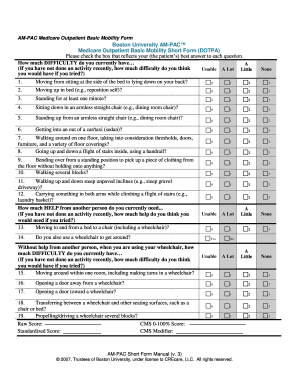
Get Ampac Basic Mobility Outpatient Short Form
How it works
-

Open form follow the instructions
-

Easily sign the form with your finger
-

Send filled & signed form or save
How to fill out the Ampac Basic Mobility Outpatient Short Form online
The Ampac Basic Mobility Outpatient Short Form is designed to assess a person's mobility and functional status. This comprehensive guide will walk you through each section of the form, offering clear instructions to help you complete it accurately and efficiently online.
Follow the steps to successfully complete the form online.
- Press the ‘Get Form’ button to access the Ampac Basic Mobility Outpatient Short Form and open it in your online editor.
- Begin by reviewing the initial questions to determine the appropriate response for your mobility skills. These questions address how much difficulty you have with various activities.
- For each activity listed, select the box that best reflects your level of difficulty, choosing from the options: ‘Unable’, ‘A Lot’, ‘A Little’, or ‘None’.
- Continue through the form, which assesses both your mobility and the level of assistance needed from another person for different activities.
- Make sure to indicate if you use a wheelchair and evaluate the difficulty you might face while performing activities with a wheelchair.
- Complete all sections until you reach the conclusion area where your raw score, CMS score, standardized score, and CMS modifier will be calculated based on your responses.
- Finally, save your changes. You can choose to download, print, or share the completed form as needed.
Complete the Ampac Basic Mobility Outpatient Short Form online to take the first step in evaluating your mobility needs.
The basic mobility short form is a concise assessment tool utilized to measure a patient's mobility capabilities. Specifically, the AMPAC Basic Mobility Outpatient Short Form focuses on outpatient care, allowing healthcare providers to gauge progress efficiently. This form covers fundamental activities necessary for daily living. By using this assessment, clinicians can design effective rehabilitation plans, ensuring better patient outcomes.