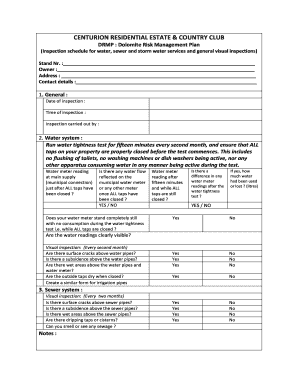
CENTURION RESIDENTIAL ESTATE & COUNTRY CLUB DRMP : Dolomite Risk Management Plan (Inspection schedule for water, sewer and storm water services and general visual inspections) Stand Nr. : Owner.
Open form follow the instructions
Easily sign the form with your finger
Send filled & signed form or save
How to fill out the Dolomite Risk Management Plan online
The Dolomite Risk Management Plan is essential for ensuring the safety and integrity of your property. This guide will provide you with step-by-step instructions on how to effectively complete the form online, addressing each section in detail.
Follow the steps to complete the Dolomite Risk Management Plan.
- Click ‘Get Form’ button to obtain the Dolomite Risk Management Plan and open it in the online editor.
- Fill in the stand number, owner information, address, and contact details at the top of the form. Ensure that all fields are accurately completed.
- In the general inspection section, input the date and time of the inspection, along with the name of the person carrying out the inspection.
- Proceed to the water system section. Follow the instructions for conducting the water tightness test. Take the water meter reading after ensuring all taps are closed.
- Indicate whether there is any water flow on the municipal water meter after all taps have been closed by selecting YES or NO.
- Complete the remaining questions regarding water meter readings and visible water consumption during the test, ensuring to note any differences.
- Conduct a visual inspection of the water system and record observations about surface cracks, wet areas, and drain functionality.
- Move to the sewer system section. Conduct the visual inspection as outlined, and document observations about any issues such as cracks or sewage odors.
- Complete the storm water system section by inspecting drainage areas and documenting any concerns related to water ponding or drainage blockages.
- Fill out the general inspection section detailing any visual issues with the structure or surroundings.
- If applicable, complete the swimming pools or water features section, noting any observations around the pool area.
- Record any occurrences such as blockages or leakages in the respective section and provide descriptions as necessary.
- Finally, review all provided information for accuracy. Save changes to the completed form, and choose to download or print it for your records.
Complete the Dolomite Risk Management Plan online today to ensure your property remains safe and compliant.
Experience a faster way to fill out and sign forms on the web. Access the most extensive library of templates available.
Related content
Dec 13, 2024 — Mine operators are required to provide a conceptual reclamation plan to...
The study concludes that only 50% of assessed Dolomite Risk Management Plans are capable...
The focus of the Laboratory's research program is on methods for the prevention and...
Get answers to your most pressing questions about US Legal Forms API.
What are the 5 key components of a risk management plan?
The five key components of a Dolomite Risk Management Plan are risk identification, risk assessment, risk response planning, risk monitoring, and communication. Each component plays a critical role in ensuring that risks are effectively managed. Start by identifying and assessing risks, then plan how to respond. Continually monitor these risks and communicate updates to your team to maintain awareness and preparedness.
What are the 5 steps to a risk management plan?
The five steps to a Dolomite Risk Management Plan include risk identification, risk assessment, risk control, risk monitoring, and risk reporting. Start by identifying risks unique to your dolomite operations. Then assess their potential impact and likelihood. Create a control strategy to manage those risks, monitoring your plan's effectiveness over time. Finally, report on your findings and adjust the plan as necessary.
How to monitor a risk management plan?
Monitoring a Dolomite Risk Management Plan requires regular reviews of risk assessments and control measures. Use performance indicators to track the effectiveness of your strategies, making adjustments when necessary. Keeping precise records helps in identifying trends and areas needing improvement. Consider using tools offered by US Legal Forms to streamline the monitoring process.
What is the dolomite risk management strategy?
The Dolomite Risk Management Strategy involves systematic identification and evaluation of risks associated with dolomite operations. This strategy prioritizes risks based on their severity and impact on the project or organization. It focuses on implementing controls to minimize negative outcomes, ensuring the safety and efficiency of operations. Engaging with an established platform like US Legal Forms can provide additional resources to enhance your strategy.
How to set up a risk management plan?
To set up a Dolomite Risk Management Plan, begin by identifying potential risks that may impact your business. Next, assess the likelihood and impact of these risks. Afterward, document your findings and outline strategies to mitigate these risks. Finally, regularly review and adjust your plan to ensure its effectiveness as conditions change.
What are the 5 risk management plans?
The five types of risk management plans include strategic, operational, financial, compliance, and reputational plans. Each type serves a specific purpose in the context of the Dolomite Risk Management Plan. Understanding these distinctions aids businesses in focusing their risk management efforts effectively.
How do I write a risk management plan?
To write a risk management plan, begin by identifying risks specific to your organization, then assess their potential impact. Afterward, develop a clear strategy to manage each risk, and continually monitor the effectiveness of your risk management strategies. A Dolomite Risk Management Plan can serve as a helpful framework for this process.
What are 5 risk management strategies?
Five common risk management strategies include risk avoidance, risk reduction, risk sharing, risk transfer, and risk acceptance. Utilizing these strategies helps in forming a comprehensive Dolomite Risk Management Plan. Each strategy can be tailored to fit specific organizational needs and risk profiles.
What are the 4 key components of a risk management plan?
A robust risk management plan consists of risk identification, risk assessment, risk response, and risk monitoring. These components work together seamlessly in a Dolomite Risk Management Plan to address and mitigate risks. By integrating these elements, organizations can effectively manage uncertainties.
What are the 5 P's of risk management?
The 5 P's of risk management include Prioritize, Planning, Prevention, Performance, and Post-event analysis. These elements form a comprehensive approach when developing a Dolomite Risk Management Plan. By focusing on these aspects, businesses can ensure they are prepared for various risk scenarios.
Use professional pre-built templates to fill in and sign documents online faster. Get access to thousands of forms.
If you believe that this page should be taken down, please follow our DMCA take down process here.