We use cookies to improve security, personalize the user experience, enhance our marketing activities (including cooperating with our marketing partners) and for other business use.
Click "here" to read our Cookie Policy. By clicking "Accept" you agree to the use of cookies. Read less
Read more
Accept
Loading
Form preview
  • US Legal Forms
  • Form Library
  • More Forms
  • More Multi-State Forms
  • Sanitation Standard Operating Procedures

Get Sanitation Standard Operating Procedures

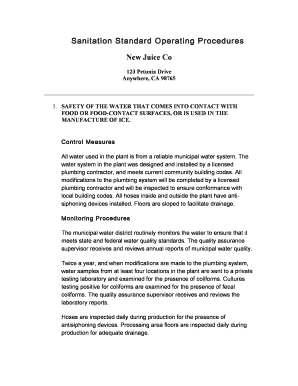
Sanitation Standard Operating Procedures New Juice Co 123 Petunia Drive Anywhere, CA 987651. SAFETY OF THE WATER THAT COMES INTO CONTACT WITH FOOD OR FOODCONTACT SURFACES, OR IS USED IN THE MANUFACTURE.

How it works

  1. Open form

    Open form follow the instructions

  2. Easily sign form

    Easily sign the form with your finger

  3. Share form

    Send filled & signed form or save

How to fill out the Sanitation Standard Operating Procedures online

Filling out the Sanitation Standard Operating Procedures (SSOP) online is an essential step in maintaining food safety and compliance in food processing facilities. This guide will provide you with comprehensive steps to complete the SSOP form effectively and efficiently.

Follow the steps to fill out the Sanitation Standard Operating Procedures form.

  1. Press the ‘Get Form’ button to access the SSOP form and open it in the online editor.
  2. Begin by reviewing the 'Safety of the water' section. Fill in the details regarding the municipal water system, ensuring to note compliance with local building codes and the presence of antisiphoning devices.
  3. Move to the 'Monitoring Procedures' field and provide information about routine water quality assessments and inspections that are conducted. Record the frequency of water testing and any relevant results.
  4. In the 'Corrective Actions' section, outline the actions that will be taken in the event of any water quality failures, such as ceasing production or contacting the municipal water system.
  5. Proceed to the 'Condition and cleanliness of food contact surfaces' section. Detail the cleaning and sanitization procedures for food-contact surfaces, utensils, and worker clothing.
  6. Complete the 'Monitoring Procedures' for food-contact surfaces, indicating who conducts inspections and how often they are performed.
  7. Continue to 'Prevention of cross-contamination' and document the measures taken to ensure the separation of raw and cooked products, including worker hygiene protocols.
  8. Fill in the 'Maintenance of hand washing, hand sanitizing, and toilet facilities' by providing details on handwashing facilities available and their maintenance protocols.
  9. In the 'Protection from adulteration' section, describe the measures taken to protect food and food-contact surfaces from contaminants and the protocols for storing chemicals.
  10. Complete the record-keeping details by noting all necessary inspections and corrective actions required throughout the form. Ensure that each section has accurate and thorough documentation.
  11. Once all sections are completed and reviewed for accuracy, you can save changes, download, print, or share the form as needed.

Start filling out your Sanitation Standard Operating Procedures online today to enhance your facility's safety measures.

Get form

Experience a faster way to fill out and sign forms on the web. Access the most extensive library of templates available.
Get form

Related content

Sanitation Standard Operation Procedures (SSOP)...
Dec 2, 2019 — The Sanitation SOPs cover the entire establishment and all shifts of...
Learn more
Writing Sanitation Standard Operating Procedures...
Jan 22, 2018 — What is a Sanitation Standard Operating Procedure (SSOP)? · a piece of...
Learn more
Procedimientos operativos estándar de saneamiento...
Nov 2, 2020 — Procedimientos operativos estándar de saneamiento - Sanitation Standard...
Learn more

Related links form

State Farm Form Ub 04 Florida Form Oir C1 1423 Special Education Evaluation Report Sample Pcb Premium

Questions & Answers

Get answers to your most pressing questions about US Legal Forms API.

Contact support

The five components of effective standard operating procedures typically include purpose, scope, responsibilities, procedures, and documentation. Each component provides clarity on how tasks should be performed to achieve desired outcomes. By including these components in your sanitation standard operating procedures, you create a comprehensive roadmap for staff to follow. This leads to enhanced safety and compliance within your facility.

The 5S standard operating procedures focus on five principles: Sort, Set in order, Shine, Standardize, and Sustain. This methodology is designed to organize and manage workspace more efficiently, leading to improved productivity and safety. By integrating 5S into sanitation standard operating procedures, your facility can cultivate a cleaner and more organized environment. This ultimately supports better sanitation practices and product quality.

A standard operating procedure, or SOP, is a documented process that outlines specific steps to be followed to achieve consistency and quality in operations. Examples of SOPs can include employee training procedures, equipment operation guidelines, or sanitation standard operating procedures. These documents are essential for promoting efficiency and compliance within an organization. By creating clear SOPs, staff can perform tasks accurately and consistently.

The high 5 standard operating procedure emphasizes five crucial components for effective sanitation and safety in food handling. These components usually include hands, surfaces, equipment, utensils, and storage practices. By prioritizing these areas, your facility can significantly enhance safety measures. Incorporating high 5 principles within sanitation standard operating procedures helps ensure comprehensive sanitation practices.

Proper sanitation procedures encompass a series of steps designed to minimize contamination risks within food handling and production areas. These include thorough cleaning and sanitizing of surfaces, proper waste disposal, and employee hygiene practices. By adhering to sanitation standard operating procedures, facilities can effectively reduce the likelihood of foodborne illnesses. Consistent application of these procedures is vital for maintaining a safe and hygienic environment.

The four regulatory requirements for sanitation standard operating procedures (SSOP) include performing a hazard analysis, establishing critical limits, monitoring procedures, and corrective actions. These elements ensure that sanitation practices effectively reduce or eliminate contaminants in food production environments. Regulatory guidelines require facilities to implement and document these procedures for compliance. By following these requirements, you can maintain safer food handling operations.

The SOP of sanitation pertains to the specific procedures ensuring cleanliness and hygiene in a facility, especially in food processing. These procedures encompass guidelines on cleaning and sanitizing equipment, surfaces, and staff hygiene practices. By following a well-defined SOP for sanitation, facilities can minimize contamination risks and comply with health regulations effectively. This practice not only protects consumers but enhances brand credibility.

To develop effective standard operating procedures, start by assessing your current processes and identifying areas for standardization. Collaborate with your team to gather insights and ensure that procedures reflect the best practices. Additionally, consider utilizing resources like USLegalForms to access templates and guidelines, making the creation process smoother. By involving various stakeholders, you will promote greater adherence to procedures.

Creating a sample SOP begins with identifying the specific requirements of your process. Outline the steps involved clearly and concisely, using simple language to ensure everyone can understand. Incorporate templates available through platforms like USLegalForms, which provide templates for easy customization. This strategy allows for quick implementation and promotes uniformity across your operations.

Making your own SOP can streamline your operations. First, identify the process you want to standardize. Gather information from industry best practices or internal expertise to draft a detailed procedure. Ensure you include step-by-step instructions, responsible personnel, and measurable outcomes to track effectiveness. This approach brings consistency and quality to your operations.

Get This Form Now!

Use professional pre-built templates to fill in and sign documents online faster. Get access to thousands of forms.
Get form
If you believe that this page should be taken down, please follow our DMCA take down processhere.

Industry-leading security and compliance

US Legal Forms protects your data by complying with industry-specific security standards.
  • In businnes since 1997
    25+ years providing professional legal documents.
  • Accredited business
    Guarantees that a business meets BBB accreditation standards in the US and Canada.
  • Secured by Braintree
    Validated Level 1 PCI DSS compliant payment gateway that accepts most major credit and debit card brands from across the globe.
Get Sanitation Standard Operating Procedures
Get form
Form Packages
Adoption
Bankruptcy
Contractors
Divorce
Home Sales
Employment
Identity Theft
Incorporation
Landlord Tenant
Living Trust
Name Change
Personal Planning
Small Business
Wills & Estates
Packages A-Z
Form Categories
Affidavits
Bankruptcy
Bill of Sale
Corporate - LLC
Divorce
Employment
Identity Theft
Internet Technology
Landlord Tenant
Living Wills
Name Change
Power of Attorney
Real Estate
Small Estates
Wills
All Forms
Forms A-Z
Form Library
Customer Service
Terms of Service
Privacy Notice
Legal Hub
Content Takedown Policy
Bug Bounty Program
About Us
Help Portal
Legal Resources
Blog
Affiliates
Contact Us
Delete My Account
Site Map
Industries
Forms in Spanish
Localized Forms
State-specific Forms
Forms Kit
Legal Guides
Real Estate Handbook
All Guides
Prepared for You
Notarize
Incorporation services
Our Customers
For Consumers
For Small Business
For Attorneys
Our Sites
US Legal Forms
USLegal
FormsPass
pdfFiller
signNow
altaFlow
DocHub
Instapage
Social Media
Call us now toll free:
+1 833 426 79 33
As seen in:
  • USA Today logo picture
  • CBC News logo picture
  • LA Times logo picture
  • The Washington Post logo picture
  • AP logo picture
  • Forbes logo picture
© Copyright 1997-2025
airSlate Legal Forms, Inc.
3720 Flowood Dr, Flowood, Mississippi 39232
Form Packages
Adoption
Bankruptcy
Contractors
Divorce
Home Sales
Employment
Identity Theft
Incorporation
Landlord Tenant
Living Trust
Name Change
Personal Planning
Small Business
Wills & Estates
Packages A-Z
Form Categories
Affidavits
Bankruptcy
Bill of Sale
Corporate - LLC
Divorce
Employment
Identity Theft
Internet Technology
Landlord Tenant
Living Wills
Name Change
Power of Attorney
Real Estate
Small Estates
Wills
All Forms
Forms A-Z
Form Library
Customer Service
Terms of Service
Privacy Notice
Legal Hub
Content Takedown Policy
Bug Bounty Program
About Us
Help Portal
Legal Resources
Blog
Affiliates
Contact Us
Delete My Account
Site Map
Industries
Forms in Spanish
Localized Forms
State-specific Forms
Forms Kit
Legal Guides
Real Estate Handbook
All Guides
Prepared for You
Notarize
Incorporation services
Our Customers
For Consumers
For Small Business
For Attorneys
Our Sites
US Legal Forms
USLegal
FormsPass
pdfFiller
signNow
altaFlow
DocHub
Instapage
Social Media
Call us now toll free:
+1 833 426 79 33
As seen in:
  • USA Today logo picture
  • CBC News logo picture
  • LA Times logo picture
  • The Washington Post logo picture
  • AP logo picture
  • Forbes logo picture
© Copyright 1997-2025
airSlate Legal Forms, Inc.
3720 Flowood Dr, Flowood, Mississippi 39232