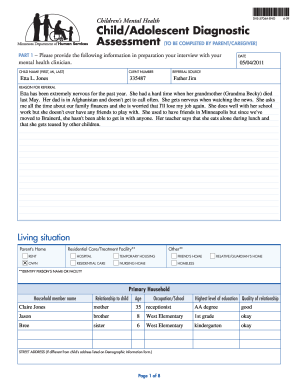
Clear Form Data FILLABLE FORM DHS-5704A-ENG Children s Mental Health Child/Adolescent Diagnostic Assessment (TO BE COMPLETED BY PARENT/CAREGIVER) PART 1 Please provide the following information in.

How it works
  • Open form

    Open form follow the instructions

  • Easily sign form

    Easily sign the form with your finger

  • Share form

    Send filled & signed form or save

How to fill out the Child Adolescent Diagnostic Assessment Form online

Filling out the Child Adolescent Diagnostic Assessment Form can be a vital step in supporting your child's mental health. This comprehensive guide will walk you through the process of completing the form online, ensuring that you provide all necessary information accurately and thoroughly.

Follow the steps to complete the form successfully

  1. Click ‘Get Form’ button to obtain the Child Adolescent Diagnostic Assessment Form and open it in your preferred online editor.
  2. Begin by entering your child's full name in the appropriate section, including first name, middle initial, and last name.
  3. Provide the client number if available, as well as the referral source, which indicates who referred you to this assessment.
  4. Fill in the child's date of birth and the date on which you are completing the assessment.
  5. In the section designated for the reason for referral, provide detailed information about why you are completing this assessment, including any specific concerns or observations about your child’s behavior or feelings.
  6. Complete the Living Situation section by selecting the appropriate housing arrangement and providing details about any other household members.
  7. Proceed to indicate any developmental issues, health concerns, or functioning challenges your child may have experienced, answering each question as relevant.
  8. Provide a detailed account of any self-destructive behavior or attention problems your child exhibits.
  9. Detail your child’s school functioning, noting their educational classification and any special education services they may receive.
  10. Complete the child's legal and trauma history sections if applicable, being sure to provide any pertinent details.
  11. Review the Family Environment/Relationships section to accurately describe relationships within the family, including parent-child bond, sibling dynamics, and any relevant issues.
  12. Finish by providing comments on any other family concerns, identifying aspects such as health problems or financial stresses that may impact your child's needs.
  13. Once you have completed the form, save your changes, and choose to download, print, or share the document as needed.

Begin the process today and complete your Child Adolescent Diagnostic Assessment Form online to support your child's mental health.

Get form

Experience a faster way to fill out and sign forms on the web. Access the most extensive library of templates available.

Related content

Standard - Child/Adolescent Diagnostic Assessment

There are two parts to the Child/Adolescent Diagnostic Assessment Form. Part 1 is designed...

Learn more
Screening Tools | UCSF Child and Adolescent...

Child | Parent · CES-DC. PHQ-9 Adolescent (ages 11-17) English I Spanish. SMFQ (Short...

Learn more
Evidence-based assessment/Attention deficit...

Sep 18, 2024 — "Evidence-based assessment of attention deficit hyperactivity disorder in...

Learn more
Questions & Answers

Get answers to your most pressing questions about US Legal Forms API.

Contact support

What is the diagnostic interview for children and adolescents?

The diagnostic interview for children and adolescents is a structured conversation designed to gather information about a child's symptoms, experiences, and behaviors. This interview often involves both the child and their parents or guardians. Employing the Child Adolescent Diagnostic Assessment Form can help guide this conversation, ensuring crucial areas are discussed thoroughly.

A diagnosis should include a clear description of the child’s symptoms, background information, and how these issues impact daily functioning. It should also reference any standardized testing or assessments conducted. The Child Adolescent Diagnostic Assessment Form serves as a helpful tool to organize and present this information logically and coherently.

A diagnostic assessment should include personal, educational, and medical histories, as well as observations about the child's behavior and emotional state. It should also incorporate input from caregivers and teachers. Using the Child Adolescent Diagnostic Assessment Form ensures that vital information is captured systematically and comprehensively.

To conduct an assessment on a child, start by establishing rapport to help the child feel comfortable expressing themselves. Collect information through interviews, observations, and assessments to get a full picture of the child's emotional and psychological state. Utilizing the Child Adolescent Diagnostic Assessment Form can facilitate this process, guiding you through essential aspects to evaluate.

Creating a diagnostic assessment involves defining the purpose of the assessment and identifying key areas to evaluate. Gathering input from multiple sources, including parents and educators, can provide a comprehensive view of the child. The Child Adolescent Diagnostic Assessment Form can serve as a useful template to ensure no vital components are overlooked.

A good diagnostic assessment is thorough, reliable, and tailored to the individual child. It should cover various aspects of the child's life, including emotional, social, and cognitive factors. The Child Adolescent Diagnostic Assessment Form is designed to facilitate these characteristics, ensuring that all critical areas are assessed and understood.

To fill out a psychosocial assessment, begin by gathering detailed background information about the child’s family, education, and social interactions. It is essential to provide clear and truthful answers about the child's behaviors and emotions. Utilizing the Child Adolescent Diagnostic Assessment Form streamlines this process, ensuring all relevant areas are addressed effectively.

A diagnostic assessment typically includes a comprehensive review of a child's mental health, behavior, and development. It may consist of interviews with the child, parents, and teachers, along with standardized tests and questionnaires. The Child Adolescent Diagnostic Assessment Form helps gather necessary information to understand the child's needs and challenges.

The purpose of the CANS is to accurately represent the shared vision of the child/youth serving system—children, youth, and families. As such, completion of the CANS is accomplished in order to allow for the effective communication of this shared vision for use at all levels of the system.

The Child and Adolescent Psychiatric Assessment (CAPA) is an interviewer-based structured psychiatric interview that collects data on the onset dates, duration, frequency, and intensity of symptoms of a wide range of psychiatric diagnoses (Table 1) ing to DSM-IV, DSM-III-R, or ICD-10 criteria.

Get This Form Now!

Use professional pre-built templates to fill in and sign documents online faster. Get access to thousands of forms.

If you believe that this page should be taken down, please follow our DMCA take down process here.

Get Child Adolescent Diagnostic Assessment Form