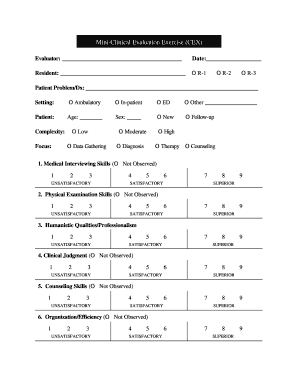
Mini-Clinical Evaluation Exercise (CEX) Evaluator: Resident: Date: O R-1 O R-2 O R-3 Patient Problem/Dx: Setting: Patient: Complexity: Focus: O Ambulatory Age: O Low O Data Gathering O In-patient.

How it works
  • Open form

    Open form follow the instructions

  • Easily sign form

    Easily sign the form with your finger

  • Share form

    Send filled & signed form or save

How to use or fill out the Mini-Clinical Evaluation Exercise (CEX) - Georgetown online

The Mini-Clinical Evaluation Exercise (CEX) - Georgetown is an essential tool used in clinical education to assess medical residents' competencies. This guide provides straightforward steps to help users effectively fill out the form online while ensuring clarity and accuracy.

Follow the steps to complete your Mini-CEX online.

  1. Click 'Get Form' button to obtain the document and open it for editing.
  2. Begin by filling out the evaluator name and the date in the designated spaces at the top of the form.
  3. Next, enter the resident's name and select their corresponding level (R-1, R-2, R-3) using the available options.
  4. Provide the patient's problem or diagnosis in the space provided, ensuring to be as descriptive as necessary.
  5. Specify the setting of the evaluation (Ambulatory, In-patient, ED, Other) by selecting the appropriate option.
  6. Fill in the patient's age and sex to provide additional context for the evaluation.
  7. Indicate whether the patient is new or a follow-up by selecting the relevant option.
  8. Select the complexity level of the case and the focus area using the appropriate options provided.
  9. For each evaluation category (medical interviewing skills, physical examination skills, etc.), rate the performance on a scale of 1 to 9, ensuring to check 'Not Observed' if applicable.
  10. Fill in the time spent on the Mini-CEX and providing feedback, ensuring to be as accurate as possible.
  11. Lastly, include any additional comments and obtain both the resident's and evaluator's signatures in the designated sections.
  12. Once completed, save your changes, then download, print, or share the form as needed.

Start filling out the Mini-Clinical Evaluation Exercise (CEX) - Georgetown online today.

Get form

Experience a faster way to fill out and sign forms on the web. Access the most extensive library of templates available.

Related content

Review of mini-clinical evaluation exercise...

by E Meresh · 2018 · Cited by 25 — This article describes medical students' experience...

Learn more
Review of mini-clinical evaluation exercise...

This article describes medical students' experience of mini-clinical evaluation exercise...

Learn more
NEGEA 2020 Annual Meeting Abstract Compendium

"Factors influencing the educational impact of Mini-CEX and DOPS: A qualitative synthesis...

Learn more
Questions & Answers

Get answers to your most pressing questions about US Legal Forms API.

Contact support

How many mini-CEX for arcp?

The number of Mini-CEX required for the ARCP (Annual Review of Competence Progression) can vary based on individual training programs and guidelines. Typically, a minimum of three to six Mini-Clinical Evaluation Exercises (CEX) - Georgetown may be recommended to adequately assess clinical skills. Engaging in these evaluations throughout your training can significantly enhance your abilities and prepare you for the ARCP process. Therefore, it is wise to consult your specific program's requirements to ensure compliance.

The Clinical Evaluation Exercise (CEX) is a broader assessment tool that measures various competencies in healthcare education. Unlike the Mini-CEX, which focuses on shorter encounters, the CEX may involve longer evaluations to assess a wider range of skills and knowledge. The Mini-Clinical Evaluation Exercise (CEX) - Georgetown is part of this framework, highlighting its importance in graduate medical education. This method emphasizes real-time feedback, encouraging learners to adapt and grow in their clinical practices.

A MiniCEX includes direct observation of a clinical interaction, focusing on specific skills such as communication, clinical reasoning, and patient management. Evaluators assess learners during these interactions, providing structured feedback to help improve their clinical abilities. Each observation should involve real patients to ensure that the Mini-Clinical Evaluation Exercise (CEX) - Georgetown reflects true clinical practice. Therefore, it is essential to include a variety of cases and scenarios to maximize learning outcomes.

The Mini-Clinical Evaluation Exercise (CEX) - Georgetown is a structured assessment used to evaluate a learner's clinical skills in real patient encounters. This interactive method helps in providing immediate feedback to learners, enhancing their performance in clinical settings. By observing the competencies of a healthcare professional in action, the Mini-CEX fosters continuous improvement and learning. It is a valuable tool for both educators and students at Georgetown.

To perform the Mini-Clinical Evaluation Exercise (CEX) - Georgetown, a clinician engages in a patient encounter while being observed by a trained evaluator. The evaluator uses a standardized form to record observations on key competencies, such as communication skills and clinical judgment. After the encounter, the clinician and evaluator discuss the performance, allowing for constructive feedback that reinforces learning and development.

The Mini-Clinical Evaluation Exercise (CEX) - Georgetown is an innovative assessment method designed to evaluate clinical skills in real-time. This structured approach focuses on direct observation of a clinician’s performance during patient interactions. With the mini-CEX, educators can provide immediate feedback, which enhances the learning experience and contributes to continuous improvement.

The MiniCEX exam is an assessment tool developed to evaluate key clinical skills and competencies in a succinct format. It provides an opportunity for trainees to demonstrate their abilities in real clinical scenarios while receiving timely feedback. The Mini-Clinical Evaluation Exercise (CEX) - Georgetown emphasizes the importance of formative assessment in refining medical training.

The mini clinical evaluation exercise, or mini-CEX, is a practical method to assess various clinical skills, including communication, clinical judgement, and professionalism. It promotes direct observation and feedback, which are vital for trainee development. Implementing the Mini-Clinical Evaluation Exercise (CEX) - Georgetown can improve training outcomes and educational effectiveness.

CEX assessment is a streamlined version of the clinical evaluation exercise, aimed at assessing specific clinical competencies within a short timeframe. It focuses on direct observation and feedback to foster continuous improvement among medical trainees. Utilizing the MiniClinical Evaluation Exercise (CEX) Georgetown can significantly enhance the quality of assessments in clinical education.

A MiniCEX is an observed, real-life, interaction between you and a patient. The MiniCEX assesses your clinical skills, attitudes and behaviours. The MiniCEX is completed in the non-primary care setting.

Get This Form Now!

Use professional pre-built templates to fill in and sign documents online faster. Get access to thousands of forms.

If you believe that this page should be taken down, please follow our DMCA take down process here.

Get Mini-Clinical Evaluation Exercise (CEX) - Georgetown