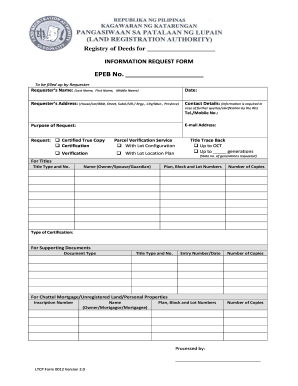
Registry of Deeds for INFORMATION REQUEST FORMEPEB No. To be filled up by RequesterRequesters Name: (Last Name,Date:First Name, Middle Name)Requesters Address: (House/Lot/Blk#, Street, Subd./Vill./.
Open form follow the instructions
Easily sign the form with your finger
Send filled & signed form or save
How to fill out the Registry Of Deeds For online
Filling out the Registry Of Deeds For can seem daunting, but understanding its components can simplify the process. This guide provides a clear, step-by-step approach for users to easily navigate the online form.
Follow the steps to complete your Registry Of Deeds For online.
- Click ‘Get Form’ button to obtain the form and open it in the editor.
- Complete the information request section by entering your EPEB number and the name of the requester, which includes the last name, first name, and middle name.
- Fill in your address with details such as house/lot/block number, street, subdivision/village/barangay, city/municipality, and province.
- Provide your contact details, which include a telephone or mobile number and an email address for any necessary follow-up by the Registry of Deeds.
- State the purpose of your request by selecting the appropriate option: 'Certified True Copy,' 'Certification,' or 'Verification.'
- If you are requesting parcel verification service, check the boxes for either 'With Lot Configuration' or 'With Lot Location Plan'.
- For title trace back requests, specify how many generations you want traced by filling in the number under 'Up to _____ generations.'
- In the 'For Titles' section, input the title type and number, names of the owner, spouse, or guardian, along with the plan, block, and lot numbers, and the number of copies required.
- In the 'For Supporting Documents' section, select the document type, title type and number, entry number, date, and number of copies needed.
- For requests regarding chattel mortgage, unregistered land, or personal properties, include the inscription number and the names of the owner, mortgagor, or mortgagee, alongside the necessary plan, block, and lot numbers, and the number of copies needed.
- Once all fields are filled in, ensure to review your entries for accuracy, then proceed to save changes, download, print, or share your completed form.
Complete your Registry Of Deeds For online today to ensure your requests are processed efficiently.
Experience a faster way to fill out and sign forms on the web. Access the most extensive library of templates available.
Related content
Popular Features · Search Property Records · Locate a Registry of Deeds Office ·...
A city or county government office where one can file real estate documents in the public...
A deed restriction on the property prevents unacceptable exposure to onsite soil...
Get answers to your most pressing questions about US Legal Forms API.
How to get copies of deeds for property?
Getting copies of deeds for property is simple and can typically be done at the local Registry Of Deeds For. You will need to provide identifying information about the property, including its address or parcel number. Many counties offer online access to property records, so you may be able to obtain copies without visiting in person. If you find this process overwhelming, US Legal Forms can simplify your search and help you with the necessary forms.
How to get a copy of a deed in CA?
To obtain a copy of a deed in California, you can visit the local county Recorder’s Office where the property is located. You will need to provide basic information about the property, such as the address or the names of the parties involved. Additionally, you can often request a copy online through the county’s official website. This process allows you to access vital documents related to property ownership through the Registry Of Deeds For your area.
What does the registry of deeds do?
The registry of deeds is responsible for recording and preserving an official record of property-related documents. This includes deeds, mortgages, liens, and easements, which are vital for ensuring legal clarity in property ownership. Additionally, the registry acts as a resource for individuals and businesses seeking to navigate property transactions. Accessing the registry of deeds for your needs can help you protect your property rights and make informed decisions.
How many registries of deeds are there in Massachusetts?
Massachusetts has 14 registries of deeds, each serving a specific geographic area. These registries manage all property records and provide essential services to residents and professionals in those regions. Knowing the number of registries and their locations can help you find the right office for your property transaction needs. Engaging with the appropriate registry of deeds for your area ensures you access accurate information and proper support.
What does the register of deeds do in MA?
In Massachusetts, the register of deeds oversees the recording of property transactions and ensures that documents are filed according to the law. This office is responsible for maintaining the integrity of land records, allowing the public to access property information conveniently. Moreover, the register aids in dispute resolution by providing evidence of property ownership. Utilizing the registry of deeds for your real estate needs in MA can streamline your transactions and provide legal protections.
What is the register of deeds MA?
The register of deeds MA refers to the official office in Massachusetts responsible for recording real estate transactions within the state. This office maintains vital documents such as deeds, mortgages, and foreclosures, ensuring they are accessible to the public. The register provides a trustworthy resource for verifying ownership and understanding property history in Massachusetts. Engaging with the services offered through the registry of deeds for MA is important for homeowners and real estate professionals alike.
What is the registry of deeds?
The registry of deeds is an official government office that records property ownership and transactions within a specific jurisdiction. This agency ensures that all deeds, mortgage documents, and liens are securely filed and made available for public viewing. It acts as a central archive where you can access historical and current information about properties. Understanding the registry of deeds for your area can provide you with vital insights into property ownership and rights.
What is the function of the registry of deeds?
The registry of deeds plays an essential role in maintaining public records of property transactions. It provides a reliable source for verifying ownership and ensuring that all property records are accurate and up to date. By storing deeds, mortgages, and various other documents, the registry of deeds helps protect property rights and facilitates the buying and selling of real estate. Therefore, it is crucial for anyone involved in property transactions to understand the significance of the registry of deeds for their interests.
What is the process of registering a deed?
The process of registering a deed begins with preparing the deed document, which details the transaction and parties involved. After signing, you must present the deed to the appropriate Registry Of Deeds For for recording. Payment of any required fees is usually necessary at this stage. Utilizing platforms like US Legal Forms can streamline your experience, offering templates and instructions for efficient registration.
Do you need a lawyer to file a deed?
While it is not a legal requirement to have a lawyer file a deed, it is strongly recommended. A lawyer can help ensure all legal aspects are properly addressed, reducing the risk of errors. If you prefer to handle it yourself, using resources like US Legal Forms can provide clarity on the process involved with the Registry Of Deeds For.
Use professional pre-built templates to fill in and sign documents online faster. Get access to thousands of forms.
If you believe that this page should be taken down, please follow our DMCA take down process here.