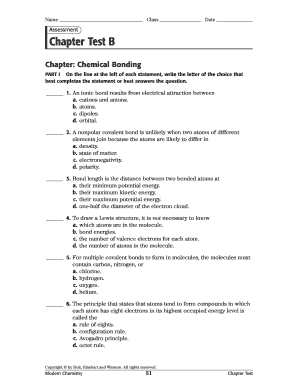
Back Print Name Class Date Assessment Chapter Test B Chapter: Chemical Bonding PART I On the line at the left of each statement, write the letter of the choice that best completes the statement or.
Open form follow the instructions
Easily sign the form with your finger
Send filled & signed form or save
How to fill out the Chapter Test B Chemical Bonding online
This guide provides detailed instructions on completing the Chapter Test B for Chemical Bonding online. Whether you are familiar with digital documents or new to them, this step-by-step approach will assist you in accurately filling out your test.
Follow the steps to successfully complete your test
- Select the 'Get Form' button to access the Chapter Test B Chemical Bonding form and open it in your preferred editor.
- In the first section, labeled 'PART I', you will respond to a series of statements by writing the letter corresponding to your answer on the line provided next to each question.
- Proceed to 'PART II'. Here, you will need to fill in the correct terms or phrases in the spaces provided based on the questions presented.
- Continue to 'PART III'. In this section, you are required to draw Lewis structures for the specified molecules in the designated spaces.
- Move on to 'PART IV'. This part involves answering questions regarding chemical bonding principles and properties. Write your responses in the provided spaces.
- Lastly, review the test to ensure all sections are completed. You can save changes to the document, download it, print it, or share it as needed.
Complete your Chapter Test B Chemical Bonding online today for a streamlined assessment experience.
Experience a faster way to fill out and sign forms on the web. Access the most extensive library of templates available.
Related content
What type of bond is formed when two atoms share a pair of electrons? A) Ionic bond B)...
Chapter Test B Arrangement Of Electrons In Atoms Chapter Test B Mastering the Arrangement...
by TH Wiedemeier · Cited by 360 — This report is a work prepared for the United States...
Get answers to your most pressing questions about US Legal Forms API.
Can you study GOC without isomerism?
It is feasible to study GOC without a detailed understanding of isomerism. However, grasping isomerism enriches your comprehension of organic compounds' behavior and reactions. Including Chapter Test B Chemical Bonding in your studies will provide essential foundational knowledge that supports further exploration into isomerism.
Is chemical bonding an easy chapter?
The perception of chemical bonding as easy or difficult varies among students. Many find the concepts straightforward once they grasp the basics. Nevertheless, mastering Chapter Test B Chemical Bonding through practice can lead to a clearer understanding and facilitate easier application in problems.
How to determine chemical bonding?
Determining chemical bonding involves analyzing the arrangement of electrons in atoms and how they interact. You can identify whether a bond is covalent or ionic based on electron sharing or transfer. Delving into Chapter Test B Chemical Bonding offers practice that can sharpen your skills in recognizing different bonding types.
Which class chapter is chemical bonding?
Chemical bonding is typically covered in high school chemistry classes, often around the 11th grade. This chapter lays the groundwork for understanding how atoms combine to form molecules. Engaging with Chapter Test B Chemical Bonding enhances your comprehension of concepts that will serve you in more advanced studies.
Can we start GOC without IUPAC?
Starting GOC without knowledge of IUPAC nomenclature is possible, yet not advisable. IUPAC rules provide the framework for naming compounds, which is vital when studying organic reactions. Having insights from Chapter Test B Chemical Bonding will enhance your understanding and retention as you move forward in GOC.
Is chemical bonding important for JEE?
Yes, chemical bonding is a significant topic for the Joint Entrance Examination (JEE). It appears frequently in both the chemistry syllabus and examination papers, making it essential for test preparation. Focusing on Chapter Test B Chemical Bonding can boost your confidence and knowledge, helping you tackle related questions in the JEE.
Can I start GOC without chemical bonding?
While you can begin the study of General Organic Chemistry (GOC) without a firm grasp on chemical bonding, it is not recommended. Understanding chemical bonding is crucial as it lays the foundation for comprehending reactivity and molecular structure. Engaging with Chapter Test B Chemical Bonding will give you insights that will support your GOC studies effectively.
Can I start organic chemistry without physical chemistry?
Yes, you can start organic chemistry without a background in physical chemistry. However, having some understanding of physical chemistry can enhance your grasp of organic concepts. The key topics like chemical bonding from Chapter Test B Chemical Bonding will help you relate organic structures and reactions. Therefore, it's beneficial but not mandatory.
Which chapter does chemical bonding fall under?
Chemical bonding typically falls under the broader topic of chemistry, specifically within the realm of molecular chemistry. In the context of your studies, you will likely encounter it in conjunction with other fundamental concepts. The Chapter Test B Chemical Bonding serves as a crucial component of your chemistry education, tying together various ideas and principles. Understanding this chapter provides a strong foundation for more advanced topics.
How to check for back bonding?
To check for back bonding, you can start by examining the molecular structure of the compounds involved. Look for elements that have multiple bonding possibilities, like transition metals. In some cases, conducting experiments and analyzing data from the Chapter Test B Chemical Bonding may also provide insights. This method helps ensure that you grasp the concepts fully.
Use professional pre-built templates to fill in and sign documents online faster. Get access to thousands of forms.
If you believe that this page should be taken down, please follow our DMCA take down process here.