Loading
Form preview
  • US Legal Forms
  • Other Templates
  • More Forms
  • More Uncategorized Forms
  • Subsurface Sewage Treatment System And

Get Subsurface Sewage Treatment System And

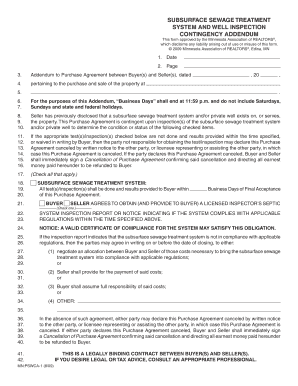
SUBSURFACE SEWAGE TREATMENT SYSTEM AND WELL INSPECTION CONTINGENCY ADDENDUM This form approved by the Minnesota Association of REALTORS, which disclaims any liability arising out of use or misuse.

How it works

  1. Open form

    Open form follow the instructions

  2. Easily sign form

    Easily sign the form with your finger

  3. Share form

    Send filled & signed form or save

How to fill out the subsurface sewage treatment system and well inspection contingency addendum online

Completing the subsurface sewage treatment system and well inspection contingency addendum is an essential step in real estate transactions that involve properties with sewage treatment systems and private wells. This guide will provide you with clear instructions on how to fill out the form online, ensuring you understand each component thoroughly.

Follow the steps to complete the form accurately and efficiently.

  1. Click ‘Get Form’ button to obtain the form and open it in the editor.
  2. Begin by entering the date in the specified field. This date should reflect the current date or the date of the agreement.
  3. Proceed to fill in the section detailing the addendum to the purchase agreement between the buyer(s) and seller(s). Ensure to include the date of the original purchase agreement.
  4. Indicate the property address where the subsurface sewage treatment system and/or private well exist. Be precise to avoid any confusion.
  5. Familiarize yourself with the definition of 'Business Days' provided in the form, noting that they do not include weekends or holidays.
  6. Review the section where the seller must disclose whether a subsurface sewage treatment system and/or private well exists. Ensure this information is accurately stated.
  7. Check the items that require inspection or testing. This is crucial for understanding what inspections must be completed.
  8. Fill in the specific time frame for when the tests or inspections are to be completed, noting that results should be provided within business days of final acceptance.
  9. Document the agreement on who will obtain the licensed inspector's report for the septic system inspection. Indicate the necessary certifications and compliance requirements.
  10. If inspections reveal non-compliance, ensure to complete the section regarding how costs will be allocated between the buyer and seller.
  11. Repeat steps for the private well section, indicating when the water quality tests must be completed and who will be responsible for obtaining results.
  12. Finally, once all fields have been filled out accurately, save your changes. You may then choose to download, print, or share the completed form as needed.

Complete your forms online today to ensure a smooth transaction process.

Get form

Experience a faster way to fill out and sign forms on the web. Access the most extensive library of templates available.
Get form

Related content

Types of Septic Systems
May 20, 2025 — A conventional decentralized individual onsite system (septic system)...
Learn more
All about septics | Onsite Sewage Treatment...
Also referred to as subsurface sewage treatments systems (SSTS), septic systems utilize...
Learn more
Subsurface Containment and Monitoring Systems:...
by L Pearlman · 1999 · Cited by 61 — This report is intended to provide a basic...
Learn more

Related links form

Trismart Ellesmere Registrar Transcript Form 891 Ordering $20 Transcripts Attestation De L'employeur Parenthood Assistance Payment Fiji

Questions & Answers

Get answers to your most pressing questions about US Legal Forms API.

Contact support

The steps in sewage treatment encompass several vital processes. Initially, sewage is collected and screened for debris. Following this, it undergoes primary and then secondary treatment, where biological organisms break down waste. Lastly, the treated sewage is subjected to disinfection, completing the cycle for a fully functional SUBSURFACE SEWAGE TREATMENT SYSTEM AND.

The five stages of sewage treatment include screening, primary treatment, secondary treatment, tertiary treatment, and disinfection. Screening removes large objects from the sewage, while primary treatment settles solids. Secondary treatment involves biological processes to further break down waste. Tertiary treatment filters the water before it is disinfected, allowing for safe discharge through a SUBSURFACE SEWAGE TREATMENT SYSTEM AND.

Identifying a full or clogged septic tank requires observing specific signs. If you notice slow drains or backups in your home, it could indicate a problem. Additionally, pooling water around the tank or a strong odor may suggest a blockage. For accurate assessment and resolution, consider using platforms like US Legal Forms to find expert guidance about SUBSURFACE SEWAGE TREATMENT SYSTEM AND.

The correct order of sewage treatment consists of several essential phases. First, the sewage is screened to eliminate large debris. Next, biological processes occur to break down the organic content. Lastly, disinfecting the treated water is the final step, ensuring that it meets health and environmental standards for use in a SUBSURFACE SEWAGE TREATMENT SYSTEM AND.

A 3 chamber septic tank operates by using three distinct compartments to treat sewage. The first chamber collects solids, allowing them to settle to the bottom. The newly formed liquid then flows into the second chamber for further separation and breakdown, while the third chamber acts as a filtering stage before effluent moves to the SUBSURFACE SEWAGE TREATMENT SYSTEM AND for final treatment.

The correct sequence for sewage treatment involves several critical steps. Initially, raw sewage enters a treatment facility, where solids are removed through screening. Following this, the sewage undergoes biological treatment, reducing harmful organic material. Finally, the treated water is disinfected before being released, ensuring a safe and effective SUBSURFACE SEWAGE TREATMENT SYSTEM AND process.

An ATS, or Advanced Treatment System, septic system employs technology to treat wastewater more effectively than traditional systems. This type of system is particularly useful in areas with limited soil drainage or strict local regulations. By utilizing advanced processes, an ATS ensures that effluent is thoroughly treated before it reaches the environment. For homeowners looking for solutions, US Legal offers resources and forms to assist in the installation of an ATS.

The three types of septic systems are conventional, aerobic, and alternative systems. Conventional systems primarily use gravity for wastewater treatment, while aerobic systems introduce air into the treatment process, enhancing efficiency. Alternative systems may include innovative practices suited for specific environmental conditions. Each type of system has its strengths, and knowing them aids in selecting the right subsurface sewage treatment system for your property.

The most common type of septic system is the conventional septic system, which consists of a tank and a drainage field. This system is straightforward, using gravity to treat wastewater effectively. While it works well for many properties, local regulations may require more advanced subsurface sewage treatment systems in certain areas. It's essential to evaluate your options and consult with professionals to find the best solution.

The four types of sewage management involve collection, treatment, disposal, and reuse. Collection systems transport sewage from homes and businesses to treatment facilities. Treatment involves breaking down waste and sanitizing it before disposal or reuse. Effective management ensures that your subsurface sewage treatment system operates efficiently and meets health and safety standards.

Get This Form Now!

Use professional pre-built templates to fill in and sign documents online faster. Get access to thousands of forms.
Get form
If you believe that this page should be taken down, please follow our DMCA take down processhere.
Get SUBSURFACE SEWAGE TREATMENT SYSTEM AND
Get form
  • Adoption
  • Bankruptcy
  • Contractors
  • Divorce
  • Home Sales
  • Employment
  • Identity Theft
  • Incorporation
  • Landlord Tenant
  • Living Trust
  • Name Change
  • Personal Planning
  • Small Business
  • Wills & Estates
  • Packages A-Z
  • Affidavits
  • Bankruptcy
  • Bill of Sale
  • Corporate - LLC
  • Divorce
  • Employment
  • Identity Theft
  • Internet Technology
  • Landlord Tenant
  • Living Wills
  • Name Change
  • Power of Attorney
  • Real Estate
  • Small Estates
  • Wills
  • All Forms
  • Forms A-Z
  • Other Templates
  • Legal Hub
  • About Us
  • Help Portal
  • Legal Resources
  • Blog
  • Affiliates
  • Contact Us
  • Delete My Account
  • Site Map
  • Industries
  • Forms in Spanish
  • Localized Forms
  • State-specific Forms
  • Forms Kit
  • Real Estate Handbook
  • All Guides
  • Notarize
  • Incorporation services
  • For Consumers
  • For Small Business
  • For Attorneys
  • USLegal
  • FormsPass
  • pdfFiller
  • signNow
  • altaFlow
  • DocHub
  • Instapage
Form Packages
  • Adoption
  • Bankruptcy
  • Contractors
  • Divorce
  • Home Sales
  • Employment
  • Identity Theft
  • Incorporation
  • Landlord Tenant
  • Living Trust
  • Name Change
  • Personal Planning
  • Small Business
  • Wills & Estates
  • Packages A-Z
Form Categories
  • Affidavits
  • Bankruptcy
  • Bill of Sale
  • Corporate - LLC
  • Divorce
  • Employment
  • Identity Theft
  • Internet Technology
  • Landlord Tenant
  • Living Wills
  • Name Change
  • Power of Attorney
  • Real Estate
  • Small Estates
  • Wills
  • All Forms
  • Forms A-Z
  • Other Templates
Customer Service
  • Legal Hub
  • About Us
  • Help Portal
  • Legal Resources
  • Blog
  • Affiliates
  • Contact Us
  • Delete My Account
  • Site Map
  • Industries
  • Forms in Spanish
  • Localized Forms
  • State-specific Forms
  • Forms Kit
Legal Guides
  • Real Estate Handbook
  • All Guides
Prepared for you
  • Notarize
  • Incorporation services
Our Customers
  • For Consumers
  • For Small Business
  • For Attorneys
Our Sites
  • USLegal
  • FormsPass
  • pdfFiller
  • signNow
  • altaFlow
  • DocHub
  • Instapage
Social Media
Call us now toll free:
+1 833 426 79 33
As seen in:
© Copyright 1999-2026 airSlate Legal Forms, Inc. 17 Station Street, Suite 303, Brookline, MA 02445
  • Your Privacy Choices
  • Terms of Service
  • Privacy Notice
  • Content Takedown Policy
  • Bug Bounty Program