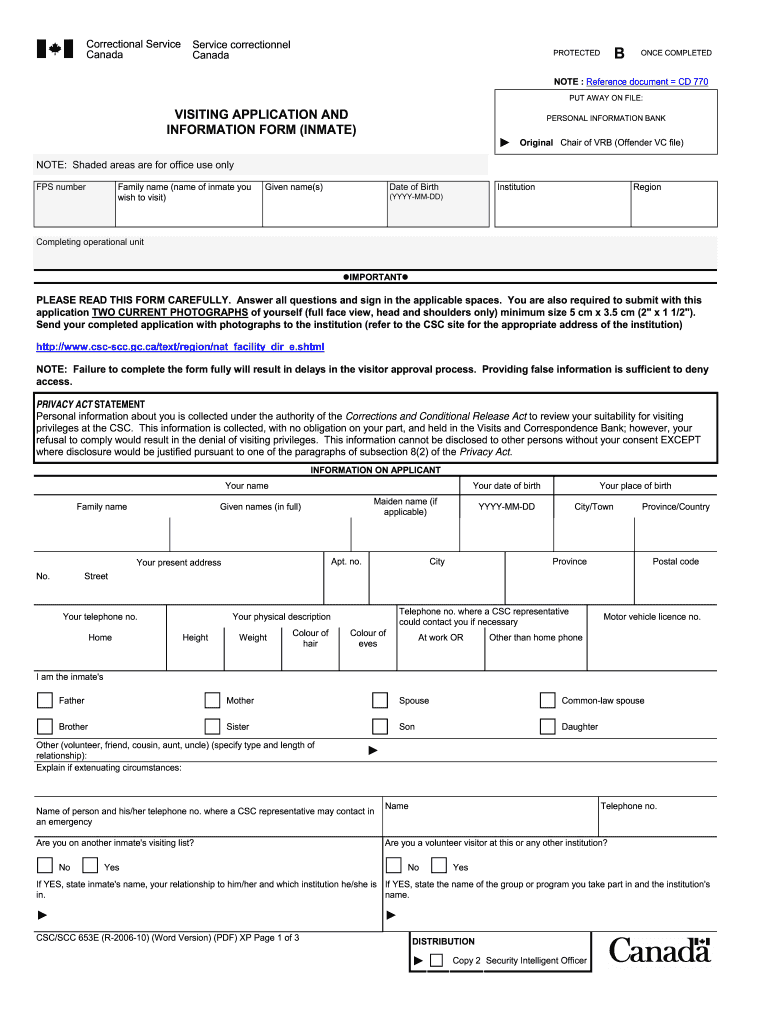
Correctional Service Canada Service correctionnel Canada B PROTECTED ONCE COMPLETED NOTE : Reference document CD 770 PUT AWAY ON FILE: VISITING APPLICATION AND INFORMATION FORM (INMATE) PERSONAL INFORMATION.
Loading

Open form follow the instructions

Easily sign the form with your finger

Send filled & signed form or save
How to use or fill out the Canada CSC/SCC 0653E (Formerly CSC/SCC 653E) online
Filling out the Canada CSC/SCC 0653E form online is an important step in applying for visiting privileges for an inmate in Canada. This guide will provide you with step-by-step instructions to ensure that you complete the form accurately and efficiently.
Follow the steps to complete your application successfully.
- Click ‘Get Form’ button to obtain the form and open it in the editing interface.
- Begin by filling in the personal information fields including your name, date of birth, and current address. Be sure to include your family name, given names, street address, city, province, and postal code.
- Provide your contact details, including your home telephone number and any alternate contact number, ensuring to indicate which number is preferred for communicating with a representative.
- Complete the physical description section by adding your height, weight, hair color, and eye color.
- Identify your relationship to the inmate by selecting the appropriate option such as father, mother, spouse, or any other relevant category.
- If applicable, mention if you are on another inmate's visiting list and provide their name and contact number.
- Address any past criminal offences by responding truthfully about prior convictions or outstanding charges.
- Read the acknowledgment and consent section carefully, then sign and date the application to confirm the accuracy of the information provided.
- Attach two current photographs of yourself, following the size requirements (minimum size of 5 cm x 3.5 cm) as specified.
- Once the form is fully completed, save your changes, then download or print the document for submission. Ensure to share it with the relevant institution as instructed.
Complete your documents online today to streamline your visiting application process.
Experience a faster way to fill out and sign forms on the web. Access the most extensive library of templates available.
Get answers to your most pressing questions about US Legal Forms API.
How many institutions are there in Canada?
In total, there are approximately 150 correctional institutions in Canada, encompassing federal, provincial, and territorial facilities. These institutions vary in terms of security levels and functions. The Canada CSC/SCC 0653E (Formerly CSC/SCC 653E) framework is essential for maintaining standards and ensuring the proper management of all offender programs across these institutions.
How many maximum security prisons are there in Canada?
Canada has a network of five maximum security prisons under the umbrella of CSC. These facilities house the most dangerous offenders and offer heightened security measures. The Canada CSC/SCC 0653E (Formerly CSC/SCC 653E) plays a critical role in determining operational strategies, ensuring the safety of both staff and inmates.
How many CSC institutions are there in Canada?
Currently, Canada hosts 43 correctional institutions managed by CSC. These institutions vary in security levels and are designed to accommodate the varying needs of offenders. The Canada CSC/SCC 0653E (Formerly CSC/SCC 653E) serves as a framework that encompasses the various operations within these facilities, promoting effective rehabilitation.
What does CSC stand for in Canada?
In Canada, CSC stands for Correctional Service Canada. This agency is responsible for the administration of sentences for federal offenders and plays a crucial role in ensuring public safety. With the Canada CSC/SCC 0653E (Formerly CSC/SCC 653E) guidelines, the CSC strives to foster community reintegration and reduce recidivism rates.
How many civil servants are there in Canada?
As of recent data, there are approximately 300,000 civil servants in Canada. These professionals play a vital role in implementing government policies and delivering public services. The work environment supports a culture of accountability and excellence, contributing to the overall effectiveness of Canada CSC/SCC 0653E (Formerly CSC/SCC 653E) initiatives.
What is the CSC in Canada?
The Correctional Service Canada (CSC) oversees federal offenders and manages rehabilitation efforts for inmates. The Canada CSC/SCC 0653E (Formerly CSC/SCC 653E) is a key document in this process, guiding procedures and policies. This ensures that offenders receive the necessary support for reintegration into society, which benefits both the individuals and the community.
Are conjugal visits allowed in Canada?
Conjugal visits are permitted in some Canadian correctional facilities, primarily to support family ties and personal relationships. This policy is strategically designed to enhance the rehabilitation process. The guidelines for visits are outlined in the Canada CSC/SCC 0653E (Formerly CSC/SCC 653E), which emphasizes the importance of maintaining family connections for inmates. Such provisions contribute to inmates' emotional well-being and successful reintegration.
How do I visit a correctional service in Canada?
Visiting a correctional service in Canada involves several steps, including applying for visitor approval and understanding facility rules. You'll need to provide identification and details about the inmate you intend to visit. It’s advisable to review the specific visiting hours and protocols for the correctional institution beforehand. For further assistance, utilize platforms offering guidance on the Canada CSC/SCC 0653E (Formerly CSC/SCC 653E), ensuring a smooth visiting experience.
How do I contact an inmate in Canada?
To contact an inmate in Canada, you can send mail directly to the correctional facility where the inmate resides. Ensure you include the inmate’s full name and identification number on the envelope. Additionally, many facilities offer phone services where inmates can make calls to pre-approved numbers. For seamless communication, review guidelines related to the Canada CSC/SCC 0653E (Formerly CSC/SCC 653E) on the official correctional service website.
What are the three types of correctional facilities in Canada?
In Canada, correctional facilities are divided into three main types: federal, provincial, and territorial institutions. Federal facilities house inmates serving sentences of over two years, while provincial and territorial facilities accommodate those serving shorter sentences. Each facility type has distinct programs and services tailored to inmates' needs. Understanding these differences is crucial when navigating the Canada CSC/SCC 0653E (Formerly CSC/SCC 653E) framework.
Use professional pre-built templates to fill in and sign documents online faster. Get access to thousands of forms.
If you believe that this page should be taken down, please follow our DMCA take down process here.
This form is available in several versions. Select the version you need from the drop-down list below.