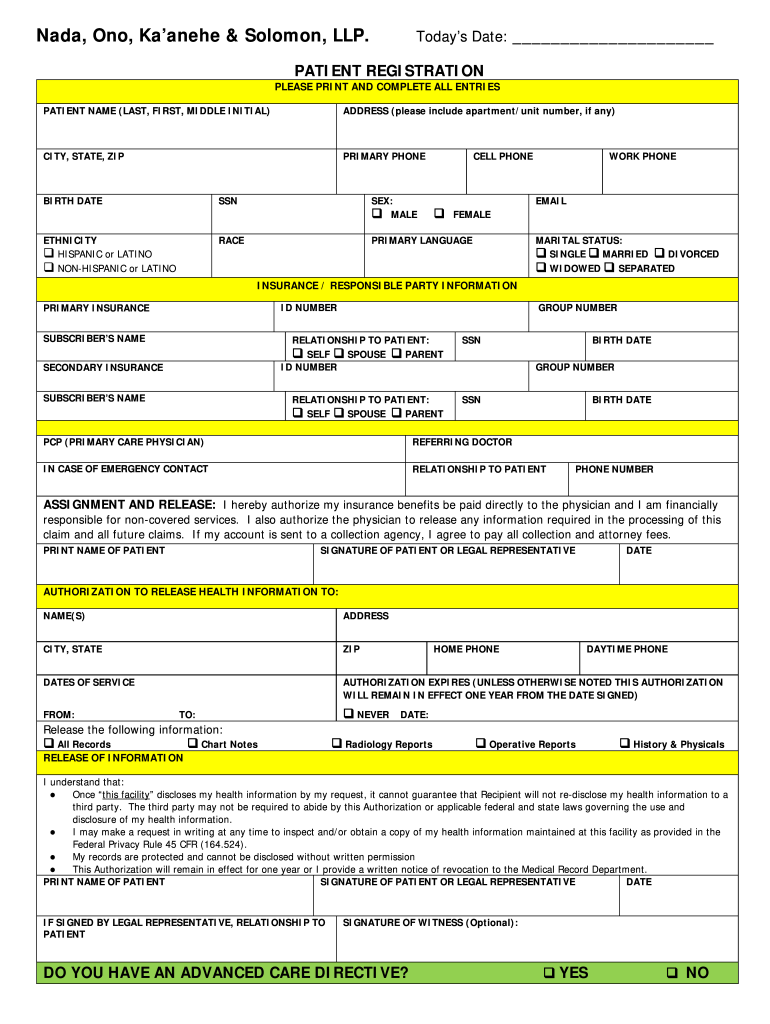
Include apartment/unit number, if any) CITY, STATE, ZIP PRIMARY PHONE CELL PHONE BIRTH DATE SSN SEX: MALE ETHNICITY RACE PRIMARY LANGUAGE HISPANIC or LATINO NON-HISPANIC or LATINO FEMALE WORK PHONE EMAIL MARITAL STATUS: SINGLE MARRIED DIVORCED WIDOWED SEPARATED INSURANCE / RESPONSIBLE PARTY INFORMATION PRIMARY INSURANCE ID NUMBER SUBSCRIBER S NAME RELATIONSHIP TO PATIENT: SELF SPOUSE PARENT ID NUMBER SSN RELATIONSHIP TO PATI.
Loading

Open form follow the instructions

Easily sign the form with your finger

Send filled & signed form or save
How to fill out the HI Kidney Specialists Patient Registration online
Filling out the HI Kidney Specialists Patient Registration form online is a crucial step in ensuring you receive the best care possible. This guide will provide you with a clear and supportive approach to completing each section of the form, making the process straightforward and efficient.
Follow the steps to successfully complete your patient registration.
- Press the ‘Get Form’ button to obtain the patient registration form and open it in the designated online editor.
- Begin by entering your name in the format of last name, first name, and middle initial in the 'Patient Name' section.
- Provide your complete address, including the apartment or unit number if applicable, in the 'Address' section, followed by your city, state, and ZIP code.
- Enter your primary phone number and additional contact information, including a cell phone and work phone if available.
- Fill in your date of birth using the format requested and your Social Security Number (SSN) for identification purposes.
- Indicate your sex by selecting the corresponding option. Ensure you include your ethnicity, race, and primary language next.
- Fill out your email address and marital status by checking the relevant box for single, married, divorced, widowed, or separated.
- Provide details regarding your primary insurance, including the insurance provider, ID number, subscriber’s name, and their relationship to you. Repeat the process for any secondary insurance.
- Complete the emergency contact section by providing the name, relationship, and phone number of the person to contact in case of an emergency.
- Review the assignment and release information, printing your name, signing the document, and entering the date to authorize insurance payments and release of medical information.
- Complete any additional sections relating to medical history, medications, allergies, and preferred pharmacy and laboratory.
- Finish by reviewing your entries for accuracy. You may then save changes, download, print, or share the completed form as needed.
Complete your HI Kidney Specialists Patient Registration form online today to ensure prompt and effective care.
Experience a faster way to fill out and sign forms on the web. Access the most extensive library of templates available.
Related content
by G Rosa-Diez · 2021 · Cited by 25 — A kidney replacement therapy registry (KRTR) is...
The Division of Pediatric Nephrology at Children's Mercy provides family-centered care for...
This transmittal introduces Chapter 40, Hospital and Hospital Health Care Complex Cost...
Get answers to your most pressing questions about US Legal Forms API.
Which Dr is best for kidney?
A nephrologist is the best doctor to treat you if you have a condition that affects your kidneys or kidney function. A urologist is a doctor who specializes in diagnosing and treating conditions that affect your urinary system. Your urinary system includes your bladder, urethra, ureters and kidneys.
How long can a person live with stage 3 kidney disease?
Stage 3 kidney disease means that the kidney's function has been cut by half, and most patients experience ancillary problems like high blood pressure or bone difficulties. A survey of 13 studies on stage 3 kidney disease found that the all-cause mortality rate varied from 6% in 3 years to 51% in ten years.
What is the first stage of kidney failure?
In Stage 1 CKD, the damage to your kidneys is mild. Your kidneys are still working well, but you may have signs of kidney damage or physical damage to your kidneys. Stage 1 CKD means you have a normal estimated glomerular filtration rate (eGFR) of 90 or greater, but there is protein in your urine (i.e., your pee).
What is stage 3 kidney disease?
What is Stage 3 CKD? In Stage 3 CKD, your kidneys have mild to moderate damage, and they are less able to filter waste and fluid out of your blood.
How do you treat stage 3 kidney disease?
Treatment for stage 3 chronic kidney disease Drugs such as Angiotensin-converting enzyme (ACE) inhibitors, Angiotensin-receptor blockers (ARBs) and now sodium-glucose cotransporter-2 (SGLT-2) inhibitors are effective at reducing further kidney damage and slowing down the progression of CKD.
Can you slow down stage 3 kidney disease?
A stage 3 kidney disease diagnosis doesn't necessarily mean that your condition will progress to stage 4 or stage 5. With lifestyle changes and a treatment plan from your doctor, it's possible to slow the progression of CKD and preserve kidney function.
What does stage 1 kidney disease feel like?
Typically, there are no symptoms associated with stage 1 CKD. If symptoms are present, they are most likely related to the type of kidney damage you have. For example, if you have albuminuria, you may notice foamy urine.
Use professional pre-built templates to fill in and sign documents online faster. Get access to thousands of forms.
If you believe that this page should be taken down, please follow our DMCA take down process here.