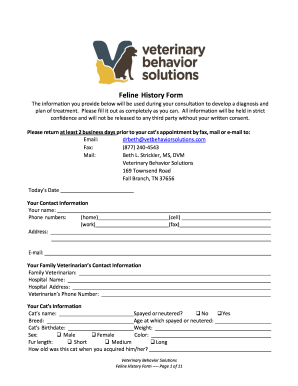
Will be held in strict confidence and will not be released to any third party without your written consent. Please return at least 2 business days prior to your cat s appointment by fax, mail or e mail to: Email: drbeth vetbehaviorsolutions.com Fax: (877) 240-4543 Mail: Beth L. Strickler, MS, DVM Veterinary Behavior Solutions 169 Townsend Road Fall Branch, TN 37656 Today s Date Your Contact Information Your name: Phone numbers: (home) (work) Address: (cell) (fax) E mail: Your Family V.
Open form follow the instructions
Easily sign the form with your finger
Send filled & signed form or save
How to fill out the TN Veterinary Behavior Solutions Feline History Form online
Filling out the TN Veterinary Behavior Solutions Feline History Form is an essential step in providing comprehensive information about your cat’s history and behavior. This guide will help you navigate each section of the form online, ensuring a complete and accurate submission for your consultation.
Follow the steps to successfully complete the feline history form online:
- Press the ‘Get Form’ button to access the form and open it in your chosen document editor.
- Begin by entering today’s date at the top of the form.
- Provide your contact information, including your name, phone numbers (home, work, cell, and fax), mailing address, and email.
- Next, fill in your family veterinarian’s contact details, including their name, hospital name, address, and phone number.
- In the section for your cat's information, input their name, whether they are spayed or neutered, breed, age at spay/neuter, birthdate, weight, sex, color, and fur length.
- Indicate how old your cat was when you acquired them and where you got them from (shelter, breeder, friend, etc.). Also, state how long you have owned your cat.
- Describe any surgical procedures, such as declawing or tendonectomizing, including the age at which it happened and any medications given post-surgery.
- Discuss your previous experience with cats and the reason for obtaining your current cat.
- In the behavior history section, clearly describe the main behavioral problem, its frequency, seriousness, and previous incidents.
- Provide details regarding your cat’s medical history, current medications or special diets, and a list of vaccines received.
- Describe your cat’s environment, including the number of household members, type of home, and any recent changes in the household.
- Discuss the type of diet and feeding routines, including any dietary changes that have occurred.
- Detail your cat's daily routine, including sleeping habits, exercise, and types of toys.
- Provide information about other animals in the household, and your cat's interactions and relationships with these animals and the people in your home.
- If applicable, complete the elimination behavior section regarding your cat's litter box habits.
- Once all required fields are filled out and reviewed for accuracy, save your changes, and prepare to download, print, or email the completed form as needed.
Complete your feline history form online today to ensure your cat receives the best possible care!
Experience a faster way to fill out and sign forms on the web. Access the most extensive library of templates available.
Related content
Aug 14, 2024 — DeCaire stated she owned her own feline animal hospital and served as an...
Behavior. Behavior History Form – Avian · Behavior History Form – Canine · Behavior...
The ATSDR toxicological profile succinctly characterizes the toxicologic and adverse...
Get answers to your most pressing questions about US Legal Forms API.
What is the behavioral assessment for cats?
A behavioral assessment for cats involves evaluating their behavior in various contexts to identify issues and formulate solutions. This can include observing a cat's interactions, preferences, and reactions to different stimuli. Utilizing the TN Veterinary Behavior Solutions Feline History Form plays a crucial role in systematically gathering the cat's history, leading to more effective assessments.
What is the #1 behavioral complaint from cat owners?
The most common behavioral complaint among cat owners is inappropriate elimination, where cats urinate or defecate outside of their litter box. This issue can stem from multiple factors, including stress or medical problems. Utilizing the TN Veterinary Behavior Solutions Feline History Form allows you to identify patterns and address the underlying causes effectively.
What degree is needed for animal behaviorists?
Most animal behaviorists hold a bachelor's degree in animal science, psychology, or a related discipline. Advanced degrees, such as a master's or PhD, can provide additional expertise and career opportunities. Understanding feline behavior through practical tools, like the TN Veterinary Behavior Solutions Feline History Form, can markedly benefit your educational journey.
What qualifications do I need to be an animal behaviourist?
To work as an animal behaviourist, you generally need a degree in animal science or a related field. Additional certifications from recognized organizations can enhance your credentials and show your dedication to the field. Completing the TN Veterinary Behavior Solutions Feline History Form may help you reflect on your qualifications and areas for improvement.
How long does it take to become a cat behaviorist?
The journey to becoming a cat behaviorist can vary, typically taking anywhere from several months to a few years depending on your educational choices. Engaging in workshops, courses, and practical experience with actual cats facilitates this process. Utilize resources like the TN Veterinary Behavior Solutions Feline History Form to navigate your progress.
How to become a certified cat behaviorist?
Becoming a certified cat behaviorist requires a combination of education and hands-on experience. Most paths include completing a recognized training program and passing an examination focused on feline behavior principles. You can prepare effectively using tools such as the TN Veterinary Behavior Solutions Feline History Form to gather necessary insights and knowledge.
What tests do cats need yearly?
Cats typically need an annual wellness exam, which includes routine blood work, vaccinations, and possibly a dental checkup. Depending on your cat's age and health history, your veterinarian may recommend additional tests to ensure their well-being. Utilizing the TN Veterinary Behavior Solutions Feline History Form can help track these health needs effectively.
How to become a feline behaviourist?
To become a feline behaviourist, start by understanding feline behavior and body language. Gain practical experience by working with cats in shelters or clinics. You may consider completing courses or workshops specific to feline behavior, which can be facilitated through resources like the TN Veterinary Behavior Solutions Feline History Form.
What is a red flag behavior in cats?
Red flag behaviors in cats include extreme aggression, excessive hiding, or sudden changes in eating or grooming habits. These signs can indicate underlying health issues or significant stress. If you notice any of these behaviors, using the TN Veterinary Behavior Solutions Feline History Form can help you document the changes, making it easier for professionals to evaluate your cat's situation.
What is the most common behavioral issue in cats?
The most common behavioral issue in cats is inappropriate elimination, which often means urinating or defecating outside the litter box. This behavior can stem from stress, medical problems, or litter box aversion. The TN Veterinary Behavior Solutions Feline History Form can assist you in documenting any changes in your cat's litter habits, helping professionals develop a tailored approach to resolve the issue.
Use professional pre-built templates to fill in and sign documents online faster. Get access to thousands of forms.
If you believe that this page should be taken down, please follow our DMCA take down process here.