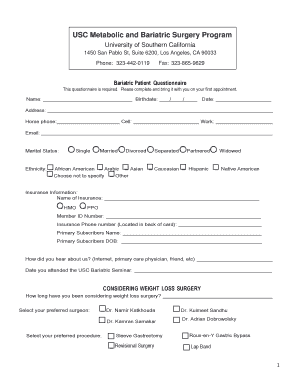
Ire This questionnaire is required. Please complete and bring it with you on your first appointment. Name: Birthdate: / / Date: Address: Home phone: Cell: Work: Email: Marital Status: Ethnicity: Single Married Divorced African American Arabic Asian Choose not to specify Other Separated Partnered Caucasian Hispanic Widowed Native American Insurance Information: Name of Insurance: HMO PPO Member ID Number: Insurance Phone number (Located in back of card): Primary Subscribers.
Open form follow the instructions
Easily sign the form with your finger
Send filled & signed form or save
How to fill out the USC Metabolic And Bariatric Surgery Program Bariatric Patient Questionnaire online
The USC Metabolic And Bariatric Surgery Program Bariatric Patient Questionnaire is a vital document that helps medical professionals understand your health and prepare for your weight loss surgery. This guide provides step-by-step instructions on how to complete this questionnaire online accurately and efficiently.
Follow the steps to successfully complete the questionnaire.
- Click ‘Get Form’ button to obtain the form and open it in your editor.
- Begin by entering your personal details such as your name, birthdate, address, and contact information in the designated fields.
- Provide your marital status and ethnicity by selecting from the available options.
- Fill in your insurance information, including the name of your insurance provider, member ID, and primary subscriber details.
- Indicate how you heard about the program and the date you attended the USC Bariatric Seminar.
- Answer the questions regarding your weight loss surgery considerations, preferred surgeon, and surgical procedure.
- Document your diet history by listing previous diet programs you have tried and any methods used for weight control.
- Record your weight history and significant personal events that may have influenced your weight over the years.
- Complete the section on food habits by detailing your consumption of beverages, meals, snacks, and any other dietary practices.
- List your surgical history, including types of procedures and any complications experienced.
- Provide any hospitalizations and medication histories, including medications taken and allergies.
- Detail your medical history, including any neurological, cardiac, pulmonary, endocrine, gastrointestinal, and psychiatric issues.
- Answer questions related to your social habits and exercise routines.
- Include family history concerning any hereditary health issues and review of symptoms you may currently experience.
- Finish by signing the document, ensuring that all information is accurate, and save, download, print, or share the completed form as needed.
Complete your USC Metabolic And Bariatric Surgery Program Bariatric Patient Questionnaire online today for a smoother appointment process.
Experience a faster way to fill out and sign forms on the web. Access the most extensive library of templates available.
Related content
by T Jiang · 2024 · Cited by 3 — The main aim of this study was to analyse the unique...
Gastric Sleeve Surgery (Our surgeons offer laparoscopic sleeve gastrectomy to help you...
Two examples are the Patient Health Questionnaire-9 (PHQ-9) and the ... Surgical Site...
Get answers to your most pressing questions about US Legal Forms API.
What does ASMBS stand for?
ASMBS stands for the American Society for Metabolic and Bariatric Surgery. This organization is dedicated to advancing the field of metabolic and bariatric surgery through research, education, and advocacy. Aligning with programs like the USC Metabolic And Bariatric Surgery Program means you benefit from the latest advancements and guidelines established by ASMBS.
What is mbsaqip?
MBSAQIP stands for the Metabolic and Bariatric Surgery Accreditation and Quality Improvement Program. This program accredits bariatric surgery centers and focuses on improving the quality of care for patients. Facilities like USC Metabolic And Bariatric Surgery Program that are accredited by MBSAQIP demonstrate a commitment to adhering to high standards and improving surgical outcomes.
What questions should I ask before bariatric surgery?
Before bariatric surgery, you should ask about the surgeon's experience, the types of procedures offered, and the expected outcomes. Inquire about the USC Metabolic And Bariatric Surgery Program's support services, such as nutrition counseling and follow-up care. Understanding the commitment required post-surgery will help you prepare adequately.
What is the 30 30 rule for bariatric surgery?
The 30 30 rule refers to the recommendation that patients should wait at least 30 days before and after surgery to avoid significant weight loss or gain. This ensures that patients are stable and can benefit fully from the surgical procedure. Adhering to guidelines set by programs such as USC Metabolic And Bariatric Surgery Program is crucial for achieving lasting success.
What is the mbsaqip database?
The MBSAQIP database, or Metabolic and Bariatric Surgery Accreditation and Quality Improvement Program database, collects and analyzes data regarding bariatric surgeries. This database supports quality improvement initiatives and tracks patient outcomes. Programs like USC Metabolic And Bariatric Surgery rely on such data to ensure adherence to best practices and deliver the highest standard of care.
What is the CDC database system?
The CDC database system is a comprehensive repository that tracks health statistics and disease data in the United States. It aids in public health research and policy-making. It plays a vital role in understanding obesity trends, which can inform programs like the USC Metabolic And Bariatric Surgery Program by providing vital data.
Who is the best bariatric surgeon in the world?
Identifying the best bariatric surgeon can be subjective, as it depends on individual needs and experiences. However, many surgeons affiliated with leading programs, like USC Metabolic And Bariatric Surgery Program, are highly regarded in the field. It’s important to research credentials, reviews, and outcomes for surgeons in your area to find the right fit for your journey.
How to qualify for bariatric surgery?
To qualify for bariatric surgery, you typically need to have a body mass index (BMI) of 40 or higher, or a BMI of 35 with obesity-related health conditions. Most programs, including the USC Metabolic And Bariatric Surgery Program, require you to undergo a comprehensive evaluation, including medical assessments and psychological evaluations. Your commitment to long-term lifestyle changes is essential for a successful outcome.
What criteria qualifies a patient for bariatric surgery?
Qualifying criteria for bariatric surgery typically include a body mass index (BMI) over 40, failure of previous weight loss attempts, and associated health conditions. Patients must also demonstrate readiness for significant lifestyle changes post-surgery. Filling out the USC Metabolic And Bariatric Surgery Program Bariatric Patient Questionnaire thoroughly can support your qualification process.
What questions are asked during psych evaluation for bariatric surgery?
During a psych evaluation for bariatric surgery, questions typically focus on mental health history, motivation for surgery, and coping strategies. Evaluators may inquire about your support system and readiness for post-surgery lifestyle changes. These insights greatly contribute to your responses in the USC Metabolic And Bariatric Surgery Program Bariatric Patient Questionnaire.
Use professional pre-built templates to fill in and sign documents online faster. Get access to thousands of forms.
If you believe that this page should be taken down, please follow our DMCA take down process here.