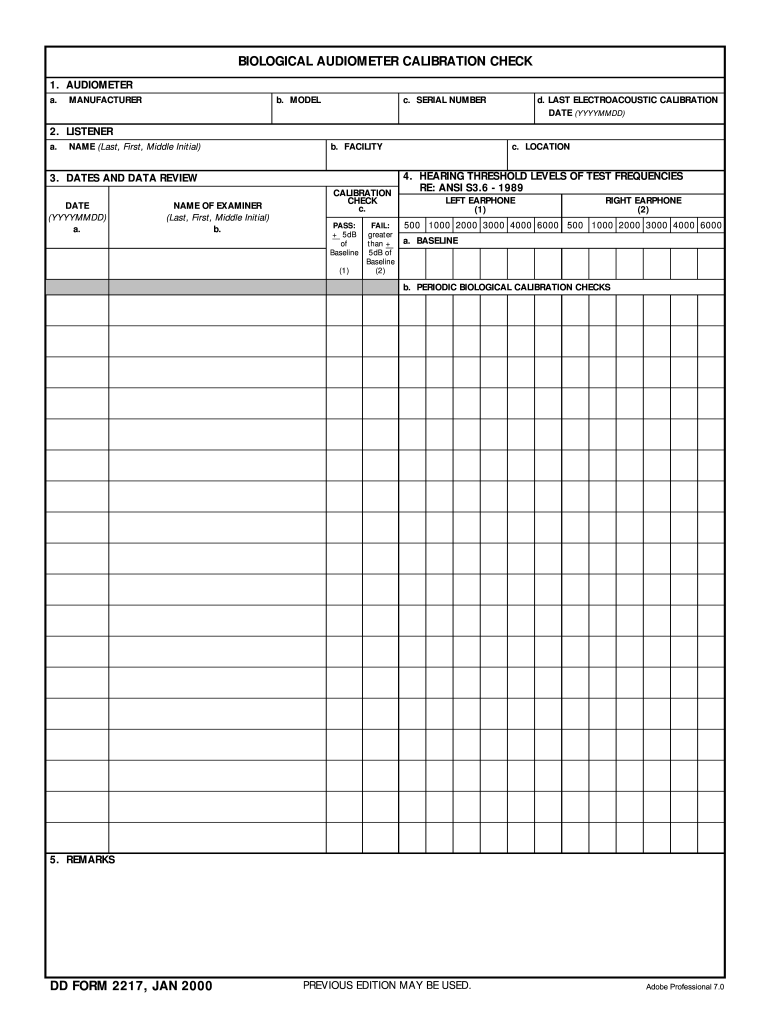
T test results in increments of 5 dB (e.g., 0, 5, 10, 15, etc.). b. Periodic Biological Calibration Checks. Enter hearing threshold levels in increments of 5 dB. Use a separate line for each calibration check. 3. DATES AND DATA REVIEW. a. Date. Enter year, month, and day (see Item 1.d.) of each biological calibration check. b. Name of Examiner. Enter surname, given name and middle initial of individual operating audiometer. DD FORM 2217 (BACK), JAN 2000 5. REMARKS. Enter any comments pertaini.
Loading

Open form follow the instructions

Easily sign the form with your finger

Send filled & signed form or save
How to fill out the audiometer calibration forms online
Filling out the audiometer calibration forms online can ensure accurate and efficient documentation of audiometric tests. This guide provides a step-by-step approach to completing the form, making the process accessible for all users.
Follow the steps to accurately fill out the audiometer calibration forms online.
- Click ‘Get Form’ button to access the audiometer calibration form and open it in your preferred editor.
- In the first section labeled 'Audiometer', enter details including the manufacturer, model, serial number, and the date of the last electroacoustic calibration using the format YYYYMMDD.
- Proceed to the 'Listener' section, where you need to fill in the name of the individual testing (last, first, middle initial) and the facility where the test is conducted.
- In the 'Dates and Data Review' area, input the date of each calibration check performed. Record the name of the examiner responsible for conducting the checks.
- Mark the appropriate box under 'Calibration Check' to indicate whether the calibration passed or failed. Remember that a pass means the results are within +5 dB of the baseline for the specified frequencies.
- In the next section titled 'Hearing Threshold Levels of Test Frequencies,' record the baseline hearing threshold levels and the periodic biological calibration thresholds for both the left and right earphones across the specified test frequencies.
- Lastly, complete the 'Remarks' section with any observations related to signal distortions or noise transients, including additional information about the location of the audiometer.
- Once all fields are completed, you can save changes, download the form for your records, print it, or share it as needed.
Complete your audiometer calibration forms online efficiently and accurately today!
Experience a faster way to fill out and sign forms on the web. Access the most extensive library of templates available.
Related content
Each month an audiometer is in use, a biological calibration is required. ... A copy of...
Oct 8, 1997 — Deviations of more than 10 decibels require an acoustic calibration...
The length of time that an audiometer should be operated before re-calibration varies...
Get answers to your most pressing questions about US Legal Forms API.
How to do calibration of audiometer?
To calibrate an audiometer, begin by using a sound level meter to measure its output at different frequencies. Make necessary adjustments until it matches the required standards. Keep thorough records of each calibration session using Audiometer Calibration Forms, as these documents provide valuable proof of compliance and performance over time.
How is an audiometer calibrated?
Calibrating an audiometer involves using a sound level meter to check the output at predefined frequencies. Adjustments are then made to ensure that the audiometer meets the required standards. Following a structured process is vital, and employing Audiometer Calibration Forms can facilitate the documentation of each step taken, ensuring lasting accuracy.
How often do audiometers need to be calibrated?
The frequency of audiometer calibration often depends on usage and regulatory standards. Generally, an annual calibration is advisable for most devices. If your audiometer undergoes frequent use or is subjected to environmental changes, consider calibrating it more often to maintain accuracy. Implementing Audiometer Calibration Forms aids in tracking these calibration intervals systematically.
How often should an audiometer be calibrated?
Audiometers should typically be calibrated annually to ensure continued accuracy and compliance with standards. However, certain scenarios may require more frequent calibration, such as heavy usage or if the device has been transported. Regular calibration does not just guarantee compliance; it also enhances the reliability of hearing test results. Using Audiometer Calibration Forms can help keep track of calibration schedules and documents.
What is exhaustive calibration?
Exhaustive calibration refers to a thorough, comprehensive testing process where each frequency and intensity level is measured and verified. This process ensures that the audiometer performs accurately across its entire range. It's crucial for compliance with industry regulations and ensures reliability in hearing assessments. Documenting this process using Audiometer Calibration Forms provides a formal record that can be referenced later.
How to do sound calibration?
Sound calibration involves verifying that the audio output of the audiometer meets recognized standards. Start by using a sound level meter to measure outputs at various frequencies. Adjust the audiometer settings as necessary to ensure compliance with the specifications. Utilizing Audiometer Calibration Forms helps maintain a clear record of the adjustments made during the calibration process.
How do you perform a calibration procedure?
To conduct a calibration procedure for audiometers, first gather the necessary equipment, including an audiometer and a calibrator. Set the audiometer to the specific frequencies and intensities required. Then, adjust the audiometer until it produces accurate results according to established standards. Utilizing Audiometer Calibration Forms can streamline this process, ensuring all steps are documented clearly.
What is the biological calibration of audiometer?
Biological calibration of an audiometer involves using human subjects to confirm that the auditory levels produced are consistent with human perception. This process is important for assessing how well audiometers function in real-world environments. Maintaining proper Audiometer Calibration Forms is crucial for tracking these tests and ensuring the audiometer operates correctly.
What are the audiometer calibrations necessary for OSHA compliance?
Deviations of 10 decibels or greater require an acoustic calibration. Audiometer calibration shall be checked acoustically at least annually in ance with appendix E: Acoustic Calibration of Audiometers. Test frequencies below 500 Hz and above 6000 Hz may be omitted from this check. 1910.95 - Occupational noise exposure. - OSHA osha.gov https://.osha.gov › regulations › standardnumber osha.gov https://.osha.gov › regulations › standardnumber
How much does it cost to calibrate an audiometer?
MacGill® will also calibrate, to ANSI standards, audiometers you already own, regardless of where and when they were purchased. Simply fill out the form below and ship it to us along with your audiometer. The price is $85 per unit, which includes the cost of shipping the audiometer back to you.
Use professional pre-built templates to fill in and sign documents online faster. Get access to thousands of forms.
If you believe that this page should be taken down, please follow our DMCA take down process here.