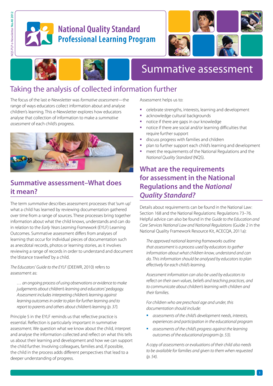
NQS PLP eNewsletter No.40 2012 Summative assessment Taking the analysis of collected information further The focus of the last eNewsletter was formative assessmentthe range of ways educators collect.

How it works
  • Open form

    Open form follow the instructions

  • Easily sign form

    Easily sign the form with your finger

  • Share form

    Send filled & signed form or save

How to fill out the Nqs Plp E Newsletter online

This guide provides a comprehensive overview of how to effectively complete the Nqs Plp E Newsletter online. With clear instructions and supportive language, users will learn to navigate the form easily and accurately.

Follow the steps to fill out the Nqs Plp E Newsletter form online.

  1. Click the ‘Get Form’ button to obtain the form and open it in your preferred editing platform.
  2. Read through the introductory section to understand the purpose of the newsletter and what the summative assessment entails.
  3. Fill in any required personal information at the beginning of the form, such as your name, position, and the date of assessment.
  4. In each section, carefully enter observations and evaluations about the children's learning, referring to the Early Years Learning Framework (EYLF) Learning Outcomes.
  5. Utilize the summarization areas to compile key insights into each child's strengths, interests, and areas for further support, noting cultural backgrounds when possible.
  6. Review and reflect on the collected documentation. This reflection is crucial for a comprehensive summative assessment.
  7. Once all information is complete, make necessary adjustments if needed, then save your changes.
  8. Finally, download, print, or share the completed form as required.

Start filling out the Nqs Plp E Newsletter online today to streamline your assessment process.

Get form

Experience a faster way to fill out and sign forms on the web. Access the most extensive library of templates available.

Related content

The quality of physical environments in education...

Apr 4, 2017 — 4 Early Childhood Australia, An environment for learning, National Quality...

Learn more
(PDF) NQS PLP E Newsletter No48

This newsletter discusses the holistic nature of children's learning as outlined in the...

Learn more
Questions & Answers

Get answers to your most pressing questions about US Legal Forms API.

Contact support

What does element 1.2 2 of the NQS aim to achieve?

The aim of Quality Area 2 under the National Quality Standard is to safeguard and promote children's health and safety, minimise risks and protect children from harm, injury and infection.

1.1. 2 Child-centred Each child's current knowledge, strengths, ideas, culture, abilities and interests are the foundation of the program. 1.1. 3 Program learning opportunities All aspects of the program, including routines, are organised in ways that maximise opportunities for each child's learning.

Aim of Element 1.1. 1 is to ensure that an approved learning framework guides the development of the curriculum at an education and care service and supports curriculum decision-making as an ongoing cycle of observation, analysing learning, documentation, planning, implementation and reflection.

Educational program and practiceElement 1.1.1Approved learning frameworkElement 1.1.2Child-centredElement 1.1.3Program learning opportunitiesStandard 1.2Practice8 more rows

One of the simplest ways to stay current is to regularly read information from the industry's top minds and organizations dedicated to early childhood education. Schedule time each week to review your favorite resources and share and discuss any new information that interests you with your colleagues.

1.2. 1 Intentional teaching Educators are deliberate, purposeful, and thoughtful in their decisions and actions. 1.2. 2 Responsive teaching and scaffolding Educators respond to children's ideas and play and extend children's learning through open-ended questions, interactions and feedback.

1.1. 2 – Each child's current knowledge, strengths ideas, culture, abilities and interests are the foundation of the program. 1.1. 3 – All aspects of the program, including routine, are organized in wants that maximized opportunities for each child's learning.

The Framework puts children's learning at the core and comprises three inter-related elements: Principles, Practice and Learning Outcomes (see Figure 1). All three elements are fundamental to early childhood pedagogy and curriculum decision-making.

Get This Form Now!

Use professional pre-built templates to fill in and sign documents online faster. Get access to thousands of forms.

If you believe that this page should be taken down, please follow our DMCA take down process here.

Get Nqs Plp E Newsletter