Loading
Form preview
  • US Legal Forms
  • Form Library
  • More Forms
  • More Uncategorized Forms
  • Commonly Used Satiric Devices

Get Commonly Used Satiric Devices

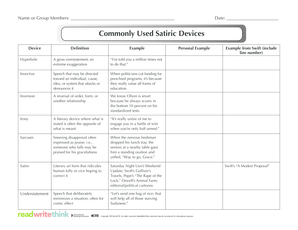
Name or Group Members: Date: Commonly Used Satiric Devices Device Definition Example Hyperbole A gross overstatement; an extreme exaggeration Speech that may be directed toward an individual, cause,.

How it works

  1. Open form

    Open form follow the instructions

  2. Easily sign form

    Easily sign the form with your finger

  3. Share form

    Send filled & signed form or save

How to fill out the Commonly Used Satiric Devices online

Filling out the Commonly Used Satiric Devices form is an essential task for understanding various satirical techniques. This guide provides a comprehensive overview of each component of the form, ensuring that users can navigate it with ease.

Follow the steps to complete the form effortlessly.

  1. Click ‘Get Form’ button to access the document and open it in your editor of choice.
  2. Begin by entering your name or the names of group members in the designated field. This identifies the contributors to your analysis.
  3. Next, fill in the date in the specified section. Ensure you use the correct format to maintain consistency.
  4. Proceed to the section labeled 'Commonly Used Satiric Devices.' For each device, provide a definition, an example, and if applicable, a personal example related to the work of Jonathan Swift, including line numbers where needed.
  5. After completing all sections of the form, review your entries for accuracy and clarity. Make any necessary adjustments.
  6. Once you are satisfied with the content, you can save changes, download the document, print it, or share it as needed.

Start filling out your documents online today for a streamlined experience.

Get form

Experience a faster way to fill out and sign forms on the web. Access the most extensive library of templates available.
Get form

Related content

What Is Satire In Literature
At its core, satire is a unique literary device that uses humor, irony, exaggeration, or...
Learn more
What is Satire? || Definition & Examples | College...
Satire is the art of making someone or something look ridiculous, raising laughter in...
Learn more
A Survey of Sign Lexicons and Finger Alphabets...
by L Bragg · 1997 · Cited by 57 — Visual-kinetic communication systems—ancient...
Learn more

Related links form

SOLICITUD DE TRANSFERENCIA INTERBANCARIA - Agility CMS Registered Radiologic Technologist Assistant - Entry Level Clinical Activities - 2014 - Track Publix Immunization Consent Form EXHIBIT 8 ESCROW FUNDS RECONCILIATION Borrower Name

Questions & Answers

Get answers to your most pressing questions about US Legal Forms API.

Contact support

Commonly used satiric devices in literature include irony, hyperbole, and sarcasm. Irony allows writers to convey a deeper message by presenting a situation in a contradictory light. Hyperbole enhances the absurdity of the subject, while sarcasm delivers sharp criticism, often highlighting societal flaws in a relatable manner.

The most common form of satire can be found in popular media, including television shows, blogs, and social media posts. Programs like 'Saturday Night Live' or 'The Daily Show' utilize humor to critique current events and cultural phenomena. This widespread accessibility opens the doors for conversations about important societal issues. Utilizing commonly used satiric devices helps make complex subjects relatable and understandable.

The four types of satire are horatian, juvenalian, menippean, and social satire. Horatian satire adopts a more playful tone, often gently mocking its subjects. Juvenalian satire, however, takes a harsher approach, expressing indignation and scorn. Menippean satire focuses on a more philosophical critique, blending various aspects of society, while social satire examines cultural norms and practices.

The four commonly used satiric devices include parody, irony, hyperbole, and juxtaposition. Each device plays a distinct role in crafting effective satire, from mimicking styles to exaggerating characteristics for comic effect. Parody imitates existing works to offer critique, while irony reveals truths hidden beneath surface meanings. Utilizing these devices collectively enhances the satirical message and engages the audience effectively.

Satire employs various literary devices, primarily irony, satire utilizes metaphor, simile, and caricature to enhance its critique. Irony, in particular, enables writers to present a stark contrast between appearance and reality, highlighting absurdities. By mixing these devices, authors can enrich their satirical work and provoke thoughtful discussion. This versatility contributes to the enduring appeal of satire in literature.

In novels, satire often employs a blend of narrative style, character development, and plot devices to critique society. Writers integrate humor and irony into their storytelling, using commonly used satiric devices to spark reflection on serious issues. This technique enables authors to hold a mirror to society while keeping readers engaged. The careful crafting of these elements creates a resonant experience for the audience.

The primary weapon in satire is humor, which disarms the audience and opens them up to critical thought. Through wit and clever phrasing, satirists can point out absurdities while entertaining their readers. Commonly used satiric devices like irony and exaggeration further sharpen this weapon. This interplay between humor and critique makes satire a powerful tool for social commentary.

Commonly used satiric devices incorporate irony, hyperbole, understatement, and social comment. These devices allow writers to craft powerful critiques of their subject matter. By employing these methods, satirists can create layers of meaning and facilitate a deeper understanding. Mastery of these devices enriches the satirical landscape and engages readers on multiple levels.

Satire is often found in various forms of composition, including essays, novels, articles, and dramatic works. Writers utilize satire to comment on societal norms, political systems, or human behavior within these formats. The underlying goal remains to provoke thought and inspire change. Understanding the versatile nature of satire allows writers to choose the right composition for their message.

Commonly used satiric devices include parody, caricature, and dark humor. Each technique serves a purpose in conveying criticism while engaging the audience. By analyzing the subject matter, writers can decide which technique best emphasizes their point. Engaging your readers through these techniques keeps the satire relevant and entertaining.

Get This Form Now!

Use professional pre-built templates to fill in and sign documents online faster. Get access to thousands of forms.
Get form
If you believe that this page should be taken down, please follow our DMCA take down processhere.

Industry-leading security and compliance

US Legal Forms protects your data by complying with industry-specific security standards.
  • In businnes since 1997
    25+ years providing professional legal documents.
  • Accredited business
    Guarantees that a business meets BBB accreditation standards in the US and Canada.
  • Secured by Braintree
    Validated Level 1 PCI DSS compliant payment gateway that accepts most major credit and debit card brands from across the globe.
Get Commonly Used Satiric Devices
Get form
  • Adoption
  • Bankruptcy
  • Contractors
  • Divorce
  • Home Sales
  • Employment
  • Identity Theft
  • Incorporation
  • Landlord Tenant
  • Living Trust
  • Name Change
  • Personal Planning
  • Small Business
  • Wills & Estates
  • Packages A-Z
  • Affidavits
  • Bankruptcy
  • Bill of Sale
  • Corporate - LLC
  • Divorce
  • Employment
  • Identity Theft
  • Internet Technology
  • Landlord Tenant
  • Living Wills
  • Name Change
  • Power of Attorney
  • Real Estate
  • Small Estates
  • Wills
  • All Forms
  • Forms A-Z
  • Form Library
  • Legal Hub
  • About Us
  • Help Portal
  • Legal Resources
  • Blog
  • Affiliates
  • Contact Us
  • Delete My Account
  • Site Map
  • Industries
  • Forms in Spanish
  • Localized Forms
  • State-specific Forms
  • Forms Kit
  • Real Estate Handbook
  • All Guides
  • Notarize
  • Incorporation services
  • For Consumers
  • For Small Business
  • For Attorneys
  • USLegal
  • FormsPass
  • pdfFiller
  • signNow
  • altaFlow
  • DocHub
  • Instapage
Form Packages
  • Adoption
  • Bankruptcy
  • Contractors
  • Divorce
  • Home Sales
  • Employment
  • Identity Theft
  • Incorporation
  • Landlord Tenant
  • Living Trust
  • Name Change
  • Personal Planning
  • Small Business
  • Wills & Estates
  • Packages A-Z
Form Categories
  • Affidavits
  • Bankruptcy
  • Bill of Sale
  • Corporate - LLC
  • Divorce
  • Employment
  • Identity Theft
  • Internet Technology
  • Landlord Tenant
  • Living Wills
  • Name Change
  • Power of Attorney
  • Real Estate
  • Small Estates
  • Wills
  • All Forms
  • Forms A-Z
  • Form Library
Customer Service
  • Legal Hub
  • About Us
  • Help Portal
  • Legal Resources
  • Blog
  • Affiliates
  • Contact Us
  • Delete My Account
  • Site Map
  • Industries
  • Forms in Spanish
  • Localized Forms
  • State-specific Forms
  • Forms Kit
Legal Guides
  • Real Estate Handbook
  • All Guides
Prepared for you
  • Notarize
  • Incorporation services
Our Customers
  • For Consumers
  • For Small Business
  • For Attorneys
Our Sites
  • USLegal
  • FormsPass
  • pdfFiller
  • signNow
  • altaFlow
  • DocHub
  • Instapage
Social Media
Call us now toll free:
+1 833 426 79 33
As seen in:
© Copyright 1999-2026 airSlate Legal Forms, Inc. 3720 Flowood Dr, Flowood, Mississippi 39232
  • Your Privacy Choices
  • Terms of Service
  • Privacy Notice
  • Content Takedown Policy
  • Bug Bounty Program