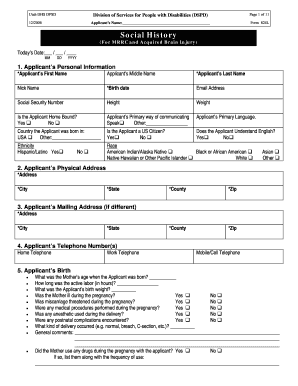
Utah DHS DPSD 12/2006 Division of Services for People with Disabilities (DSPD) Applicant's Name: Page 1 of 11 Form 824L Social History (For MRRC and Acquired Brain Injury) Today's Date: / / MM DD.
Open form follow the instructions
Easily sign the form with your finger
Send filled & signed form or save
How to fill out the Social History Update Form online
Completing the Social History Update Form online is a crucial step in ensuring comprehensive documentation for individuals seeking services. This guide provides clear and supportive instructions to help users accurately fill out the form, ensuring all necessary information is collected effectively.
Follow the steps to complete the Social History Update Form
- Click ‘Get Form’ button to access the Social History Update Form and open it in your preferred editing platform.
- Fill in the applicant’s personal information in the first section. This includes fields such as first name, last name, date of birth, social security number, primary communication method, and language. Ensure all required fields are marked with an asterisk (*) are completed.
- Provide the applicant’s physical address and, if different, their mailing address in the subsequent sections. Be meticulous with the details to ensure accurate location information.
- Indicate the applicant's telephone numbers, including home, work, and mobile/cell numbers. This information is essential for communication purposes.
- Complete sections regarding the applicant’s birth details, childhood milestones, education history, employment history, social adjustment, and significant health or psychological issues. Provide thorough responses to each question, as this information is critical for support services.
- Document any medications the applicant is currently taking, their respective reasons for use, and the prescribing professionals. Ensure all information is up to date.
- Fill out information regarding the applicant's family relationships, including parents, siblings, and other significant individuals. This offers insight into the applicant’s support network.
- Conclude by entering details regarding the applicant’s income, assistance received, and any impact from court orders. It is important to be thorough to reflect the applicant's overall situation.
- Once all information is accurately filled out, review the form for completeness and accuracy. Users may then save changes, download a copy, print the form, or share it as needed.
Complete the Social History Update Form online today to ensure comprehensive support and care for applicants.
Experience a faster way to fill out and sign forms on the web. Access the most extensive library of templates available.
Related content
For applicants 18 years and older Only (use back of form if needed): ... History of...
When did your communication problem first begin? What are your goals for your...
May 30, 2014 — The tool reviews patient ID, personal data, author identification...
Get answers to your most pressing questions about US Legal Forms API.
How to complete a social history?
Completing a social history involves using a Social History Update Form to record comprehensive details about a patient's background. Start by engaging in a conversation that addresses various aspects of the patient’s life, such as their home environment, work, and social activities. The insights gained will significantly aid healthcare providers in delivering effective and personalized care.
What questions are asked in a social history?
When filling out a Social History Update Form, expect questions that explore living conditions, education, support systems, and lifestyle choices. Common questions may include inquiries about substance use, relationships, and significant life events. Answering these questions provides a well-rounded view of the patient's life, essential for effective healthcare.
What is an example of social history?
An example of social history might include noting that a patient lives alone, has supportive family members, and works in a high-stress job. It could also detail their smoking habits and social network. Providing such information on a Social History Update Form allows healthcare providers to understand the patient's lifestyle, enabling a more personalized approach to their care.
How to write a social history of a patient?
To write a patient's social history, gather pertinent information using a Social History Update Form as your guide. Start by discussing the patient's current living arrangements, education, and job. Consider their cultural background and relationships, as these factors can considerably affect their overall well-being and healthcare outcomes.
What do you write in social history?
In a Social History Update Form, describe relevant facts about a patient's life that may impact their health. Include details on lifestyle choices, like smoking or alcohol use, and important family medical histories. By capturing these aspects, healthcare professionals can tailor their approach and provide appropriate support to the patient.
What to include in a social history?
When completing a Social History Update Form, include information such as the patient's living situation, family background, education, and occupation. This section also covers social habits, relationships, and any significant life events that may influence the patient's health. Providing comprehensive details helps healthcare providers understand a person's context and offers crucial insights for better care.
What is the difference between social history and personal history?
Social history focuses on a person's social environment, including their relationships and lifestyle choices. Conversely, personal history pertains to an individual's medical background and personal health experiences. Both sections are important, and the Social History Update Form helps distinguish and document each aspect effectively.
What is the social history of a client?
The social history of a client encompasses details about their background, lifestyle, and relationships. It highlights aspects like their family dynamics, work circumstances, and social activities. A well-completed Social History Update Form will enable you to capture a comprehensive view of the client's social environment.
How to ask for social history?
To ask for social history, create a comfortable environment where the patient feels at ease to share personal information. Use open-ended questions and reassure them about confidentiality. Utilizing the Social History Update Form as a reference can help you cover all essential points while engaging the patient effectively.
What to ask for social history?
When collecting social history, ask about the patient's lifestyle, such as their occupation, living situation, and family dynamics. Inquire about their social connections, habits, and any significant life events that may affect their health. Using the Social History Update Form can guide you in gathering this crucial information effectively.
Use professional pre-built templates to fill in and sign documents online faster. Get access to thousands of forms.
If you believe that this page should be taken down, please follow our DMCA take down process here.