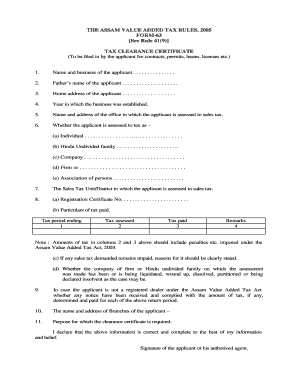
THE ASSAM VALUE ADDED TAX RULES, 2005 FORM-63 See Rule 41(9) TAX CLEARANCE CERTIFICATE (To be filed in by the applicant for contracts, permits, leases, licenses etc.) 1. Name and business of the applicant.

How it works
  • Open form

    Open form follow the instructions

  • Easily sign form

    Easily sign the form with your finger

  • Share form

    Send filled & signed form or save

How to fill out the THE ASSAM VALUE ADDED TAX RULES, 2005 FORM-63 online

Filling out the THE ASSAM VALUE ADDED TAX RULES, 2005 FORM-63 is essential for obtaining a tax clearance certificate necessary for various business operations. This guide provides a step-by-step approach to help you complete the form accurately.

Follow the steps to complete the form effectively.

  1. Click ‘Get Form’ button to obtain the form and open it in the editor.
  2. Provide the name and business of the applicant clearly in the designated field.
  3. Enter the father's name of the applicant in the relevant section.
  4. Fill in the home address of the applicant accurately to ensure proper identification.
  5. State the year in which the business was established, providing a clear time frame of operation.
  6. Indicate the name and address of the sales tax office where the applicant is registered.
  7. Select the capacity in which the applicant is assessed, choosing from individual, Hindu Undivided Family, company, firm, or association of persons.
  8. Specify the sales tax unit or district applicable to the applicant's assessments.
  9. Fill in the Registration Certificate number as well as the tax details including the tax periods, amounts assessed, and amounts paid, along with any relevant remarks.
  10. If applicable, provide reasons for any unpaid sales tax in the specified section.
  11. Indicate whether there have been any liquidation or insolvency proceedings related to the business.
  12. For unregistered dealers, mention any notices received and ensure all tax determinations are reported accurately.
  13. List the branch names and addresses of the applicant, if any.
  14. Clearly state the purpose for which the tax clearance certificate is required.
  15. Finally, sign the form affirming that the provided information is complete and accurate.
  16. After reviewing your entries for accuracy, save changes, download, print, or share the completed form as necessary.

Begin your online process to fill out the document today!

Get form

Experience a faster way to fill out and sign forms on the web. Access the most extensive library of templates available.

Related content

Nebraska Supreme Court Fredericks Peebles & Morgan...

Aug 3, 2018 — As we will discuss in more detail later, Assam did not properly raise a...

Learn more
Assam State, India, 2001 - 2009

Introducing the value-added tax. Sarma also led tax reforms as minister of state for...

Learn more
UNDP/WWF/GEF India Wild Cats Project

by HP Bhattarai · 2020 — measures are supportive to the act and can add value to the...

Learn more
Questions & Answers

Get answers to your most pressing questions about US Legal Forms API.

Contact support

What is the explanation of value-added tax?

Value-added tax is a consumption tax placed on a product whenever value is added at each stage of production or distribution. It allows businesses to collect tax on behalf of the government while prioritizing fair taxation practices. The Assam Value Added Tax Rules, 2005 Form-63 provides specific instructions on how value-added tax is calculated and administered in Assam.

Assam value added tax refers to the tax levied on the sale of goods within the state of Assam. The Assam Value Added Tax Rules, 2005 Form-63 outline the regulations and procedures for tax payment, exemptions, and compliance. Understanding these rules is vital for businesses to manage their tax liabilities effectively.

Value added tax (VAT) in India is a tax levied on the value added at each stage of production and distribution of goods. It was introduced to replace the sales tax system and provide a more efficient taxation framework. The Assam Value Added Tax Rules, 2005 Form-63 is a critical part of this system in Assam, ensuring transparency and fairness in tax collection.

Yes, VAT is applicable on liquor in Assam, and the rates may vary based on the type of liquor. The Assam Value Added Tax Rules, 2005 Form-63 specifies the applicable rates and regulations for liquor sales. It is important for business owners in the liquor industry to be aware of these rules to remain compliant and avoid penalties.

To obtain a value added tax number in Assam, you need to register your business with the Assam Tax Department. You must submit an application along with required documents, such as proof of identity and business registration. Once approved, your VAT number under the Assam Value Added Tax Rules, 2005 Form-63 will be issued, enabling you to operate legally.

The Assam VAT Act 2003 came into force on April 1, 2005. This act was introduced to replace the previous sales tax regime and streamline the taxation process in Assam. Familiarizing yourself with the Assam Value Added Tax Rules, 2005 Form-63 helps in understanding the changes that have occurred since its enactment.

Yes, VAT is applicable in Assam under the Assam Value Added Tax Rules. The Assam Value Added Tax Rules, 2005 Form-63 establishes the framework for tax collection in the state. As a resident or business owner in Assam, understanding these rules is essential for compliance and effective tax management.

Yes, natural gas is subject to value-added tax in Assam. The application of VAT depends on the uses of natural gas, whether for industrial or commercial purposes. Businesses and consumers should be aware of the rates and compliance requirements associated with this tax. For further insights, consult THE ASSAM VALUE ADDED TAX RULES, 2005 FORM-63 See ....

To find your VAT number, refer to your business registration documents associated with THE ASSAM VALUE ADDED TAX RULES, 2005 FORM-63 See. If you misplace these documents, you can retrieve your VAT number through the tax department’s online portal or by contacting their help desk. Keeping your VAT information organized ensures you comply with tax obligations effectively.

You can find your VAT ID by checking the registration documents provided at the time of registering under THE ASSAM VALUE ADDED TAX RULES, 2005 FORM-63 See. Additionally, you can access this information through the official tax department’s website or contact their customer service for assistance. Always keep your VAT ID accessible as it is vital for business transactions.

Get This Form Now!

Use professional pre-built templates to fill in and sign documents online faster. Get access to thousands of forms.

If you believe that this page should be taken down, please follow our DMCA take down process here.

Get THE ASSAM VALUE ADDED TAX RULES, 2005 FORM-63 See ...