Loading
Form preview
  • US Legal Forms
  • Other Templates
  • More Forms
  • More Uncategorized Forms
  • Dynamic Gait Index

Get Dynamic Gait Index

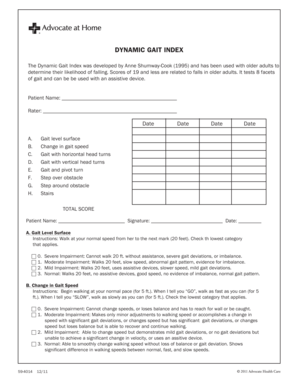
DYNAMIC GAIT INDEX T he Dynamic Gait Index was developed by Anne ShumwayCook (1995) and has been used with older adults to determine their likelihood of falling. Scores of 19 and less are related.

How it works

  1. Open form

    Open form follow the instructions

  2. Easily sign form

    Easily sign the form with your finger

  3. Share form

    Send filled & signed form or save

How to fill out the Dynamic Gait Index online

The Dynamic Gait Index is a valuable assessment tool designed to evaluate a person’s likelihood of falling. This guide will assist you in completing the form online, ensuring that you provide accurate and thorough information in each section.

Follow the steps to fill out the Dynamic Gait Index with ease.

  1. Click the ‘Get Form’ button to access the Dynamic Gait Index form and open it in your online document editor.
  2. Begin filling out the form by providing the patient's name and the rater's name in the designated fields at the top of the form.
  3. Indicate the date for each assessment you will complete in the provided space.
  4. Proceed to section A, 'Gait Level Surface.' Walk at your normal speed for 20 feet and select the lowest category from the provided options that best describes the person's gait.
  5. Move to section B, 'Change in Gait Speed.' Perform the exercise as instructed, changing walking speeds as directed, and choose the appropriate category that reflects any observed impairments.
  6. Continue to section C, 'Gait with Horizontal Head Turns.' Follow the instructions to assess gait while turning the head and mark the category that accurately represents the person's ability.
  7. Next, assess in section D, 'Gait with Vertical Head Turns.' Again, follow the instructions and select the category that applies based on the person's performance.
  8. In section E, 'Gait and Pivot Turn,' evaluate how the individual manages turning and stopping. Choose the appropriate description based on their performance.
  9. Proceed to section F, 'Step Over Obstacle.' Direct the individual to step over an object and evaluate their performance, selecting the suitable category.
  10. Move to section G, 'Step Around Obstacles.' Observe how they navigate around both cones, and choose the category that best represents their ability.
  11. Finally, assess section H, 'Stairs.' Observe how the individual ascends and descends stairs, indicating the appropriate level of impairment on the form.
  12. Once all sections are completed, review the total score calculated based on the assessments. Save any changes made to the document, and choose to download, print, or share the form as needed.

Complete your Dynamic Gait Index online to enhance your assessments and ensure accurate evaluations.

Get form

Experience a faster way to fill out and sign forms on the web. Access the most extensive library of templates available.
Get form

Related content

The Dynamic Gait Index in healthy older adults...
by T Herman · 2009 · Cited by 280 — The Dynamic Gait Index (DGI) was developed as a...
Learn more
Dynamic Gait Index
Description: Developed to assess the likelihood of falling in older adults. Designed to...
Learn more
Fall Risk and Functional Impairments: Using...
Gait velocity- a new vital sign? Standardized gait tests. 2, 3, and 6 minute walk tests;...
Learn more

Related links form

Form Ps2416 Mn Fr01 Form County Judicial District Court File Number Case Type Civil - Courts Mn Form As 2746

Questions & Answers

Get answers to your most pressing questions about US Legal Forms API.

Contact support

The dynamics of gait refers to the complex interactions of movement, weight distribution, and balance during walking. This involves how individuals adapt their walking patterns in response to different terrains or obstacles. Analyzing these dynamics can help in developing effective rehabilitation programs.

The mechanics of gait involves the physical movements and forces involved in walking. It includes how the body positions itself and how various joints and muscles work together to create movement. A solid understanding of gait mechanics is crucial for therapies aimed at improving mobility.

The dynamics of walking involve the various forces at play during movement, including gravity, inertia, and muscle force. These elements interact to produce a fluid and coordinated gait pattern. By studying these dynamics, we can develop strategies for enhancing mobility and preventing falls.

A normal dynamic gait index score typically ranges from 19 to 24, indicating adequate walking ability and balance. Scores below 19 may suggest an increased risk of falls and require further evaluation or intervention. Understanding your DGI score can guide your approach to improving mobility.

The dynamic gait index, or DGI, is an assessment tool used to measure an individual's ability to walk while maintaining balance under various conditions. It evaluates gait stability while a person navigates obstacles or changes speed. The DGI is vital for identifying fall risks among diverse populations.

The Berg balance scale primarily evaluates an individual's stability and balance through static and dynamic tasks. In contrast, the dynamic gait index specifically assesses how well a person can walk in different situations, focusing on their ability to maintain balance while in motion. Each tool serves unique purposes in evaluating mobility.

The physiology of gait involves the biological processes that allow movement. It includes muscle contractions, joint movements, and neurological signals that coordinate our walking patterns. These elements work together seamlessly, ensuring smooth, efficient movement.

Gait dynamics refers to the patterns and mechanics involved in walking. It encompasses how a person moves, including their speed, stability, and ability to change direction. Understanding gait dynamics is essential for assessing mobility and falls risk.

Yes, you can perform the Dynamic Gait Index while using an assistive device. However, using an assistive device may impact your score, as it can change how your body moves. It is essential to note this during evaluation. Seeking guidance from healthcare professionals ensures accurate assessment when using aids.

Performing a Dynamic Gait Index requires specific tasks intended to evaluate balance and walking ability. Typically, trained professionals guide you through tasks such as walking while turning, stepping over obstacles, and performing quick stops. Each task is scored, contributing to your overall DGI score. Understanding the DGI process is crucial for effective assessment.

Get This Form Now!

Use professional pre-built templates to fill in and sign documents online faster. Get access to thousands of forms.
Get form
If you believe that this page should be taken down, please follow our DMCA take down processhere.
Get Dynamic Gait Index
Get form
  • Adoption
  • Bankruptcy
  • Contractors
  • Divorce
  • Home Sales
  • Employment
  • Identity Theft
  • Incorporation
  • Landlord Tenant
  • Living Trust
  • Name Change
  • Personal Planning
  • Small Business
  • Wills & Estates
  • Packages A-Z
  • Affidavits
  • Bankruptcy
  • Bill of Sale
  • Corporate - LLC
  • Divorce
  • Employment
  • Identity Theft
  • Internet Technology
  • Landlord Tenant
  • Living Wills
  • Name Change
  • Power of Attorney
  • Real Estate
  • Small Estates
  • Wills
  • All Forms
  • Forms A-Z
  • Other Templates
  • Legal Hub
  • About Us
  • Help Portal
  • Legal Resources
  • Blog
  • Affiliates
  • Contact Us
  • Delete My Account
  • Site Map
  • Industries
  • Forms in Spanish
  • Localized Forms
  • State-specific Forms
  • Forms Kit
  • Real Estate Handbook
  • All Guides
  • Notarize
  • Incorporation services
  • For Consumers
  • For Small Business
  • For Attorneys
  • USLegal
  • FormsPass
  • pdfFiller
  • signNow
  • altaFlow
  • DocHub
  • Instapage
Form Packages
  • Adoption
  • Bankruptcy
  • Contractors
  • Divorce
  • Home Sales
  • Employment
  • Identity Theft
  • Incorporation
  • Landlord Tenant
  • Living Trust
  • Name Change
  • Personal Planning
  • Small Business
  • Wills & Estates
  • Packages A-Z
Form Categories
  • Affidavits
  • Bankruptcy
  • Bill of Sale
  • Corporate - LLC
  • Divorce
  • Employment
  • Identity Theft
  • Internet Technology
  • Landlord Tenant
  • Living Wills
  • Name Change
  • Power of Attorney
  • Real Estate
  • Small Estates
  • Wills
  • All Forms
  • Forms A-Z
  • Other Templates
Customer Service
  • Legal Hub
  • About Us
  • Help Portal
  • Legal Resources
  • Blog
  • Affiliates
  • Contact Us
  • Delete My Account
  • Site Map
  • Industries
  • Forms in Spanish
  • Localized Forms
  • State-specific Forms
  • Forms Kit
Legal Guides
  • Real Estate Handbook
  • All Guides
Prepared for you
  • Notarize
  • Incorporation services
Our Customers
  • For Consumers
  • For Small Business
  • For Attorneys
Our Sites
  • USLegal
  • FormsPass
  • pdfFiller
  • signNow
  • altaFlow
  • DocHub
  • Instapage
Social Media
Call us now toll free:
+1 833 426 79 33
As seen in:
© Copyright 1999-2026 airSlate Legal Forms, Inc. 17 Station Street, Suite 303, Brookline, MA 02445
  • Your Privacy Choices
  • Terms of Service
  • Privacy Notice
  • Content Takedown Policy
  • Bug Bounty Program