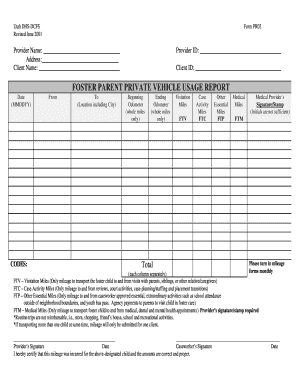
Utah DHS-DCFS Revised June 2001 Form PR02 Provider Name: Address: Client Name: Provider ID: Client ID: FOSTER PARENT PRIVATE VEHICLE USAGE REPORT Date (MMDDYY) CODES: From To (Location including City).

How it works
  • Open form

    Open form follow the instructions

  • Easily sign form

    Easily sign the form with your finger

  • Share form

    Send filled & signed form or save

How to fill out the foster parent private vehicle usage report - Hsdcfs Utah online

Filling out the foster parent private vehicle usage report online is essential for reimbursement of travel expenses incurred while transporting foster children. This guide will help you navigate each section of the form with clarity and precision.

Follow the steps to accurately complete your report.

  1. Click ‘Get Form’ button to obtain the necessary form and open it for editing.
  2. Begin by entering the provider name and address in the designated fields. This information identifies the individual or organization submitting the report.
  3. Next, fill in the client name, provider ID, and client ID to ensure accurate tracking of the foster child associated with the mileage claim.
  4. Record the date of travel using the MMDDYY format, which refers to the month, day, and year of each trip.
  5. For each trip, indicate the locations traveled to and from, including the city. This helps clarify the purpose of the mileage.
  6. Enter the beginning odometer reading (in whole miles only) at the start of your journey in the corresponding column.
  7. Similarly, record the ending odometer reading (in whole miles only) upon completion of your trip.
  8. Calculate and document the total miles traveled for each trip. This figure is essential for reimbursement.
  9. Identify the type of mileage by entering the appropriate figures in the respective columns: visitation miles (FTV), case activity miles (FTC), other essential miles (FTP), and medical miles (FTM). Ensure accurate reporting according to the defined categories.
  10. Obtain the medical provider’s signature or stamp if applicable, as initials are not sufficient. This confirms the legitimacy of the medical miles reported.
  11. Finally, secure the signatures of both the provider and caseworker, along with the respective dates. This certifies that all reported mileage is accurate and incurred for the designated child.
  12. Once filled, you can save changes, download, print, or share the completed form as needed.

Complete your foster parent private vehicle usage report online today for prompt reimbursement.

Get form

Experience a faster way to fill out and sign forms on the web. Access the most extensive library of templates available.

Related content

Transport to/from child's school of origin (Only...

Utah DHS-DCFS. Revised September 2011. Provider Name: Client Name: Caretaker Name:...

Learn more
Innovative Technologies in Child Welfare Services

May 1, 2018 — This report highlights the use of cloud/web-based information systems and...

Learn more
ANNUAL REPORT AND ACCOUNTS

Apr 27, 2017 — I am pleased to present this Annual Report to shareholders for the...

Learn more
Questions & Answers

Get answers to your most pressing questions about US Legal Forms API.

Contact support

How do I email DCFS Utah?

To email DCFS Utah, you can find contact information on their official website. Look for their 'Contact Us' section where email addresses are listed for different departments. Make sure to include relevant details in your inquiry for a prompt response. If you have questions about the FOSTER PARENT PRIVATE VEHICLE USAGE REPORT - Hsdcfs Utah, this is a good opportunity to get clarity directly from the source.

Several factors may disqualify an individual from becoming a foster parent in Utah. These can include certain criminal backgrounds, unresolved substance abuse issues, or inadequate housing conditions. It’s essential to review the specific criteria set by the state. Learning about resources like the FOSTER PARENT PRIVATE VEHICLE USAGE REPORT - Hsdcfs Utah can guide you through the qualification process.

Requesting records for DCFS in Utah involves filling out a request form and providing it to the appropriate department. You should include your identification and any details relevant to the records you seek. Be sure to refer to the official DCFS website for guidance and to access any forms you may need. Understanding the FOSTER PARENT PRIVATE VEHICLE USAGE REPORT - Hsdcfs Utah can also clarify what types of records might be applicable to your situation.

To request DCFS records in Utah, you need to contact the Utah Division of Child and Family Services directly. You may be required to submit a written request along with specific identification. Check their official website for detailed instructions and any necessary forms. For those interested in the FOSTER PARENT PRIVATE VEHICLE USAGE REPORT - Hsdcfs Utah, this process is similarly structured and can offer pertinent records.

Becoming a foster parent in Utah usually takes about six to twelve months, depending on various factors like background checks and training completion. The process involves several steps, including orientation, training classes, and home studies. Engaging with resources like the FOSTER PARENT PRIVATE VEHICLE USAGE REPORT - Hsdcfs Utah can provide valuable insights into the requirements and timelines involved.

To complete a GRAMA request in Utah, you must first identify the specific records you want. Then, fill out the GRAMA request form, which you can find on the Utah government website. Submit this form to the government agency that holds the records. It's beneficial to understand the process of the FOSTER PARENT PRIVATE VEHICLE USAGE REPORT - Hsdcfs Utah to streamline your request.

To request records from Child Protective Services in Indiana, you need to submit a formal request to the agency that maintains the records. This typically involves completing a request form and providing some identification. You can also check their website for more detailed steps and any potential fees involved. The FOSTER PARENT PRIVATE VEHICLE USAGE REPORT - Hsdcfs Utah can help you understand how similar processes work in Utah.

To be a foster parent in Utah, you need a stable and loving environment where children can feel safe. Required documentation includes financial statements, background checks, and references. Completing foster parent training is also a vital step in the process. Resources such as the FOSTER PARENT PRIVATE VEHICLE USAGE REPORT - Hsdcfs Utah provide an excellent guide to ensure you have everything needed for a successful fostering experience.

Yes, Utah is experiencing a shortage of foster parents, which impacts the ability to provide safe homes for children in need. Many factors contribute to this shortage, including the increasing number of children needing care and a lack of awareness about fostering. Communities can help by promoting fostering initiatives and supporting current foster families. Leveraging resources like the FOSTER PARENT PRIVATE VEHICLE USAGE REPORT - Hsdcfs Utah can rally support for fostering efforts.

The hardest part of fostering often includes dealing with emotional challenges, both for the foster parents and the children. Transitioning a child into a new environment can be tough, and fostering requires patience and resilience. It is also essential to manage the complexities of family dynamics and the child’s background. The FOSTER PARENT PRIVATE VEHICLE USAGE REPORT - Hsdcfs Utah helps you to navigate these challenges effectively.

Get This Form Now!

Use professional pre-built templates to fill in and sign documents online faster. Get access to thousands of forms.

If you believe that this page should be taken down, please follow our DMCA take down process here.

Get FOSTER PARENT PRIVATE VEHICLE USAGE REPORT - Hsdcfs Utah