How it works
  • Open form

    Open form follow the instructions

  • Easily sign form

    Easily sign the form with your finger

  • Share form

    Send filled & signed form or save

How to fill out the Conduct Disorder Scale online

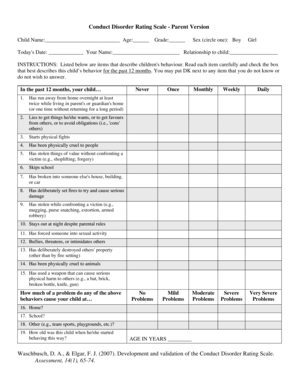
The Conduct Disorder Scale is a valuable tool designed to assess behavioral issues in children. This guide provides clear and supportive instructions for effectively filling out the form online.

Follow the steps to complete the Conduct Disorder Scale

  1. Press the ‘Get Form’ button to access the form and open it in your preferred editor.
  2. Begin the form by entering the child's name, age, and grade in the designated fields. Ensure accurate information is filled into these sections for proper assessment.
  3. Next, indicate the child's sex by circling either 'Boy' or 'Girl'. This is essential for statistical purposes.
  4. Fill in today’s date along with your name in the appropriate spaces provided. This helps to personalize the assessment.
  5. In the section titled 'INSTRUCTIONS', read each behavior item carefully. Evaluate your child's behavior over the past 12 months and check the box that best describes the frequency of each behavior.
  6. If you are uncertain about any item, feel free to write 'DK' next to those behaviors. This indicates that you do not know or prefer not to answer.
  7. Assess the severity of each behavior by selecting options such as 'Never', 'Once', 'Monthly', 'Weekly', 'Daily', 'No Problems', 'Mild Problems', 'Moderate Problems', 'Severe Problems', or 'Very Severe Problems' for each corresponding behavior.
  8. Address the questions regarding the impact of the behaviors at home, school, and other environments by filling out the corresponding sections.
  9. Finally, indicate the age when your child began exhibiting these behaviors in the designated field.
  10. Once all sections are completed, review your answers carefully. You can then choose to save the changes, download, print, or share the form as needed.

Complete the Conduct Disorder Scale online for effective behavioral assessment.

Get form

Experience a faster way to fill out and sign forms on the web. Access the most extensive library of templates available.

Related content

The conduct and oppositional defiant disorder...

by A Raine · 2022 · Cited by 14 — Conduct and Oppositional Defiant Disorder Scales...

Learn more
CODDS-LPE Scales - CDN

The CODDS scales provides total scores for CD and ODD as well as a score for total...

Learn more
Enhancing Your Adaptive Behavior Evaluations

Most common method of adaptive behavior assessment is with rating scales completed by...

Learn more
Questions & Answers

Get answers to your most pressing questions about US Legal Forms API.

Contact support

How to get tested for conduct disorders?

Getting tested for conduct disorders involves seeking an evaluation from a mental health professional experienced in child behavior assessments. They will use standardized tools, including the Conduct Disorder Scale, to assess the individual. Early testing can significantly influence the management and outcome of the disorder. Utilize platforms like USLegalForms to find necessary resources for testing and evaluations.

Measuring conduct disorder involves the use of specific scales and assessments designed to evaluate behavior. This process typically includes parent and teacher questionnaires, as well as direct assessments of the child. Accurate measuring is vital for developing individualized treatment plans. Accessing these resources through platforms like USLegalForms can ensure effective measurement.

Commonly used scales for conduct disorder include the Child Behavior Checklist and the Conners Rating Scale. These scales provide valuable insights into the behavior of affected individuals and help in paving the way for appropriate interventions. Integrating these assessments into your evaluation process can lead to better outcomes. Platforms like USLegalForms can assist in acquiring these essential tools.

The scale for conduct disorder evaluates behavioral issues in children and adolescents through direct observation and standardized questionnaires. This approach identifies problematic behaviors aligned with conduct disorder. Utilizing a reliable conduct disorder scale can lead to more effective treatment plans. You can explore various scales on platforms like USLegalForms for comprehensive access.

The scale for oppositional defiant disorder typically includes tools like the Oppositional Defiant Disorder Scale. Similar to the Conduct Disorder Scale, these assessments evaluate behaviors associated with defiance and opposition. Understanding the differences between oppositional defiant disorder and conduct disorder is crucial for targeted intervention. Professional guidance can help make this distinction clearer.

The CDS scale, or Conduct Disorder Scale, is a tool designed to measure the severity of conduct disorder symptoms. It takes into account various behavioral patterns, such as aggression, deceitfulness, and defiance. Employing the CDS scale can aid in determining treatment and support needs. Consider using reputable platforms to access this scale for accurate assessments.

Various assessments can be used to evaluate conduct disorder, including the Child Behavior Checklist and the Diagnostic Interview Schedule for Children. These tools provide a structured approach to understanding a child's behavior through standardized questions. Accessing these assessments through platforms like USLegalForms ensures you have the right resources to conduct thorough evaluations.

The score for a Conduct Disorder Scale varies depending on the specific assessment tool used. Generally, higher scores indicate more severe symptoms of conduct disorder. Understanding your score can help clarify the severity of behaviors and direct you to appropriate treatment options. It’s important to consult a mental health professional to gain comprehensive insight.

Yes, conduct disorder is included in the DSM-5, the Diagnostic and Statistical Manual of Mental Disorders, Fifth Edition. This resource outlines the criteria for diagnosing conduct disorder, which aligns with assessments like the Conduct Disorder Scale. Understanding its classification in the DSM-5 enables professionals to effectively identify and treat individuals experiencing this disorder.

The behavior-based rating scale focuses on specific actions associated with conduct disorder, similar to the Conduct Disorder Scale. It evaluates behaviors in real-world situations, which helps professionals understand the individual’s impact on their environment. This assessment method supports tailored interventions to promote positive behavioral changes.

Get This Form Now!

Use professional pre-built templates to fill in and sign documents online faster. Get access to thousands of forms.

If you believe that this page should be taken down, please follow our DMCA take down process here.

Get Conduct Disorder Scale