Loading
Form preview
  • US Legal Forms
  • Other Templates
  • More Forms
  • More Multi-State Forms
  • Nevada Transfer On Death Deed 2020

Get Nevada Transfer On Death Deed 2020-2026

How it works

  1. Open form

    Open form follow the instructions

  2. Easily sign form

    Easily sign the form with your finger

  3. Share form

    Send filled & signed form or save

How to fill out the Nevada Transfer On Death Deed online

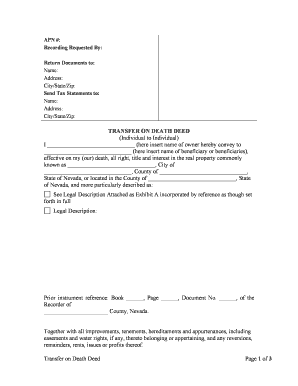
The Nevada Transfer On Death Deed allows users to transfer property ownership to beneficiaries upon their death. This guide provides a clear, step-by-step approach to accurately complete the form online.

Follow the steps to fill out the Nevada Transfer On Death Deed online

  1. Click 'Get Form' button to obtain the Transfer On Death Deed form and open it in your preferred editor.
  2. Fill in the recording requested by section. Include the name of the person or entity requesting the document to be recorded, ensuring it is accurate.
  3. Complete the return documents to section. Enter the name, address, city, state, and zip code where the recorded document should be sent.
  4. Input the send tax statements to information. Provide the name, address, city, state, and zip code for where tax statements should be directed.
  5. In the Transfer On Death Deed section, write the name of the owner and the name of the beneficiary or beneficiaries. Make sure that spellings are correct and match official identification.
  6. Specify the property being transferred by stating its common address, including city, county, and state. Ensure that all location details are accurate.
  7. If applicable, attach and refer to the legal description of the property as Exhibit A. It must be incorporated by reference as if fully written within the deed.
  8. Indicate the prior instrument reference by entering the book, page, and document number from the recorder's office if it exists.
  9. Review the revocability statement and ensure you understand it. This deed does not transfer ownership until the owner's death and revokes any previous deeds for the same property.
  10. Sign and date the document in the designated areas, ensuring that the signature is legible.
  11. Have the document notarized, ensuring that the notary public fills in their name and commission expiration information.
  12. Finally, save changes to the document, and choose to download, print, or share the completed form as needed.

Complete your Transfer On Death Deed online today to ensure your property is accurately conveyed according to your wishes.

Get form

Experience a faster way to fill out and sign forms on the web. Access the most extensive library of templates available.
Get form

Related content

Vehicle Beneficiary Transfer on Death
The owner must submit the Certificate of Title, a Transfer on Death Application (VP 239)...
Learn more
Revocable Transfer on Death Deeds
by D Major · 2009 · Cited by 15 — What Is a TOD Deed? TOD deeds are a nonprobate...
Learn more
2017 Publication 225
Oct 19, 2017 — Transfer due to death. The transfer of an in- stallment obligation (other...
Learn more

Related links form

Generic Application Canada Form App 003 Va Dbq Forms Pdf W2G, 1099 Or Win/Loss Statement Request

Questions & Answers

Get answers to your most pressing questions about US Legal Forms API.

Contact support

The best way to leave assets to heirs is by utilizing a Nevada Transfer On Death Deed for property and other designated accounts. This approach allows you to ensure your assets transfer directly to your heirs without the need for probate, thus simplifying the process for them. Additionally, it's advisable to consider comprehensive estate planning to cover all assets.

Using a Nevada Transfer On Death Deed is one of the best ways to transfer property after death. This deed ensures that your property automatically passes to your selected beneficiary without the need for lengthy probate proceedings. It’s a practical choice that provides clarity and efficiency for your estate planning.

The 3-year rule in Nevada generally refers to the timeframe in which a deceased estate must settle any outstanding debts. This means that the estate's executor has three years to resolve any claims against the estate, or the estate might lose valuable assets. Understanding this rule is crucial for beneficiaries to manage their inheritance effectively.

To transfer a deed in Nevada, you can use a Nevada Transfer On Death Deed for a straightforward process. This deed must be filed with the county recorder while you are alive, specifying the beneficiary who will inherit the property after your death. This method avoids the cumbersome probate process and ensures swift property transfer.

Yes, Nevada allows transfer on death deeds, making it easier for you to plan your estate. This deed type is a popular choice for many individuals because it permits property transfer to a designated beneficiary after death, while you maintain control during your lifetime. Utilizing a Nevada Transfer On Death Deed can simplify the process and provide peace of mind.

The Nevada Transfer On Death Deed stands out as a highly effective way to leave property upon your death. By executing this deed, you ensure that your property goes directly to the intended beneficiary without the complications of probate. This allows your loved ones to receive their inheritance promptly and with minimal hassle.

In Nevada, transferring title after death can be streamlined with a Nevada Transfer On Death Deed. This deed enables a smooth transfer of property to your beneficiary, as they can claim the title without needing to go through probate. Simply file the deed while you are alive, and the title transfers automatically to your chosen individual upon your passing.

The Nevada Transfer On Death Deed offers a simple, effective method to transfer property to a family member without going through probate. This deed allows you to retain ownership during your lifetime while ensuring that your property passes directly to your designated beneficiary upon your death. By using this approach, you eliminate unnecessary delays and costs that often accompany traditional methods.

Filing a transfer on death deed in Nevada involves preparing the deed and ensuring it complies with state law. Once you have the deed completed and notarized, you should file it with the county recorder where the property is located. This filing officially records the intent to transfer the property upon your death. For assistance, USLegalForms provides tools and templates to help you navigate the entire filing process.

Yes, Nevada does allow a transfer on death deed, making it an effective tool for estate planning. This legal document enables property owners to designate a beneficiary who will inherit the property directly without going through probate. Utilizing a Nevada Transfer On Death Deed ensures that your property is transferred smoothly and efficiently after your passing. Consider using resources from USLegalForms to help you draft this deed.

Get This Form Now!

Use professional pre-built templates to fill in and sign documents online faster. Get access to thousands of forms.
Get form
If you believe that this page should be taken down, please follow our DMCA take down processhere.
Get Nevada Transfer On Death Deed
Get form
  • Adoption
  • Bankruptcy
  • Contractors
  • Divorce
  • Home Sales
  • Employment
  • Identity Theft
  • Incorporation
  • Landlord Tenant
  • Living Trust
  • Name Change
  • Personal Planning
  • Small Business
  • Wills & Estates
  • Packages A-Z
  • Affidavits
  • Bankruptcy
  • Bill of Sale
  • Corporate - LLC
  • Divorce
  • Employment
  • Identity Theft
  • Internet Technology
  • Landlord Tenant
  • Living Wills
  • Name Change
  • Power of Attorney
  • Real Estate
  • Small Estates
  • Wills
  • All Forms
  • Forms A-Z
  • Other Templates
  • Legal Hub
  • About Us
  • Help Portal
  • Legal Resources
  • Blog
  • Affiliates
  • Contact Us
  • Delete My Account
  • Site Map
  • Industries
  • Forms in Spanish
  • Localized Forms
  • State-specific Forms
  • Forms Kit
  • Real Estate Handbook
  • All Guides
  • Notarize
  • Incorporation services
  • For Consumers
  • For Small Business
  • For Attorneys
  • USLegal
  • FormsPass
  • pdfFiller
  • signNow
  • altaFlow
  • DocHub
  • Instapage
Form Packages
  • Adoption
  • Bankruptcy
  • Contractors
  • Divorce
  • Home Sales
  • Employment
  • Identity Theft
  • Incorporation
  • Landlord Tenant
  • Living Trust
  • Name Change
  • Personal Planning
  • Small Business
  • Wills & Estates
  • Packages A-Z
Form Categories
  • Affidavits
  • Bankruptcy
  • Bill of Sale
  • Corporate - LLC
  • Divorce
  • Employment
  • Identity Theft
  • Internet Technology
  • Landlord Tenant
  • Living Wills
  • Name Change
  • Power of Attorney
  • Real Estate
  • Small Estates
  • Wills
  • All Forms
  • Forms A-Z
  • Other Templates
Customer Service
  • Legal Hub
  • About Us
  • Help Portal
  • Legal Resources
  • Blog
  • Affiliates
  • Contact Us
  • Delete My Account
  • Site Map
  • Industries
  • Forms in Spanish
  • Localized Forms
  • State-specific Forms
  • Forms Kit
Legal Guides
  • Real Estate Handbook
  • All Guides
Prepared for you
  • Notarize
  • Incorporation services
Our Customers
  • For Consumers
  • For Small Business
  • For Attorneys
Our Sites
  • USLegal
  • FormsPass
  • pdfFiller
  • signNow
  • altaFlow
  • DocHub
  • Instapage
Social Media
Call us now toll free:
+1 833 426 79 33
As seen in:
© Copyright 1999-2026 airSlate Legal Forms, Inc. 17 Station Street, Suite 303, Brookline, MA 02445
  • Your Privacy Choices
  • Terms of Service
  • Privacy Notice
  • Content Takedown Policy
  • Bug Bounty Program