Loading
Form preview
  • US Legal Forms
  • Other Templates
  • More Forms
  • More Multi-State Forms
  • Find Someone Who - Grammar. Grammar 2020

Get Find Someone Who - Grammar. Grammar 2020-2026

How it works

  1. Open form

    Open form follow the instructions

  2. Easily sign form

    Easily sign the form with your finger

  3. Share form

    Send filled & signed form or save

How to use or fill out the FIND SOMEONE WHO - Grammar. Grammar online

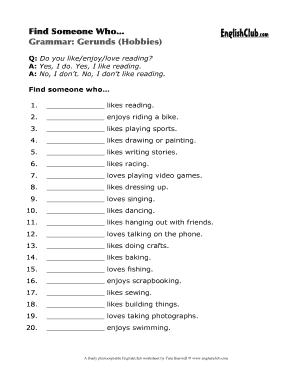
This guide provides a comprehensive overview of how to fill out the FIND SOMEONE WHO - Grammar. Grammar form online. By following these instructions, users can easily engage with the activities designed to enhance their understanding of gerunds and hobbies.

Follow the steps to successfully complete the form.

  1. Click ‘Get Form’ button to obtain the form and open it in the editor.
  2. Review the introductory questions to familiarize yourself with the format. These questions encourage conversation about hobbies and interests.
  3. In the blank lines provided, write the names of users who fit each description. For instance, under ‘_____________ likes reading,’ identify a person who enjoys that activity.
  4. Continue filling in the remaining sections with names based on the various hobbies listed, ensuring you connect them correctly with the appropriate gerund.
  5. Once all sections are completed, review the form for any errors or omissions. Edit as necessary.
  6. Save your changes. You may also choose to download, print, or share the completed form as needed.

Start completing the FIND SOMEONE WHO - Grammar. Grammar form online today!

Get form

Experience a faster way to fill out and sign forms on the web. Access the most extensive library of templates available.
Get form

Related content

The Monster Book of Language Teaching Activities
Find Someone Who… Circulate around the room and find someone who can answer “yes” to...
Learn more
Using Which, That, and Who
Use 'who' for people, 'that' for vital information about things, and 'which' for...
Learn more
Ernest the Chicken
Sep 28, 2025 — Ernest the Chicken is a free-to-play quest where players must discover...
Learn more

Related links form

Tsa Form 1 Parent Teen Driving Agreement. Teen Driving - Cdc Dcss 0053 Tcac Income Calculation Exercise

Questions & Answers

Get answers to your most pressing questions about US Legal Forms API.

Contact support

The fundamental grammar rule for 'who' and 'whom' differentiates their usage based on their role in the sentence. Use 'who' for the subject and 'whom' for the object. Mastering this distinction aids in constructing sentences that are not only grammatically correct but also effective in communicating your thoughts clearly.

'Who is this?' is indeed a grammatically correct phrase used when addressing someone directly. In this case, 'who' serves as the subject of the sentence. Understanding how to use such phrases correctly allows you to communicate more effectively and FIND SOMEONE WHO engages your audience.

The choice between 'who is' and 'who are' hinges on whether you refer to a singular or plural subject. When discussing one person, 'who is' is appropriate, as in 'Who is at the door?' Conversely, use 'who are' for multiple individuals, like 'Who are the guests?' Keeping this in mind reduces confusion as you seek to FIND SOMEONE WHO writes clearly.

To properly use 'who,' 'whom,' and 'which,' it's vital to grasp their specific roles. 'Who' identifies a subject, 'whom' marks an object, and 'which' serves to introduce a clause or select among options. Mastering these terms can help you FIND SOMEONE WHO uses them correctly, making your writing clearer.

Determining when to use 'who' or 'whom' is straightforward once you understand their functions. Utilize 'who' when referring to the subject performing the action and 'whom' for the recipient of the action. Understanding these rules will significantly enhance your grammatical accuracy as you find someone who embodies strong writing skills.

The difference between 'whose' and 'whom' is fundamental in English grammar. 'Whose' indicates possession, as in 'Whose book is this?' while 'whom' is used as an object, such as in 'To whom did you give the book?' Knowing these distinctions is key to mastering the language and FIND SOMEONE WHO communicates effectively.

The correct phrase in standard English is 'Who are we?' This is because 'we' serves as the subject. In contrast, 'who is us' is technically incorrect, as it improperly uses 'is' with a plural subject. Keeping this rule in mind helps you navigate the intricacies of grammar.

Identifying a person grammatically involves understanding their role in a sentence. This can be as simple as recognizing whether they are the subject or the object. When composing sentences, always seek to FIND SOMEONE WHO is grammatically correct to ensure clarity and cohesion.

The primary rule for using 'who' and 'whom' is to recognize their roles in a sentence. Use 'who' when the subject performs an action, while 'whom' should be used when the individual is receiving an action. To simplify the process of finding someone who fits correctly, remember this rule as you use our platform.

When deciding between 'who is' and 'who are,' focus on the subject in your sentence. If you are referring to one individual or a collective group that acts as a unit, use 'who is.' However, when discussing multiple individuals, 'who are' is the right choice. This clarity will help you FIND SOMEONE WHO - Grammar more effectively.

Get This Form Now!

Use professional pre-built templates to fill in and sign documents online faster. Get access to thousands of forms.
Get form
If you believe that this page should be taken down, please follow our DMCA take down processhere.
Get FIND SOMEONE WHO - Grammar. Grammar
Get form
  • Adoption
  • Bankruptcy
  • Contractors
  • Divorce
  • Home Sales
  • Employment
  • Identity Theft
  • Incorporation
  • Landlord Tenant
  • Living Trust
  • Name Change
  • Personal Planning
  • Small Business
  • Wills & Estates
  • Packages A-Z
  • Affidavits
  • Bankruptcy
  • Bill of Sale
  • Corporate - LLC
  • Divorce
  • Employment
  • Identity Theft
  • Internet Technology
  • Landlord Tenant
  • Living Wills
  • Name Change
  • Power of Attorney
  • Real Estate
  • Small Estates
  • Wills
  • All Forms
  • Forms A-Z
  • Other Templates
  • Legal Hub
  • About Us
  • Help Portal
  • Legal Resources
  • Blog
  • Affiliates
  • Contact Us
  • Delete My Account
  • Site Map
  • Industries
  • Forms in Spanish
  • Localized Forms
  • State-specific Forms
  • Forms Kit
  • Real Estate Handbook
  • All Guides
  • Notarize
  • Incorporation services
  • For Consumers
  • For Small Business
  • For Attorneys
  • USLegal
  • FormsPass
  • pdfFiller
  • signNow
  • altaFlow
  • DocHub
  • Instapage
Form Packages
  • Adoption
  • Bankruptcy
  • Contractors
  • Divorce
  • Home Sales
  • Employment
  • Identity Theft
  • Incorporation
  • Landlord Tenant
  • Living Trust
  • Name Change
  • Personal Planning
  • Small Business
  • Wills & Estates
  • Packages A-Z
Form Categories
  • Affidavits
  • Bankruptcy
  • Bill of Sale
  • Corporate - LLC
  • Divorce
  • Employment
  • Identity Theft
  • Internet Technology
  • Landlord Tenant
  • Living Wills
  • Name Change
  • Power of Attorney
  • Real Estate
  • Small Estates
  • Wills
  • All Forms
  • Forms A-Z
  • Other Templates
Customer Service
  • Legal Hub
  • About Us
  • Help Portal
  • Legal Resources
  • Blog
  • Affiliates
  • Contact Us
  • Delete My Account
  • Site Map
  • Industries
  • Forms in Spanish
  • Localized Forms
  • State-specific Forms
  • Forms Kit
Legal Guides
  • Real Estate Handbook
  • All Guides
Prepared for you
  • Notarize
  • Incorporation services
Our Customers
  • For Consumers
  • For Small Business
  • For Attorneys
Our Sites
  • USLegal
  • FormsPass
  • pdfFiller
  • signNow
  • altaFlow
  • DocHub
  • Instapage
Social Media
Call us now toll free:
+1 833 426 79 33
As seen in:
© Copyright 1999-2026 airSlate Legal Forms, Inc. 17 Station Street, Ste. 203, Brookline, MA 02445
  • Your Privacy Choices
  • Terms of Service
  • Privacy Notice
  • Content Takedown Policy
  • Bug Bounty Program