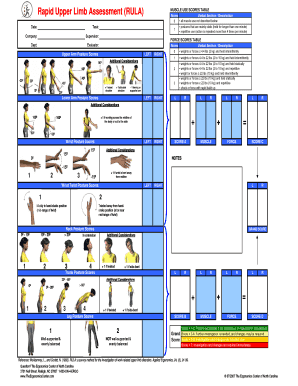
Ights or forces 4.4 lbs (2 kg) and held intermittently 1 weights or forces 4.4 to 22 lbs (2 to 10 kg) and held intermittently 2 90 45 20 1 postures that are mainly static (held for longer than one minute) repetitive use (action is repeated more than 4 times per minute) FORCE SCORES TABLE Score Verbal Anchor / Description Upper Arm Posture Scores -20 all muscle use not described below 1 Task: 3 45 2 20 2 3 20 + 1 raised shoulder 4 + 1 abd.
Open form follow the instructions
Easily sign the form with your finger
Send filled & signed form or save
How to fill out the Rapid Upper Limb Assessment Worksheet online
Filling out the Rapid Upper Limb Assessment Worksheet is essential for evaluating upper limb posture and muscle use within a workplace. This guide provides step-by-step instructions for completing the form online, ensuring clarity and ease of understanding for all users.
Follow the steps to accurately assess upper limb posture.
- Click the ‘Get Form’ button to access the Rapid Upper Limb Assessment Worksheet and open it in your designated editor.
- Begin by entering the date, company name, supervisor's name, department, and evaluator's name at the top of the worksheet to clearly identify the assessment.
- Refer to the muscle use scores table. Assess each relevant posture and mark the appropriate scores based on the descriptions provided for both left and right sides.
- Move to the force scores table. Evaluate the force applied and record scores accordingly, keeping in mind the task you are evaluating.
- Continue on to fill out the upper arm posture scores by noting down positions of the arms and their relative angles. Use the specific weights or forces to guide your scoring.
- Record lower arm posture scores, noting necessary adjustments for the weights and their handling.
- Assess wrist posture scores and enter them in the designated fields, using the guide for correct angles and positioning.
- Evaluate neck posture, trunk posture, and leg posture as per the scoring criteria in the worksheet. Mark any additional considerations that apply.
- Add any additional notes that provide context or specifics regarding the assessment which may be important for further investigation.
- After completing all fields, review the grand score indicating the overall posture assessment. This score will guide any necessary action or investigation required for workplace ergonomics.
- Once you have filled out the form, save the changes made, and opt to download, print, or share the completed worksheet as needed.
Start filling out your Rapid Upper Limb Assessment Worksheet online today to enhance workplace safety and ergonomics.
Experience a faster way to fill out and sign forms on the web. Access the most extensive library of templates available.
Related content
by L McAtamney · 1993 · Cited by 5538 — RULA (rapid upper limb assessment) is a survey...
by AKP Harahap · 2024 · Cited by 3 — RULA Employee Assessment Worksheet based on RULA:...
used to measure a subject's simple but rapid eye- hand coordination as well as arm-hand...
Get answers to your most pressing questions about US Legal Forms API.
What does a RULA score of 7 mean?
A RULA score of 7 indicates a high risk of injury, suggesting that immediate changes are necessary to improve ergonomic conditions. This score reflects the need for prompt attention to the identified postural issues. Utilizing the Rapid Upper Limb Assessment Worksheet allows users to document and address these risks effectively, ensuring a safer working environment.
How to use RULA assessment?
To use the RULA assessment, you should begin by observing the work task and recording the relevant postures observed using a Rapid Upper Limb Assessment Worksheet. Next, assign scores based on the specific postures, force, and repetitions involved. Finally, analyze the results to determine if further ergonomic adjustments are needed to enhance user comfort and safety.
What is the validity and reliability of RULA?
RULA has been validated through various studies, demonstrating its effectiveness in identifying posture-related risks in the workplace. Researchers have noted its reliability and practicality in diverse settings. When utilizing a Rapid Upper Limb Assessment Worksheet, individuals can be confident in the assessment's outcomes and make informed decisions based on solid data.
What is the purpose of the RULA?
The purpose of RULA is to provide a quick yet comprehensive evaluation of potential risks associated with ergonomic factors in workplace tasks. It aims to pinpoint postural problems that may lead to musculoskeletal disorders, allowing for timely corrective measures. By employing a Rapid Upper Limb Assessment Worksheet, users can track and improve their ergonomic conditions systematically.
What is the difference between RULA and REBA?
RULA and REBA are both ergonomic assessment tools, but they serve different purposes. RULA focuses on evaluating upper limb and neck postures, while REBA assesses the entire body during repetitive tasks. Utilizing a Rapid Upper Limb Assessment Worksheet can highlight specific upper limb concerns, making it ideal for tasks that predominantly involve arm and wrist movements.
What is the rapid upper limb assessment method?
The rapid upper limb assessment method, often referred to as RULA, is a systematic tool designed to evaluate the ergonomic risks associated with upper limb tasks. This method allows users to identify potential posture-related discomfort or injuries in the workplace. By utilizing a Rapid Upper Limb Assessment Worksheet, individuals can effectively document their findings and prioritize interventions.
What is the RULA assessment used for?
The RULA method was designed to allow the analysis of biomechanical/postural stresses on a worker's upper limbs and to identify the muscular effort associated with a working posture. This method is used to screen for the risk of developing MSDs.
What is a good RULA score?
Rapid Upper Limb Assessment Levels Action Level 1 – RULA score 1-2 means that the person is working in the best posture. There is no risk of injury from their work posture. Action Level 2 – RULA score 3-4 means that the person is working in a posture that could present some risk of injury from their work posture.
What is the range of RULA scores?
The RULA score represents the level of MSD risk for the job task being evaluated. The minimum RULA Score = 1, and the maximum RULA Score = 7. The design goal for the RULA assessment is a score of 3.
What is the comparison of OWAS Rulas and Reba for assessing potential work related musculoskeletal disorders?
RULA grand score and action level were associated with decisions about WMSDs. RULA was better than REBA/OWAS for assessing musculoskeletal disorders. New assessment method needed for specific body parts and musculoskeletal disorders.
Use professional pre-built templates to fill in and sign documents online faster. Get access to thousands of forms.
If you believe that this page should be taken down, please follow our DMCA take down process here.