Loading
Form preview
  • US Legal Forms
  • Other Templates
  • More Forms
  • More Uncategorized Forms
  • Tree Hazard Evaluation Form

Get Tree Hazard Evaluation Form

Ed root area: severe Y Y N ID: Undermined: severe Root area affected: % moderate LEAN: deg. from vertical Decay in plane of lean: low low natural N Potential for root failure: unnatural Roots broken: Y moderate Buttress wounded: self-corrected N low Y severe N moderate Soil heaving: Soil cracking: Compounding factors: Lean sever.

How it works

  1. Open form

    Open form follow the instructions

  2. Easily sign form

    Easily sign the form with your finger

  3. Share form

    Send filled & signed form or save

How to fill out the Tree Hazard Evaluation Form online

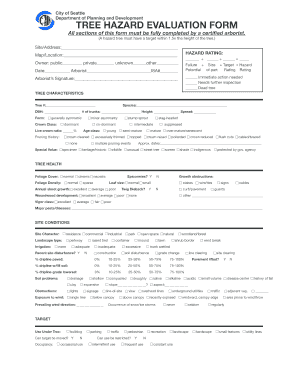
The Tree Hazard Evaluation Form is a critical document used to assess the potential hazards posed by trees. Properly filling out this form allows certified arborists to communicate vital information regarding tree health and safety. This guide provides step-by-step instructions to help you complete the form effectively online.

Follow the steps to fill out the Tree Hazard Evaluation Form online

  1. Press the ‘Get Form’ button to access the Tree Hazard Evaluation Form and open it in the editor.
  2. Begin by filling out the 'Site/Address' and 'Map/Location' fields, ensuring accurate details about the evaluated tree's location.
  3. Complete the 'Hazard Rating' section by calculating the total hazard score using the provided formula: Failure + Size + Target = Hazard.
  4. Indicate the ownership type (public, private, unknown, other) in the owner section and provide the date and arborist's details, including their ISA number.
  5. Mark the immediate actions needed, such as immediate action, further inspection, or if the tree is dead.
  6. Fill in the 'Tree Characteristics' section, providing details such as tree number, species, diameter at breast height (DBH), number of trunks, height, spread, and crown class.
  7. Assess the tree's health in the 'Tree Health' section by evaluating foliage cover, density, annual shoot growth, and any signs of pests or diseases.
  8. In the 'Site Conditions' section, describe the site's characteristics and any recent disturbances that may affect the tree.
  9. Complete the 'Target' section, indicating who or what is under the tree and whether the target can be moved or use can be restricted.
  10. Evaluate the 'Tree Defects', noting any root defects, crown defects, and their severity.
  11. Calculate the final hazard rating by synthesizing all previous ratings and assess recommended hazard abatement measures.
  12. Once all sections are completed, save your changes, and choose to download, print, or share the filled form as necessary.

Begin filling out the Tree Hazard Evaluation Form online today.

Get form

Experience a faster way to fill out and sign forms on the web. Access the most extensive library of templates available.
Get form

Related content

TREE HAZARD EVALUATION FORM ...
The hazard rating is calculated by adding the failure potential, size of part, and target...
Learn more
hazard-tree-assessment-management.pdf
Hazard tree assessment involves understanding site manager responsibilities, recognizing...
Learn more
User Manual
by N Matheny — The International Tree Failure Database. (ITFD) collects information on...
Learn more

Related links form

Case Record Form - ABDO - Abdo Org Syed Ibrahim Dilawer (B Xco Training Tips Statement For MTAA Super Dated 1 July 2013 Issued By Motor Trades

Questions & Answers

Get answers to your most pressing questions about US Legal Forms API.

Contact support

Evaluating a tree involves assessing its species, size, location, and potential risks it poses to people or property. Conducting a thorough inspection and documenting your findings on a Tree Hazard Evaluation Form helps create a well-rounded understanding of the tree's condition. This systematic approach not only enhances safety but also informs future maintenance or removal decisions.

To check the health of a tree, inspect its leaves, bark, and branches for signs of disease or pest infestations. Look for any indications of stress, such as wilting leaves or dying branches. Completing a Tree Hazard Evaluation Form during this check allows you to track the tree's health across seasons, supporting proactive management strategies.

To measure a tree properly, you typically assess its height, diameter, and crown spread. Tools such as a measuring tape and clinometer can help you obtain accurate measurements. Documenting this data on a Tree Hazard Evaluation Form ensures you maintain a detailed record for future evaluations or assessments.

Evaluating an expression tree involves traversing the tree structure and calculating the result based on the operators and operands it contains. Typically, you process the tree using a post-order traversal to compute values from the leaves up to the root. Although not directly related to physical trees, metaphorically speaking, a Tree Hazard Evaluation Form serves a similar purpose by assessing tree health and safety.

Tree evaluation methods include visual inspection, aerial assessments, and diagnostic tests to identify structural weaknesses or health issues. Each method provides valuable insights into a tree's condition and potential hazards. Employing a Tree Hazard Evaluation Form allows for thorough documentation of the chosen method and its results, promoting informed decision-making.

The tree hazard assessment form is a structured document used to record the condition and risk level of trees. This form facilitates consistent evaluations and makes it easier to communicate findings to stakeholders. Integrating a comprehensive Tree Hazard Evaluation Form into your tree care practices can enhance safety and inform management decisions.

A level 1 tree assessment is a basic visual inspection of the tree's overall health, structure, and risk factors. This type of assessment helps identify obvious signs of decay, damage, or instability. Utilizing a Tree Hazard Evaluation Form during this process streamlines documentation and provides an organized overview for future reference.

Tree risk assessment ratings categorize the likelihood of tree failure and the potential for injury or property damage. Generally, these ratings help prioritize trees for monitoring or management. A Tree Hazard Evaluation Form aids in documenting these assessments clearly, ensuring you have a reliable record of each tree's condition.

A standard tree risk assessment evaluates a tree's condition and the likelihood of it causing harm. This involves inspecting the tree's structure, health, and surrounding environment. The Tree Hazard Evaluation Form is an essential tool in this process, providing a structured approach to documenting your findings and recommendations.

For a tree to be deemed a risk, it must show substantial structural weakness and have the potential to fall or drop branches. Common indicators include extensive decay or significant lean. Utilizing the Tree Hazard Evaluation Form enables you to assess these risks meticulously and document them for further analysis.

Get This Form Now!

Use professional pre-built templates to fill in and sign documents online faster. Get access to thousands of forms.
Get form
If you believe that this page should be taken down, please follow our DMCA take down processhere.
Get Tree Hazard Evaluation Form
Get form
  • Adoption
  • Bankruptcy
  • Contractors
  • Divorce
  • Home Sales
  • Employment
  • Identity Theft
  • Incorporation
  • Landlord Tenant
  • Living Trust
  • Name Change
  • Personal Planning
  • Small Business
  • Wills & Estates
  • Packages A-Z
  • Affidavits
  • Bankruptcy
  • Bill of Sale
  • Corporate - LLC
  • Divorce
  • Employment
  • Identity Theft
  • Internet Technology
  • Landlord Tenant
  • Living Wills
  • Name Change
  • Power of Attorney
  • Real Estate
  • Small Estates
  • Wills
  • All Forms
  • Forms A-Z
  • Other Templates
  • Legal Hub
  • About Us
  • Help Portal
  • Legal Resources
  • Blog
  • Affiliates
  • Contact Us
  • Delete My Account
  • Site Map
  • Industries
  • Forms in Spanish
  • Localized Forms
  • State-specific Forms
  • Forms Kit
  • Real Estate Handbook
  • All Guides
  • Notarize
  • Incorporation services
  • For Consumers
  • For Small Business
  • For Attorneys
  • USLegal
  • FormsPass
  • pdfFiller
  • signNow
  • altaFlow
  • DocHub
  • Instapage
Form Packages
  • Adoption
  • Bankruptcy
  • Contractors
  • Divorce
  • Home Sales
  • Employment
  • Identity Theft
  • Incorporation
  • Landlord Tenant
  • Living Trust
  • Name Change
  • Personal Planning
  • Small Business
  • Wills & Estates
  • Packages A-Z
Form Categories
  • Affidavits
  • Bankruptcy
  • Bill of Sale
  • Corporate - LLC
  • Divorce
  • Employment
  • Identity Theft
  • Internet Technology
  • Landlord Tenant
  • Living Wills
  • Name Change
  • Power of Attorney
  • Real Estate
  • Small Estates
  • Wills
  • All Forms
  • Forms A-Z
  • Other Templates
Customer Service
  • Legal Hub
  • About Us
  • Help Portal
  • Legal Resources
  • Blog
  • Affiliates
  • Contact Us
  • Delete My Account
  • Site Map
  • Industries
  • Forms in Spanish
  • Localized Forms
  • State-specific Forms
  • Forms Kit
Legal Guides
  • Real Estate Handbook
  • All Guides
Prepared for you
  • Notarize
  • Incorporation services
Our Customers
  • For Consumers
  • For Small Business
  • For Attorneys
Our Sites
  • USLegal
  • FormsPass
  • pdfFiller
  • signNow
  • altaFlow
  • DocHub
  • Instapage
Social Media
Call us now toll free:
+1 833 426 79 33
As seen in:
© Copyright 1999-2026 airSlate Legal Forms, Inc. 17 Station Street, Suite 303, Brookline, MA 02445
  • Your Privacy Choices
  • Terms of Service
  • Privacy Notice
  • Content Takedown Policy
  • Bug Bounty Program