Loading
Form preview
  • US Legal Forms
  • Form Library
  • More Forms
  • More Multi-State Forms
  • Rula Worksheet

Get Rula Worksheet

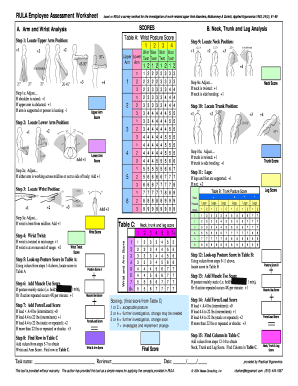
Arm and Wrist Analysis Step 1: Locate Upper Arm Position: +1 +2 +2 B. Neck, Trunk and Leg Analysis Table A: Wrist Posture Score 1 2 3 4 + Wrist Wrist Wrist Wrist Upper Lower Twist Twist Twist Twist Arm Arm Step 9: Locate Neck Position: +1 +2 +3 1 2 1 2 1 2 1 2 +3 Step 1a: Adjust If shoulder is raised: +1 If upper arm is abducted: +1 If arm is supported or person is leaning: -1 1 +4 2 Upper Arm Score Step 2: Locate Lower Arm Position: +1 3 +2 Add +1 4 Lower Arm Score Step.

How it works

  1. Open form

    Open form follow the instructions

  2. Easily sign form

    Easily sign the form with your finger

  3. Share form

    Send filled & signed form or save

How to fill out the Rula Worksheet online

The Rula Worksheet is an assessment tool used to evaluate work-related upper limb disorders. This guide provides clear and comprehensive instructions on how to complete the Rula Worksheet online, ensuring that users have a thorough understanding of each section.

Follow the steps to complete the Rula Worksheet effectively.

  1. Click the 'Get Form' button to access the Rula Worksheet and open it in your editor.
  2. Begin with section A, focusing on arm and wrist analysis. Locate the upper arm position and assign a score based on the specified criteria. Record any necessary adjustments.
  3. Continue to section B, neck, trunk, and leg analysis. Refer to Table A to score wrist posture based on the evaluated positions from previous steps.
  4. Locate and record the lower arm position as well as wrist position. Make adjustments if the wrist is bent from midline.
  5. Assess the trunk position and adjust scores for any twisting or side bending. Document the score for the trunk posture.
  6. Review the scoring for muscle use and force/load assessments, documenting scores according to activity frequency and load weight.
  7. Add together the applicable scores from previous steps to determine the final neck, trunk, and leg score. Reference Table C for overall scoring insights.
  8. Finalize your assessment by compiling all recorded scores and checking for any recommended actions based on the cumulative score evaluations.
  9. Once completed, ensure to save changes, and consider downloading, printing, or sharing the worksheet as necessary.

Complete your Rula Worksheet online today to evaluate and improve workplace ergonomics.

Get form

Experience a faster way to fill out and sign forms on the web. Access the most extensive library of templates available.
Get form

Related content

A proposed Rapid Upper Limb Assessment for...
by ZW Wong · 2025 — To propose a Rapid Upper Limb Assessment for Pianists (RULA-p) for...
Learn more
rula worksheet
by AKP Harahap · 2024 · Cited by 3 — RULA Employee Assessment Worksheet based on RULA:...
Learn more
Washington Apple Pi Journal, August 1986
Aug 8, 1986 — 80-column mode) of a larger 66 x 96 character worksheet. Fields ... I...
Learn more

Related links form

NOTE A Serviceperson Planning Early Release Should Give Both Present Military Address And Planned DA Form 5536-R Agreement Health Professionals Loan Repayment - Dmna Ny Marriott Tax Exempt Are Not Deductible - Irs

Questions & Answers

Get answers to your most pressing questions about US Legal Forms API.

Contact support

To get data from a RULA worksheet, you simply complete the assessment by inputting information about posture, force, and movement patterns. This data is then analyzed to yield a score, which helps identify ergonomic risk levels. Using the analysis from the RULA worksheet, you can develop strategies to minimize those risks. Effective data collection is crucial for making impactful improvements to workplace ergonomics.

REBA, or Rapid Entire Body Assessment, is a tool used to analyze the ergonomic risks associated with whole-body postures during work activities. The concept focuses on assessing multiple body parts simultaneously, making it ideal for evaluating repetitive and varied tasks. By completing a REBA assessment, you can spot potential risks and implement necessary changes. Understanding REBA improves overall workplace ergonomics, which enhances employee satisfaction and productivity.

While both RULA and REBA assess ergonomic risks, they focus on different aspects of posture and movement. RULA emphasizes upper body posture and force exertion, while REBA addresses whole body posture and repetitive tasks. Leveraging the RULA worksheet allows for a targeted approach to evaluating specific tasks. Understanding their differences helps organizations select the right tool for their ergonomic assessments.

The primary focus of RULA and REBA is to assess the ergonomic risks associated with tasks performed by workers. Using the RULA worksheet, you can evaluate postures adopted during work activities and identify areas for improvement. Understanding these scores assists organizations in creating safer work environments. By effectively using these tools, businesses can enhance productivity and employee wellbeing.

The RULA method works by assigning scores based on the evaluation of postures, force levels, and the frequency of movements. Each aspect of the task is scored, and the results help highlight areas for improvement. By utilizing the Rula Worksheet, you can document findings and develop action plans to enhance workplace ergonomics.

The RULA assessment method involves analyzing upper limb postures, assessing force, and reviewing repetitive tasks to identify ergonomic risks. It provides a quick, organized way to capture workplace conditions and recommend improvements. You can streamline this process using a Rula Worksheet, making ergonomic assessments easier and more effective.

RULA, or Rapid Upper Limb Assessment, is a method designed to evaluate ergonomic risks associated with upper limb work. It identifies potential problems that can lead to injury or discomfort. By adopting the Rula Worksheet, managers can address these risks proactively and enhance employee well-being.

A RULA score of 7 indicates that the posture of the worker poses a medium risk of developing musculoskeletal disorders. It suggests the need for further evaluation and potential intervention. Utilizing the Rula Worksheet helps you document and analyze postures effectively to mitigate risks.

RULA is used to assess ergonomic risks related to upper limb activities and to promote safer work environments. This tool helps identify potential musculoskeletal disorders before they occur, providing insights for improvement. A Rula Worksheet allows you to track and manage these risks effectively, ensuring that employees remain safe and productive.

A RULA worksheet is a structured tool used to evaluate and document upper limb postures in the workplace. The worksheet helps users systematically evaluate postures, assign scores, and identify areas needing attention. Using the Rula Worksheet effectively guides users in improving workplace safety and employee well-being.

Get This Form Now!

Use professional pre-built templates to fill in and sign documents online faster. Get access to thousands of forms.
Get form
If you believe that this page should be taken down, please follow our DMCA take down processhere.

Industry-leading security and compliance

US Legal Forms protects your data by complying with industry-specific security standards.
  • In businnes since 1997
    25+ years providing professional legal documents.
  • Accredited business
    Guarantees that a business meets BBB accreditation standards in the US and Canada.
  • Secured by Braintree
    Validated Level 1 PCI DSS compliant payment gateway that accepts most major credit and debit card brands from across the globe.
Get Rula Worksheet
Get form
  • Adoption
  • Bankruptcy
  • Contractors
  • Divorce
  • Home Sales
  • Employment
  • Identity Theft
  • Incorporation
  • Landlord Tenant
  • Living Trust
  • Name Change
  • Personal Planning
  • Small Business
  • Wills & Estates
  • Packages A-Z
  • Affidavits
  • Bankruptcy
  • Bill of Sale
  • Corporate - LLC
  • Divorce
  • Employment
  • Identity Theft
  • Internet Technology
  • Landlord Tenant
  • Living Wills
  • Name Change
  • Power of Attorney
  • Real Estate
  • Small Estates
  • Wills
  • All Forms
  • Forms A-Z
  • Form Library
  • Legal Hub
  • About Us
  • Help Portal
  • Legal Resources
  • Blog
  • Affiliates
  • Contact Us
  • Delete My Account
  • Site Map
  • Industries
  • Forms in Spanish
  • Localized Forms
  • State-specific Forms
  • Forms Kit
  • Real Estate Handbook
  • All Guides
  • Notarize
  • Incorporation services
  • For Consumers
  • For Small Business
  • For Attorneys
  • USLegal
  • FormsPass
  • pdfFiller
  • signNow
  • altaFlow
  • DocHub
  • Instapage
Form Packages
  • Adoption
  • Bankruptcy
  • Contractors
  • Divorce
  • Home Sales
  • Employment
  • Identity Theft
  • Incorporation
  • Landlord Tenant
  • Living Trust
  • Name Change
  • Personal Planning
  • Small Business
  • Wills & Estates
  • Packages A-Z
Form Categories
  • Affidavits
  • Bankruptcy
  • Bill of Sale
  • Corporate - LLC
  • Divorce
  • Employment
  • Identity Theft
  • Internet Technology
  • Landlord Tenant
  • Living Wills
  • Name Change
  • Power of Attorney
  • Real Estate
  • Small Estates
  • Wills
  • All Forms
  • Forms A-Z
  • Form Library
Customer Service
  • Legal Hub
  • About Us
  • Help Portal
  • Legal Resources
  • Blog
  • Affiliates
  • Contact Us
  • Delete My Account
  • Site Map
  • Industries
  • Forms in Spanish
  • Localized Forms
  • State-specific Forms
  • Forms Kit
Legal Guides
  • Real Estate Handbook
  • All Guides
Prepared for you
  • Notarize
  • Incorporation services
Our Customers
  • For Consumers
  • For Small Business
  • For Attorneys
Our Sites
  • USLegal
  • FormsPass
  • pdfFiller
  • signNow
  • altaFlow
  • DocHub
  • Instapage
Social Media
Call us now toll free:
+1 833 426 79 33
As seen in:
© Copyright 1999-2026 airSlate Legal Forms, Inc. 3720 Flowood Dr, Flowood, Mississippi 39232
  • Your Privacy Choices
  • Terms of Service
  • Privacy Notice
  • Content Takedown Policy
  • Bug Bounty Program