Open form follow the instructions
Easily sign the form with your finger
Send filled & signed form or save
How to fill out the How A Bill Becomes A Law Flowchart online
This guide will provide you with a clear and supportive approach to filling out the How A Bill Becomes A Law Flowchart online. Whether you are familiar with legislative processes or just starting, this step-by-step guide will help you complete the flowchart effectively.
Follow the steps to successfully complete the flowchart.
- Press the ‘Get Form’ button to obtain the form and access it in your editing tool.
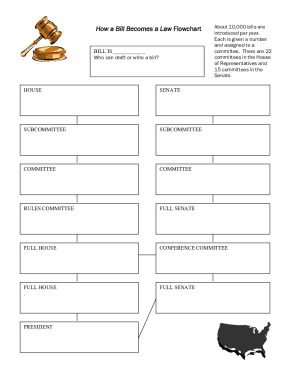
- Begin by familiarizing yourself with the flowchart's sections. Each component represents a stage in the legislative process.
- In the first section labeled 'Bill is drafted', specify who can draft or write a bill, considering the various contributors such as Congress members, the Executive Branch, and outside groups.
- In the 'House' section, indicate the introduction of the bill. Note that only members can introduce bills, and the bill is assigned to a committee.
- Next, in the 'Senate' section, repeat the bill introduction process as in the House.
- Under 'Subcommittee', describe how members study the bill, hold hearings, and debate its provisions before marking it up. Remember that if the bill passes here, it proceeds to the Committee.
- In the 'Committee' section, explain how the full committee considers the bill and if approved, sends it to the Rules Committee.
- Detail the role of the 'Rules Committee' where it issues a rule to govern debate on the floor before sending the bill to the Full House.
- For both 'Full House' and 'Full Senate' sections, describe the debate process and note that if there are amendments differing from one another, the bill must go to a Conference Committee.
- In the 'Conference Committee' section, outline how Senators and Representatives reconcile the bill differences before sending the compromise to the Full Senate.
- Conclude with the voting procedures for both the 'Full House' and 'Full Senate', explaining that if the bill passes, it proceeds to the President.
- Finally, explain the President's options: signing the bill, vetoing it, or taking no action, along with the congressional override process if vetoed.
- Once all sections are filled out, review your input for accuracy, then save your changes, download, or print the flowchart as needed.
Complete your documents online today to ensure clarity and professionalism in your submissions.
Experience a faster way to fill out and sign forms on the web. Access the most extensive library of templates available.
Related content
How a bill becomes a law · A bill is a proposal for a new law or a change to an existing...
BILL IS DRAFTED. Members of Congress, the Executive Branch, and even outside groups can...
Chapter 7 covers recall procedures, including FDA responsibilities, the recall enterprise...
Get answers to your most pressing questions about US Legal Forms API.
Who makes bills in the Philippines?
In the Philippines, bills are primarily created by members of Congress, including senators and representatives. Citizens can also influence bill creation by lobbying their representatives or advocating for specific issues. To better grasp this legislative creation process, a How A Bill Becomes A Law Flowchart can provide a clear understanding of who is involved at each step.
How does a proposed public policy bill become a law in the Barmm government?
In the Bangsamoro Autonomous Region in Muslim Mindanao (BARMM), a public policy bill is introduced by a member of the Parliament. The bill undergoes scrutiny during committee reviews and debates, with input from diverse stakeholders. If it passes all necessary steps, the Chief Minister can then sign it into law. A How A Bill Becomes A Law Flowchart is an excellent tool for learners to trace the bill's path through these stages.
How does a bill become a law in Canada for kids?
In Canada, when explaining how a bill becomes a law to kids, you can simplify the process by saying it starts with an idea and someone who brings that idea to Parliament. From there, the bill goes through several 'readings' or discussions, where everyone can talk about it. Once a majority agrees, it goes to the Governor General, who can sign it into law. A How A Bill Becomes A Law Flowchart can help visualize this fun journey.
What is the difference between law and act in the Philippines?
In the Philippines, an 'act' refers to a specific piece of legislation passed by either chamber of Congress, while a 'law' encompasses those acts once they receive presidential approval. Thus, while all laws are acts, not all acts become laws until signed by the President. Understanding this distinction becomes clearer when using a How A Bill Becomes A Law Flowchart, illustrating the transition from act to law.
How do bills become a law in the Philippines?
In the Philippines, a bill starts its journey in Congress, where it is deliberated upon in both the House of Representatives and the Senate. Each chamber holds discussions, committee reviews, and several readings of the bill. If both chambers finalize the bill, it is then submitted to the President for approval or veto. The process is further clarified through a How A Bill Becomes A Law Flowchart, which outlines all necessary steps.
How does a bill become a law in Delaware?
In Delaware, the journey of a bill begins with its introduction in either the House or Senate. After a series of discussions, committee evaluations, and amendments, the bill must pass through three readings. Once both chambers agree on the final version, the bill is sent to the Governor for approval. To simplify this process, a How A Bill Becomes A Law Flowchart can illustrate each critical stage of the legislative journey.
How does a bill become a law in the local government?
In local governments, the process for a bill becoming a law typically starts with the bill's introduction by a council member. Following this, the bill undergoes various readings and discussions, allowing for community input and revisions. Ultimately, if approved by the council, the bill is signed by the mayor or relevant local official. This process can be visualized using a How A Bill Becomes A Law Flowchart to understand each step clearly.
What are the steps a bill follows to become a law?
A bill follows several steps to become law, starting from drafting to final approval by the President. Initially, a bill is drafted and introduced in Congress, where it goes through committee reviews, debates, and votes. After passing both chambers, the bill is sent to the President, who can sign it into law or veto it. The 'How A Bill Becomes A Law Flowchart' simplifies this process, making it easy for you to understand the journey of legislation.
What are the 7 steps for a bill to become a law?
The seven steps for a bill to become a law consist of drafting, introduction, committee action, floor debate, voting, conference committee, and presidential approval. Each step is critical and shows how bills evolve into laws. The 'How A Bill Becomes A Law Flowchart' effectively illustrates each of these stages. By understanding this flowchart, citizens can better appreciate the complexity and significance of the legislative process.
What are the four main steps in the process of a bill becoming a law in GA?
In Georgia, the four main steps for a bill becoming law include introduction, committee consideration, chamber voting, and Governor approval. First, the bill is introduced in either the House or Senate. It then undergoes committee scrutiny before being debated and voted on by the chamber. Upon passing, the bill is sent to the Governor for final approval, reflecting a clear path presented in the 'How A Bill Becomes A Law Flowchart.'
Use professional pre-built templates to fill in and sign documents online faster. Get access to thousands of forms.
If you believe that this page should be taken down, please follow our DMCA take down process here.