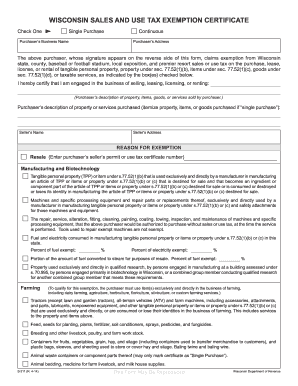
Items above. Feed, seeds for planting, plants, fertilizer, soil conditioners, sprays, pesticides, and fungicides. Breeding and other livestock, poultry, and farm work stock. Containers for fruits, vegetables, grain, hay, and silage (including containers used to transfer merchandise to customers), and plastic bags, sleeves, and sheeting used to store or cover hay and silage. Baling twine and baling wire. Animal waste containers or component parts thereof (may only mark certificate.

How it works
  • Open form

    Open form follow the instructions

  • Easily sign form

    Easily sign the form with your finger

  • Share form

    Send filled & signed form or save

How to fill out the WI DoR S-211 online

The Wisconsin Department of Revenue Sales and Use Tax Exemption Certificate, known as the WI DoR S-211, is essential for claiming exemptions from sales tax for various purchases. This guide will provide you with a clear, step-by-step approach to filling out the form accurately online.

Follow the steps to complete the WI DoR S-211 form online.

  1. Click ‘Get Form’ button to obtain the form and open it in the editor.
  2. Select the applicable exemption type by checking either the 'Single Purchase' or 'Continuous' box at the top of the form.
  3. Provide the purchaser's business name and address in the designated fields, ensuring accurate contact information.
  4. Describe the property or services being purchased under the section 'Purchaser’s description of property or services.' Itemize goods if 'Single Purchase' is selected.
  5. Enter the seller's name and address where applicable, ensuring it corresponds with the purchase location.
  6. Indicate the reason for exemption by checking the appropriate box. You may need to provide additional information depending on the selected exemption, such as a seller's permit number for resale exemptions.
  7. If claiming exemptions related to manufacturing, farming, or governmental units, provide the necessary details as specified on the form.
  8. Sign and date the form at the bottom. Ensure that the person signing has the authority to execute the certificate on behalf of the purchaser.
  9. Once completed, users can save changes, download, print, or share the form as needed.

Complete your WI DoR S-211 form online today to take advantage of tax exemptions.

Get form

Experience a faster way to fill out and sign forms on the web. Access the most extensive library of templates available.

Related content

Wisconsin Sales and Use Tax Exemption Certificate

S-211 (R. 6-22). Wisconsin Department of Revenue. Resale (Enter purchaser's seller's...

Learn more
W-9 and Tax Exempt Forms and Documents

Wisconsin Department of Revenue (WI DOR) Form S-211-SST (Multi-state Wisconsin Streamlined...

Learn more
Manual do usuário - PowerLite 700U

Resolução nativa de 1920 × 1200 pixels (WUXGA). Conectividade flexível. • Três...

Learn more
Questions & Answers

Get answers to your most pressing questions about US Legal Forms API.

Contact support

How do I get a farm tax exemption in Wisconsin?

To obtain a farm tax exemption in Wisconsin, you need to submit a completed application to your local municipality, along with proof of your agricultural income. The application should specify your farming activities and demonstrate compliance with state regulations. The WI DoR S-211 provides comprehensive guidance through this process, ensuring you have all the necessary information to submit your application successfully.

Exceptions to the underpayment penalty in Wisconsin can include circumstances where a taxpayer's income fluctuates significantly, or when they can demonstrate reasonable cause for underpayment. Knowing these exceptions is vital for compliance and financial planning. The WI DoR S-211 offers detailed explanations of the qualifications for these exceptions.

To obtain a property tax exemption in Wisconsin, you first need to file an application with your local assessor's office. You will need to provide documentation regarding your agricultural use of the property. The WI DoR S-211 is an invaluable resource that outlines the steps and necessary forms for securing your property tax exemption.

A farm in Wisconsin typically includes land used for agriculture, such as raising crops or livestock, and must meet the acreage or income requirements set by the state. The property must be actively managed for production. The WI DoR S-211 can provide further insights into how your property may qualify under the designation of a farm.

To qualify for a farm exemption, you must show proof of agricultural activity and meet the state's income requirements. This includes having a farm plan and maintaining accurate records of your agricultural production. By reviewing the WI DoR S-211, you gain access to all necessary regulations and guidelines on qualifying for exemptions.

In Wisconsin, certain entities, including federal government agencies, schools, and some non-profit organizations, are exempt from sales tax. Additionally, farmers purchasing supplies for agricultural use often qualify for exemptions. Understanding the WI DoR S-211 can help clarify your status in these situations.

To qualify for a farm tax exemption in Wisconsin, you must actively engage in farming and meet specific income criteria. The property should produce at least $6,000 in agricultural goods per year. The WI DoR S-211 provides details on eligibility and documentation needed to secure your exemption.

In Wisconsin, a property is considered a farm if it consists of at least 35 acres, or less if it produces at least $6,000 of agricultural products annually. This classification is essential for understanding eligibility for tax breaks and exemptions. Utilizing resources like the WI DoR S-211 can guide you through the requirements and help you determine your eligibility.

In Texas, the minimum acreage requirement for agricultural exemption varies by county but typically starts at 10 acres. However, the crucial factor is that the land must be used primarily for agricultural purposes. While this question refers to Texas, understanding your local laws is vital. The WI DoR S-211 form can help clarify your exemption status if you happen to operate in Wisconsin.

In Wisconsin, there is no specific minimum number of acres required to be considered a farm for tax purposes. Instead, the emphasis is on whether your land is primarily used for farming activities. Using the WI DoR S-211 can help clarify your tax status and ensure compliance with agricultural guidelines. It's beneficial to maintain clear records of your farming operations.

Get This Form Now!

Use professional pre-built templates to fill in and sign documents online faster. Get access to thousands of forms.

If you believe that this page should be taken down, please follow our DMCA take down process here.

WI DoR S-211 Form

This form is available in several versions. Select the version you need from the drop-down list below.

Get WI DoR S-211