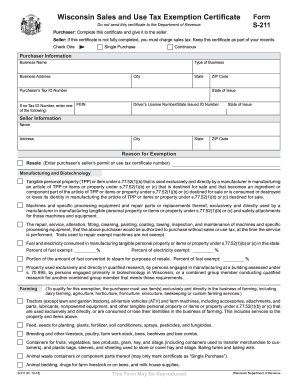
Nts, nonpowered equipment, and other tangible personal property or items or property under s.77.52(1)(b) or (c) that are used exclusively and directly, or are consumed or lose their identities in the business of farming. This includes services to the property and items above. Feed, seeds for planting, plants, fertilizer, soil conditioners, sprays, pesticides, and fungicides. Breeding and other livestock, poultry, farm work stock, bees, beehives and bee combs. Containers for fruits, v.
Open form follow the instructions
Easily sign the form with your finger
Send filled & signed form or save
How to fill out the WI DoR S-211 online
The WI DoR S-211 is an essential document used for claiming sales and use tax exemptions in Wisconsin. This guide will provide a comprehensive overview of how to correctly fill out the form online, ensuring you understand each section and field for proper completion.
Follow the steps to complete the WI DoR S-211 accurately.
- Press the ‘Get Form’ button to access the form and open it in your editing tool.
- Choose between 'Single Purchase' or 'Continuous' by selecting the applicable option.
- In the 'Purchaser Information' section, enter the business name, type of business, business address, city, state, and ZIP code. Make sure to include the Purchaser’s Tax ID Number. If you do not have a Tax ID Number, provide either the FEIN or a Driver’s License Number with the corresponding state of issue.
- Fill in the 'Seller Information' section with the seller’s name, address, city, state, and ZIP code.
- Select the reason for exemption from the provided categories, ensuring that you enter any necessary identifiers, such as the seller’s permit number if applicable.
- Sign and date the certificate at the bottom of the form to declare that the information is accurate and that the products purchased will be used in an exempt manner.
- Once all required fields are filled out and the form is complete, you can save your changes, download, print, or share the form as needed.
Complete your tax exemption documents online today to ensure compliance and efficiency.
Experience a faster way to fill out and sign forms on the web. Access the most extensive library of templates available.
Related content
S-211 (R. 6-22). Wisconsin Department of Revenue. Resale (Enter purchaser's seller's...
Wisconsin Department of Revenue (WI DOR) Form S-211-SST (Multi-state Wisconsin Streamlined...
Resolução nativa de 1920 × 1200 pixels (WUXGA). Conectividade flexível. • Três...
Get answers to your most pressing questions about US Legal Forms API.
What happens if you don't file taxes in Wisconsin?
Failing to file taxes in Wisconsin can lead to penalties, interest on unpaid taxes, and potential legal consequences. It's crucial to adhere to the filing requirements outlined in the WI DoR S-211 to avoid complications. If you're facing challenges, platforms like uslegalforms can offer help to ensure you're meeting your tax obligations.
What is Wisconsin filing requirements?
Wisconsin filing requirements outline the necessary conditions for individuals and businesses when filing their state income tax returns. These include applicable forms and due dates set by the Wisconsin Department of Revenue. By understanding the WI DoR S-211, you can navigate these requirements confidently and avoid potential issues.
What does filing requirements mean?
Filing requirements set the standards and deadlines that taxpayers must meet when submitting their returns to the revenue authorities. In Wisconsin, these requirements help ensure compliance with state laws and accurate assessment of taxes owed. Familiarizing yourself with the WI DoR S-211 can help clarify these responsibilities.
How to get farm tax exempt wi?
To obtain a farm tax exemption in Wisconsin, you must apply for the necessary forms and prove that your land is used for agricultural purposes. This often involves completing the application outlined in the WI DoR S-211. Utilizing platforms like uslegalforms can simplify this process, offering templates and guidance tailored to your needs.
How to apply for sales tax exemption in Wisconsin?
To apply for a sales tax exemption in Wisconsin, you need to complete the appropriate application form, typically the Wisconsin Sales and Use Tax Exemption Certificate. Make sure you gather all necessary documentation before submitting your application. The WI DoR S-211 offers helpful resources to guide you through this process smoothly.
Who is exempt from Wisconsin income tax?
Certain individuals and organizations may be exempt from Wisconsin income tax, including some non-profit entities and residents whose income falls below specific thresholds. It's important to review the guidelines associated with the WI DoR S-211 to see if you qualify for any exemptions. Consulting with a tax professional can provide personalized insights into your situation.
What is the filing requirement?
The filing requirement in Wisconsin refers to the obligation to submit your income tax return to the Department of Revenue. For most individuals and businesses, this means filing Form 1 or another relevant form based on your specific situation. Understanding the WI DoR S-211 can provide clarity on which forms you need and when they are due.
How do I get a farm tax exemption in Wisconsin?
To obtain a farm tax exemption in Wisconsin, you need to submit an application that details your farming operations and income. This process typically requires documentation supporting your claims, and adherence to guidelines in WI DoR S-211 is essential. Be diligent in keeping records to streamline your application and ensure eligibility for tax benefits.
How do I qualify for farm tax exemption in Wisconsin?
To qualify for a farm tax exemption in Wisconsin, you must demonstrate that your farming operation meets specific agricultural criteria, which often include income thresholds and land usage. Filing the correct forms, including those outlined in WI DoR S-211, is a crucial step. This process ensures that your farming activities can be recognized for tax benefits.
Who is exempt from Wisconsin sales tax?
In Wisconsin, certain entities and activities are exempt from sales tax, including qualifying farms that engage in agriculture-related activities. Additionally, organizations like non-profits or government bodies may also qualify for exemptions. Understanding your status is crucial to ensure you benefit from applicable tax exemptions under WI DoR S-211.
Use professional pre-built templates to fill in and sign documents online faster. Get access to thousands of forms.
If you believe that this page should be taken down, please follow our DMCA take down process here.
This form is available in several versions. Select the version you need from the drop-down list below.