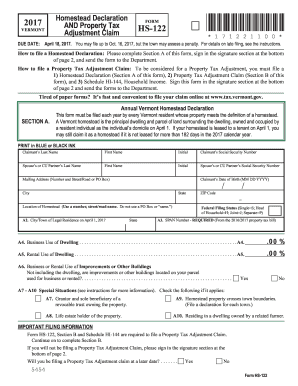
Esiding in a dwelling owned by a related farmer. revocable trust owning the property. (File a declaration for each town.) IMPORTANT FILING INFORMATION Form HS-122, Section B and Schedule HI-144 are required to file a Property Tax Adjustment Claim. Continue on to complete Section B. If you will not be filing a Property Tax Adjustment Claim, please sign in the signature section at the bottom of page 2. Will you be filing a Property Tax Adjustment claim at a later date?. . . . . . . c Yes 5454.
Open form follow the instructions
Easily sign the form with your finger
Send filled & signed form or save
How to fill out the VT HS-122 & HI-144 online
Filing the Vermont Homestead Declaration and Property Tax Adjustment Claim forms online can streamline your process and minimize paperwork. This guide provides clear, step-by-step instructions for completing the VT HS-122 and HI-144 forms to ensure you meet the necessary requirements and deadlines.
Follow the steps to fill out your forms correctly.
- Click the ‘Get Form’ button to obtain the form and open it in the editor.
- Begin with Section A of the HS-122 form. Provide the claimant's last name, first name, and initial as well as the social security number. Ensure that you fill this information accurately.
- Continue by entering the spouse’s or civil union partner’s last name, first name, initial, and social security number. Complete the mailing address, including street number, city, state, and ZIP code.
- Indicate your date of birth in the specified format (MM DD YYYY), ensuring it is correct and complete.
- Next, fill in the location of your homestead. This must be a physical address; do not use a PO Box or enter 'same.'
- Complete the city/town of legal residence on April 1 and specify your federal filing status, selecting from the options provided (Single=S; Head of Household=H; Joint=J; Separate=P).
- Obtain and enter the SPAN number from your property tax bill. This number is essential for processing your claim.
- Proceed to indicate any business or rental use of the dwelling as applicable by marking the relevant fields.
- Check the boxes for any special situations that may apply to your property, such as being a grantor of a revocable trust or holding a life estate.
- If you plan on filing a Property Tax Adjustment claim later, indicate this in Section B of the form, and make sure to sign the form in the signature section at the bottom of page 2.
- For the HI-144 schedule, follow the prompts to record income information accurately. Ensure that all necessary personal information is printed clearly in blue or black ink.
- Complete all required income fields, including details for yourself, your spouse, and any other persons living with you during the filing period.
- Review the completed forms to ensure accuracy, proper signatures, and inclusion of required documents before final submission.
- Once everything is complete, save your changes, and choose to download, print, or share the form as needed.
Begin your online filing today to streamline your property tax documentation.
Experience a faster way to fill out and sign forms on the web. Access the most extensive library of templates available.
Related content
Jan 16, 2025 — 2025 Form HS-122, Schedule HI-144, Homestead Declaration AND Property Tax...
Enter the correct household income and mark AMENDED on the HI-144. Send the amended HI-144...
Mic cardioide para uso geral em vocal e instrumento, fornece resposta de transientes e...
Get answers to your most pressing questions about US Legal Forms API.
How do you qualify for the homestead credit?
To qualify for the homestead credit in Vermont, you must submit the Vermont Form HS-122, attesting that your property is your primary residence. Additionally, your income, property value, and tax liability play crucial roles in determining your eligibility. By accurately completing the necessary paperwork, you can unlock valuable savings on your property taxes, simplifying your financial responsibilities.
What is the difference between homestead and non-homestead in Vermont?
In Vermont, a homestead is any property that serves as your primary residence, while a non-homestead property is typically used for rental or commercial purposes. Homestead properties benefit from lower property tax rates and access to property tax credits, like those provided through the VT HS-122 & HI-144 forms. Understanding this distinction can help property owners take advantage of available tax benefits.
What is Vermont Form HS-122?
Vermont Form HS-122 is the Homestead Declaration form that property owners must file to claim homestead tax status. This form ensures that you receive the correct property tax rates and can access potential credits available to homeowners. Completing the HS-122 accurately is key to maximizing your savings on property taxes.
Who is eligible for the Vermont property tax credit?
Eligibility for the Vermont property tax credit generally depends on your income, property value, and residency status. Homeowners and renters may qualify, as long as they meet specific income thresholds and reside in the state. Completing the VT HS-122 & HI-144 forms accurately will help determine your eligibility and allow you to receive assistance.
Does Vermont have a property tax discount for seniors?
Yes, Vermont offers property tax discounts for seniors through various programs. For eligible seniors, these discounts can significantly ease the financial strain of property taxes, especially if they are on a fixed income. To access these benefits, seniors should submit the necessary forms, such as the VT HS-122 & HI-144, to ensure they qualify for available tax credits.
What is a Schedule Hi 144 in Vermont?
The Schedule HI-144 is a form used in Vermont to calculate the benefits of the Vermont Property Tax Credit program. It helps assess your eligibility for property tax relief based on your income and property value. Essentially, this form enables you to seek financial assistance and reduce your property tax burden, making it easier for you to manage your expenses.
How to lower property taxes in Vermont?
Lowering property taxes in Vermont can be achieved by applying for various tax credits and exemptions available to homeowners. Understanding the requirements for the VT HS-122 & HI-144 forms will provide you with the necessary steps to reduce your tax obligations. Additionally, regularly reviewing your property assessment can help ensure you're not overpaying. Consult local resources for guidance on maximizing your savings.
How is homestead tax credit calculated?
The homestead tax credit in Vermont is calculated based on your household income and the amount of property tax you owe. The VT HS-122 & HI-144 provide the necessary formulas and tables to determine your eligibility and credit amount. Applying this assessment properly can lead to significant savings on your property tax bill. Utilize these tools to understand how much you can save.
What is the income limit for the property tax credit in Vermont?
The income limit for the property tax credit in Vermont varies based on household size and circumstances. Generally, a lower-income threshold allows more residents to benefit from this program, ensuring financial assistance where needed most. It's advisable to check the latest guidelines in the VT HS-122 & HI-144 to confirm the specific limits relevant to you. The USLegalForms platform can direct you to the latest information and assist with applications.
Who pays Vermont property transfer tax?
In Vermont, the seller typically pays the property transfer tax when real estate changes ownership. However, this can vary depending on the terms negotiated in the sales contract. Understanding this tax is essential for both buyers and sellers involved in transactions. Accessing tools and forms from USLegalForms can help clarify responsibilities and provide important information related to the VT HS-122 & HI-144.
Use professional pre-built templates to fill in and sign documents online faster. Get access to thousands of forms.
If you believe that this page should be taken down, please follow our DMCA take down process here.
This form is available in several versions. Select the version you need from the drop-down list below.