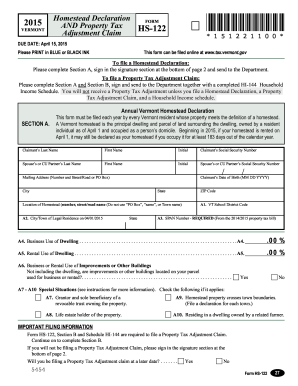
Section B. If you will not be filing a Property Tax Adjustment Claim, please sign in the signature section at the bottom of page 2. Will you be filing a Property Tax Adjustment claim at a later date?. . . . . . . c Yes 5454 c No Form HS-122 27 Claimant s Last Name Social Security Number *151221200* * 1 5 1 2 2 1 2 0 0 * DUE DATE: April 15, 2015. Claims accepted up to, but not after, October 15, 2015. SECTION B. PROPERTY TAX ADJUSTMENT CLAIM For Household Income up to approx. $10.
Open form follow the instructions
Easily sign the form with your finger
Send filled & signed form or save
How to fill out the VT Form HS-122 online
Filling out the VT Form HS-122 is an essential step for Vermont residents seeking to declare their homestead and file a property tax adjustment claim. This guide will provide you with clear instructions to complete the form efficiently online.
Follow the steps to fill out the VT Form HS-122 online.
- Press the ‘Get Form’ button to retrieve the VT Form HS-122 and open it in your document viewer.
- Begin by completing Section A of the form. This section requires your personal information, including your last name, first name, and Social Security number. Ensure that you also fill in the details of your spouse or civil union partner if applicable.
- Provide your mailing address and date of birth, ensuring accuracy in each field to avoid delays in processing.
- Indicate the location of your homestead by providing the number and street name of your principal dwelling. Be careful not to use a PO Box or the name of the town in this section.
- Complete the required fields which include the school district code and the SPAN number, both essential for tax purposes.
- If your dwelling has a business or rental use, specify that in the designated fields. This helps determine eligibility for certain tax adjustments.
- After completing Section A, check if you will be filing a Property Tax Adjustment Claim. If so, proceed to complete Section B.
- In Section B, provide information about your household income and answer all eligibility questions honestly. Fill in amounts found on your property tax bill as instructed.
- Attach the completed HI-144 Household Income Schedule if applicable, as this is necessary for processing your property tax adjustment claim.
- Review all entries for accuracy before signing the form in the designated signature section at the bottom of the second page.
- Finally, save any changes made, and download or print the filled form to keep a copy for your records before submitting it to the Department of Taxes by mail.
Complete your VT Form HS-122 online now to ensure your property tax matters are handled efficiently.
Experience a faster way to fill out and sign forms on the web. Access the most extensive library of templates available.
Related content
Jan 16, 2025 — 2025 Form HS-122, Schedule HI-144, Homestead Declaration AND Property Tax...
HOMEOWNERS Form HS-122, Homestead Declaration AND Property Tax Credit Claim, must be filed...
Mic cardioide para uso geral em vocal e instrumento, fornece resposta de transientes e...
Get answers to your most pressing questions about US Legal Forms API.
What is Vermont Form HS-122?
Vermont Form HS-122 is a state form used to apply for property tax credits, primarily aimed at helping low to moderate-income households manage their property tax liabilities. This form allows taxpayers to detail their income, property taxes, and other relevant information. Completing this form accurately can lead to significant savings on property taxes. For assistance, platforms like US Legal Forms can simplify the filing process.
Who is eligible for the Vermont property tax credit?
Eligibility for the Vermont property tax credit typically includes homeowners and renters whose income falls below a certain threshold. Property owners must also declare their primary residence to qualify. To ensure you meet the criteria, familiarizing yourself with Vermont Form HS-122 can provide detailed guidance and instructions.
How to fill out a withholding allowance form?
When completing a withholding allowance form, accurately assess your financial situation to determine the number of allowances to claim. Provide detailed personal information, and follow prompts to ensure all required sections are complete. For clarity on related tax benefits, including property credits, consult Vermont Form HS-122 and the resources available through platforms like US Legal Forms.
How to fill out a withholding exemption form?
To fill out a withholding exemption form, start by providing your personal information, including your name and Social Security number. Then, indicate whether you claim exempt status based on your tax situation. Be sure to review the criteria for exemption to ensure you qualify, and if you require additional information, refer to Vermont Form HS-122 for pertinent tax details.
What is the income limit for the property tax credit in Vermont?
In Vermont, the income limit for the property tax credit changes depending on various factors like household size and expenses. As of the latest tax year, individuals and couples should check specific thresholds to determine eligibility. If you think you might qualify, it's worthwhile to review Vermont Form HS-122 and consult with a tax professional.
What does 3 allowances mean?
Claiming 3 allowances on your W4 means you expect a certain amount of tax withheld from your paycheck, potentially leading to a smaller tax refund. Generally, each allowance reduces the amount of income subject to withholding, allowing for more of your income to be available in each paycheck. If unsure about how this affects your taxes, consider reviewing relevant documents like Vermont Form HS-122 for guidance.
What is the difference between homestead and non-homestead in Vermont?
In Vermont, a homestead is a primary residence owned and occupied by an individual, which qualifies for certain tax benefits. Non-homestead properties, on the other hand, include second homes, investment properties, and businesses, which do not receive the same tax relief. Understanding these distinctions can improve your tax planning. For property tax credits, referencing Vermont Form HS-122 may help clarify your eligibility.
Where to get healthcare gov tax forms?
Healthcare tax forms can be obtained directly from the Healthcare website, where you can find information related to health insurance coverage and tax obligations. Additionally, you may request forms by contacting your state’s health insurance assistance program. Remember, these forms may differ from the VT Form HS-122, which focuses solely on property tax credits in Vermont.
Where to pick up tax forms?
You can pick up tax forms, including the VT Form HS-122, at your local town clerk’s office or the Vermont Department of Taxes. Additionally, many forms are available online through the Vermont Department of Taxes website, allowing you to download and print them at your convenience. For a comprehensive overview of all available forms, visit the official state tax website.
Does Vermont have property tax relief for seniors?
Yes, Vermont offers property tax relief for seniors through various programs, including the property tax credit. Seniors must meet income and residency requirements to qualify for relief. By filing the VT Form HS-122, eligible seniors can benefit from reduced property taxes, allowing for a more manageable financial situation in retirement.
Use professional pre-built templates to fill in and sign documents online faster. Get access to thousands of forms.
If you believe that this page should be taken down, please follow our DMCA take down process here.
This form is available in several versions. Select the version you need from the drop-down list below.