7. Did you claim a homestead property tax exemption for any state? No. Go to Question 8. Yes. What state(s)? 8. Where are the items or possessions that you consider important to you located, e.g.: items of significant sentimental value, family heirlooms, collections of valuables, pets, or possessions that enhance the quality of your life? Item/Possession Location.
Open form follow the instructions
Easily sign the form with your finger
Send filled & signed form or save
How to fill out the VT Domicile Statement online
Filling out the Vermont Domicile Statement is an important step in confirming your residency status for tax purposes. This guide provides a clear and supportive walkthrough of the process, ensuring you have all the necessary information at your fingertips.
Follow the steps to complete the VT Domicile Statement online.
- Press the ‘Get Form’ button to access the VT Domicile Statement, and open it in your document editor.
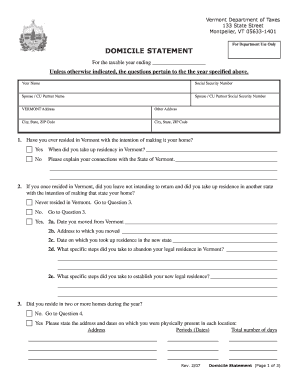
- Begin by entering your name and Social Security number in the designated fields. If applicable, provide your spouse or civil union partner's name and Social Security number.
- Fill in your primary Vermont address, followed by your other address, ensuring all details are accurate.
- Respond to the first question regarding your residency status in Vermont, indicating the date you took up residency if you answered 'Yes.' If you answered 'No,' provide a brief explanation of your connections to Vermont.
- For question two, answer whether you previously resided in Vermont and, if so, provide details such as the date you moved, your new address, and specific steps taken regarding your residency.
- In question three, indicate if you lived in multiple locations during the year. If 'Yes,' list each address, the duration of your stay, and the total number of days spent at each location.
- Proceed to question four to confirm if you own or rent property. If 'Yes,' indicate property values and how many days you spent at each location.
- Answer question five regarding the residence of your immediate family members.
- For question six, indicate any differences in the physical presence of your spouse or partner and state whether a separate domicile statement is required.
- Continue by answering the questions from seven to ten about tax exemptions, possessions of importance, employment states, and business ownership.
- In questions eleven through eighteen, provide information concerning your children's education, mailing address, tax filing states, and any additional context that supports your residency status.
- Upon completing the form, review all entries for accuracy. Save your changes, and use the options provided to download, print, or share the VT Domicile Statement.
Complete your VT Domicile Statement online today for accurate residency reporting.
Experience a faster way to fill out and sign forms on the web. Access the most extensive library of templates available.
Related content
Available 2024 forms include Homestead Declaration, Income Tax Return Booklet, Domicile...
New applicants who did not complete the in-state application as a part of their admissions...
Sep 16, 2013 — In most Federal tax contexts, a state-of-domicile rule would present...
Get answers to your most pressing questions about US Legal Forms API.
What determines residency in Vermont?
Residency in Vermont is determined by factors such as physical presence, intention to remain, and establishing a primary home. Various documents can support these claims, including utility bills and official registrations. Filing a VT Domicile Statement is essential in articulating your residency to tax officials.
What is evidence of a person's domicile?
Evidence of a person's domicile includes documents such as a lease or mortgage agreement, tax return showing the permanent address, and any registered voter status. These forms of proof are vital when establishing residency. A VT Domicile Statement accompanied by such evidence can greatly assist in verifying your domiciliary intent.
How long do you have to live in Vermont to be considered a resident?
To be considered a resident in Vermont, you typically need to live there for more than 183 days within a year. However, various other factors can also determine your residency status. Submitting a VT Domicile Statement can help solidify your claim as a resident, especially if you feel your residency status might be questioned.
What is a primary residence in Vermont?
A primary residence in Vermont is the main home where you live and intend to return after any travel. This residence is significant for tax purposes and can affect your eligibility for certain benefits. When you file a VT Domicile Statement, it helps define your primary residence clearly.
How does the 183 day rule work?
The 183 day rule works by counting the number of days you physically reside in Vermont within a year. If you exceed 183 days, you are classified as a resident, thus subject to Vermont income taxes. Incorporating a VT Domicile Statement in your tax documentation can help support your residency claim.
What is the Vermont Form 111?
Vermont Form 111 is used to file your income tax return for residents and part-year residents. This form requires information that reflects your total income and deductions for the year. Completing this form accurately often involves submitting a VT Domicile Statement to clarify your residency status.
What is the rule 60 in Vermont?
Rule 60 in Vermont pertains to the appeals process for residency determinations. This rule allows individuals to contest decisions made by tax authorities regarding their residency status. Filing a proper VT Domicile Statement can help avoid misunderstandings that may lead to disputes under this rule.
What is an example of a domicile?
An example of a domicile would be a homeowner in Vermont who lives there year-round and intends to make it their permanent home. Unlike a vacation home or temporary rental, this residence is where the person plans to return consistently. Declaring this status through a VT Domicile Statement can provide clarity to local tax authorities.
What is accepted as proof of domicile?
Accepted proofs of domicile include documents like a driver’s license, voter registration, and tax returns that show your permanent address. Additionally, utility bills and property deeds can also support your claim. When preparing your VT Domicile Statement, gathering these documents is helpful.
What is a domicile statement?
A domicile statement is a formal declaration that claims your permanent residence in a particular state, such as Vermont. This document assists in determining your tax obligations. When filing a VT Domicile Statement, you clarify your residency status to the authorities.
Use professional pre-built templates to fill in and sign documents online faster. Get access to thousands of forms.
If you believe that this page should be taken down, please follow our DMCA take down process here.
This form is available in several versions. Select the version you need from the drop-down list below.