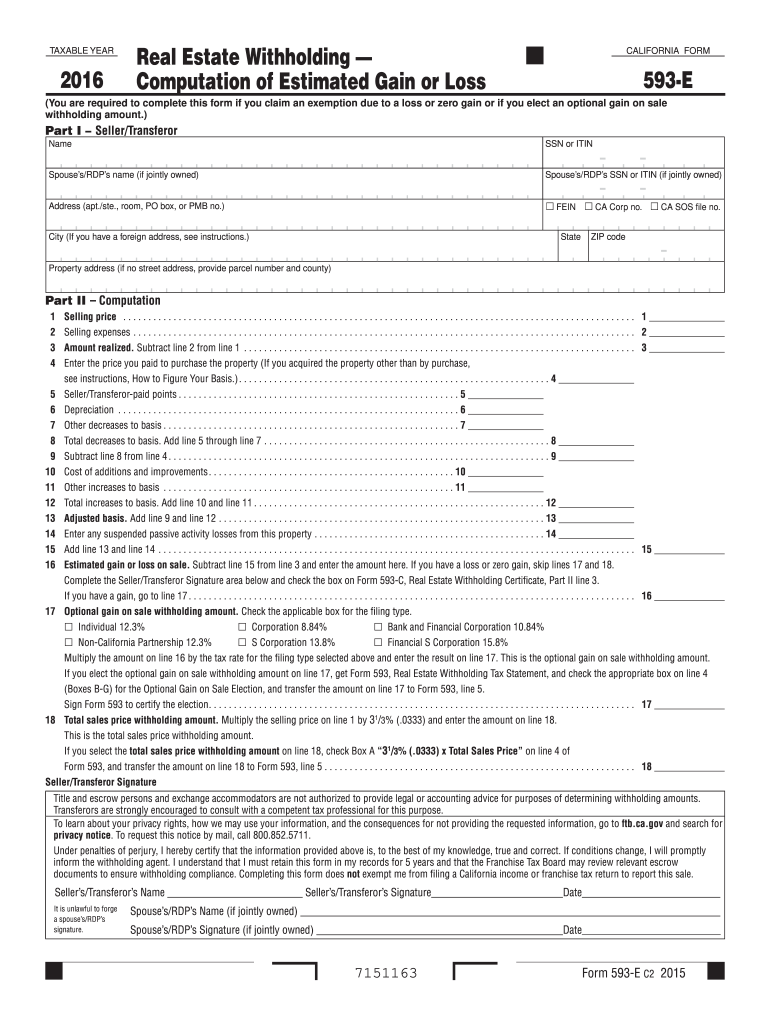
. . . . . . . . . . . . . . . . . . . . . . . . . . . . . . . . . . . . . . . . . . . . . . . . . . . . . . . . . . . . . . . . . . 9 10 Cost of additions and improvements . . . . . . . . . . . . . . . . . . . . . . . . . . . . . . . . . . . . . . . . . . . . . . . . . 10 11 Other increases to basis . . . . . . . . . . . . . . . .
Loading

Open form follow the instructions

Easily sign the form with your finger

Send filled & signed form or save
How to fill out the CA FTB 593-E online
The CA FTB 593-E form is essential for estimating the gain or loss from real estate transactions for withholding purposes. This guide provides clear, step-by-step instructions on how to complete the form accurately and confidently.
Follow the steps to fill out the CA FTB 593-E form online.
- Click the 'Get Form' button to obtain the form and open it in your preferred online editor.
- In Part I, enter the names, social security numbers (SSNs) or individual taxpayer identification numbers (ITINs), and addresses of the seller/transferor, including a spouse or registered domestic partner if jointly owned.
- In Part II, begin the computation by entering the selling price of the property on line 1. This should be the total amount expected from the sale.
- Next, enter the selling expenses on line 2. Include all costs such as commissions, advertising fees, and any legal fees.
- On line 3, calculate the amount realized by subtracting the selling expenses (line 2) from the selling price (line 1).
- On line 4, enter the purchase price of the property. This may include your down payment and any debts incurred.
- Fill out line 5 with the amount of seller/transferor-paid points, if applicable. Points are fees paid to obtain a loan.
- Complete line 6 by entering the total depreciation taken on the property during the period it was held, or the depreciation you could have taken.
- Add any other decreases to your basis for line 7, such as casualty loss deductions or energy credits.
- On line 8, calculate the total decreases by summing lines 5 through 7.
- Subtract the total decreases in line 8 from the purchase price in line 4 to get the adjusted basis on line 9.
- Complete lines 10 to 15 with any costs of additions and improvements, other increases, and any suspended passive activity losses.
- For line 16, calculate the estimated gain or loss by subtracting line 15 from line 3. If there is a loss or zero gain, proceed accordingly.
- If opting for the gain on sale withholding, complete line 17 by selecting the appropriate tax rate and multiplying it by the gain on line 16.
- On line 18, provide the total sales price withholding amount by multiplying the selling price on line 1 by 31/3%.
- Lastly, ensure you sign and date the form, retaining a copy for your records, and consider seeking advice from a tax professional if necessary. You can now save changes, download, print, or share the completed form.
Complete your CA FTB 593-E document online today for smooth processing.
Experience a faster way to fill out and sign forms on the web. Access the most extensive library of templates available.
Related content
If you have a loss or zero gain, skip lines 17 and 18 . Complete the Seller/Transferor...
Sellers of California real estate use Form 593, Real Estate Withholding ... For...
Ontario, CA 91764. Tel: (909) 593-2100. Fax: (909) 593-2500. Hours of Operation. 7:30 a.m...
Get answers to your most pressing questions about US Legal Forms API.
How to get a copy of form 593?
You can obtain a copy of CA Form 593 from the California Franchise Tax Board's official website. It's also available through various tax software solutions and tax professionals. If you prefer, our platform simplifies the process, allowing you to download and fill out the form easily. Ensure you have the most recent version to avoid any compliance issues.
Is the California franchise tax board the same as the IRS?
No, the California Franchise Tax Board (CA FTB) and the Internal Revenue Service (IRS) are distinct entities. The IRS handles federal tax matters, while the CA FTB is focused on state tax issues in California. Understanding the difference is crucial for managing your tax responsibilities correctly. You can find separate guidelines for both on their respective websites.
Who prepares Form 593?
Typically, CA Form 593 is prepared by the taxpayer or a tax professional. If you're dealing with complex transactions, having an expert prepare the form ensures accuracy and compliance with state requirements. You should gather necessary information, such as income details, before starting the preparation process. To ensure accuracy, you might consider using our user-friendly services for help.
How do I file Form 593?
Filing CA Form 593 involves completing the form accurately and submitting it to the CA FTB. You can file it electronically or by mail, based on your preference. Make sure to keep copies of the submitted form for your records. Our platform provides easy access to the form and additional resources to help you with the filing process.
How do I claim exemption from California withholding?
To claim exemption from California withholding, you will need to file the CA FTB 593-E and provide the necessary documentation. Ensure that you meet the exemption criteria specified by the CA FTB, and complete the form accurately. It's best to consult with a tax professional if you have any uncertainties. Using our platform can simplify this process, guiding you step by step.
Does Form 593 need to be attached to tax return?
Yes, you must attach CA Form 593 to your California tax return if it applies to your situation. This step ensures that the appropriate withholding credits are applied to your tax liability. Failing to include this form may delay your return processing. Be diligent about documenting all relevant forms for your records.
Who provides CA Form 593?
The California Franchise Tax Board (CA FTB) provides the CA Form 593. This form is specifically designed for withholding tax purposes in California. When you sell a property or have certain income sources, you will need this form. Make sure you get the correct version from the official CA FTB website or trusted resources.
Does a tax return need to be filed for a revocable trust?
Generally, a revocable trust does not need to file a separate tax return while the grantor is alive, as all income is typically reported on the grantor's tax return. However, once the grantor passes away, the trust may need to file a taxable income return. For further information on this matter, refer to the guidance offered by CA FTB 593-E, which can help clarify your responsibilities.
What is California Form 593 used for?
California Form 593 serves to report and calculate withholding for the sale or transfer of California real estate. This form helps ensure compliance with state tax laws and prevents future tax liabilities for sellers. Understanding the CA FTB 593-E can help you navigate the intricacies involved in real estate transactions and ensure you file correctly.
Who must file a California fiduciary income tax return?
A California fiduciary income tax return must be filed by estates and trusts that generate taxable income exceeding the state's filing threshold. Additionally, all fiduciaries responsible for managing these estates and trusts must understand their tax responsibilities. Consulting the CA FTB 593-E can provide clarity on your filing obligations and potential exceptions.
Use professional pre-built templates to fill in and sign documents online faster. Get access to thousands of forms.
If you believe that this page should be taken down, please follow our DMCA take down process here.
This form is available in several versions. Select the version you need from the drop-down list below.