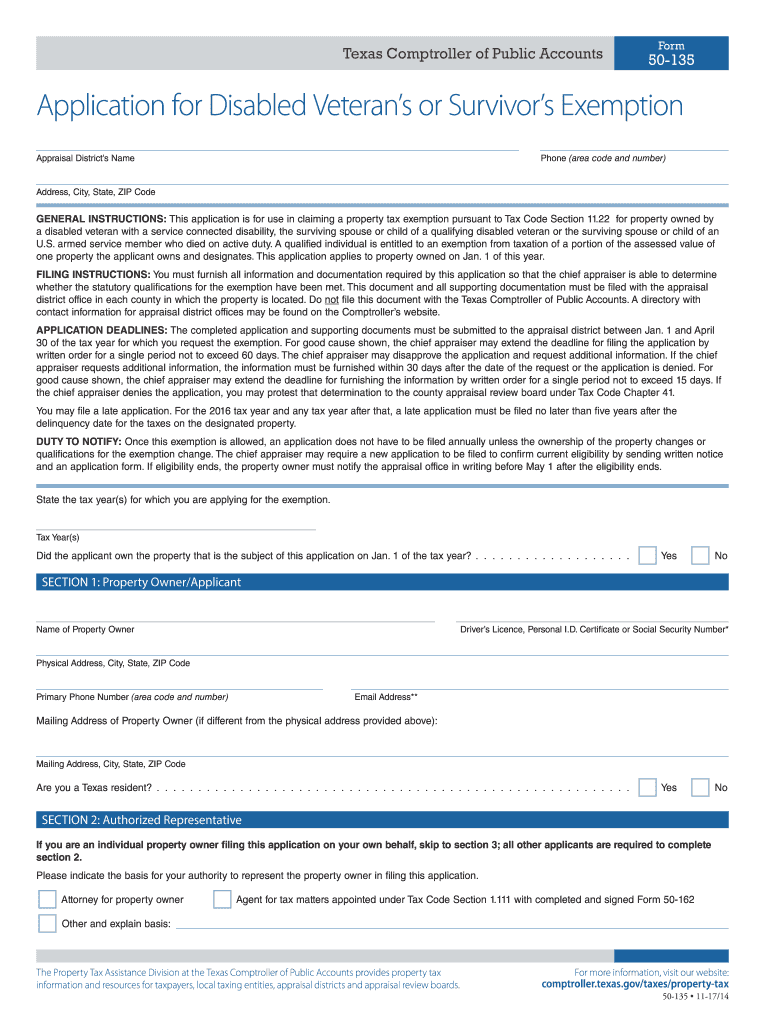
Iting before May 1 after the eligibility ends. State the tax year(s) for which you are applying for the exemption. Tax Year(s) Did the applicant own the property that is the subject of this application on Jan. 1 of the tax year? . . . . . . . . . . . . . . . . . . . . Yes No SECTION 1: Property Owner/Applicant Name of Pro.
Loading

Open form follow the instructions

Easily sign the form with your finger

Send filled & signed form or save
How to fill out the TX Comptroller 50-135 online
Filling out the TX Comptroller 50-135 online is a crucial step in applying for a Disabled Veteran’s or Survivor’s Exemption. This guide provides clear instructions to help users navigate the form efficiently and effectively.
Follow the steps to complete the application accurately.
- Press the ‘Get Form’ button to access the application. This will open the form in an editable format, allowing you to enter your information.
- Indicate the tax year(s) for which you are applying for the exemption. Ensure that you clearly specify the relevant year(s) as it is essential for processing.
- Answer the question regarding property ownership on January 1 of the tax year. Mark 'Yes' or 'No' accordingly.
- In Section 1, fill in your full name as the property owner, along with your Driver’s License, Personal I.D. Certificate, or Social Security Number. Complete your physical address, including the city, state, and ZIP code.
- Provide your primary phone number and email address. If your mailing address differs from your physical address, include that information as well.
- Confirm your residency status by selecting ‘Yes’ or ‘No’ to the question regarding Texas residency.
- If applicable, complete Section 2, which requests information about an authorized representative, including their name, title, phone number, and address.
- In Section 3, provide detailed property descriptions, including the property's physical address, Appraisal District Account Number, manufactured home details, and legal descriptions, if necessary.
- In Section 4, mark the appropriate exemption you are applying for and include the veteran’s name, branch of service, serial number, and disability rating as required.
- Attach any additional documents needed, especially if the exemption is based on a veteran’s disability rating.
- Complete Section 6 with the printed name and signature of the property owner or authorized representative, followed by the date.
- Finally, save your changes, and consider downloading or printing a copy for your records before submitting the document to your local appraisal district.
Get started with your document submission online today!
Experience a faster way to fill out and sign forms on the web. Access the most extensive library of templates available.
Related content
GENERAL INFORMATION: Property owners applying for a disabled veteran's or survivor's...
Nov 9, 2021 — To file for a disabled veteran's exemption, you must complete the...
Get answers to your most pressing questions about US Legal Forms API.
How much will I save with homestead exemption in Texas?
The savings from a homestead exemption in Texas depend on your home's value and the specific exemption you qualify for. Generally, homeowners can save several hundred to thousands of dollars yearly. To assess your potential savings accurately, refer to the TX Comptroller 50-135 for guidelines and examples that can clarify your benefits.
Does homestead exemption lower property taxes in Texas?
Yes, a homestead exemption directly lowers property taxes in Texas by allowing you to reduce the amount of your home's value that the county appraises for tax purposes. This exemption maximizes savings and can make homeownership more affordable. If you're interested in learning more, the TX Comptroller 50-135 provides comprehensive information on the subject.
How does homestead lower taxes?
A homestead lowers your taxes by exempting a portion of your home's value, effectively reducing your total taxable amount. This decrease means a lower tax bill each year, offering financial relief. For precise calculations and to see how this impacts you specifically, review the TX Comptroller 50-135 for detailed insights.
How to file property tax exemption in Texas?
Filing for a property tax exemption in Texas involves submitting an application to your local appraisal district. You typically need to provide proof of eligibility, such as age or disability. For a step-by-step process and necessary forms, consider visiting US Legal Forms, where you can find detailed templates that assist you in filing correctly.
How does the Texas veteran property tax exemption work?
The Texas veteran property tax exemption offers qualifying veterans a reduction on their property taxes. This exemption varies based on the veteran’s disability rating and can provide substantial financial relief. To get detailed information about the specific benefits, you can refer to the TX Comptroller 50-135.
How much does a homestead exemption reduce your taxes in Texas?
A homestead exemption can significantly lower your taxes by allowing you to exclude a portion of your home's value from taxation. The standard exemption is generally around $25,000, but additional exemptions can lead to even greater savings. For more precise figures and to understand how it applies to your situation, check the TX Comptroller 50-135 guidelines.
At what age do seniors stop paying property taxes in Texas?
In Texas, seniors may qualify for an exemption from property taxes at the age of 65. This exemption can drastically reduce the amount you owe, helping you manage your finances better in retirement. To explore eligibility and details, review the TX Comptroller 50-135, which outlines the benefits available to senior citizens.
Who is exempt from disabled person property taxes in Texas?
In Texas, individuals with disabilities may qualify for exemptions from property taxes. This includes those who meet specific criteria and provide documentation of their disability. The TX Comptroller 50-135 guides residents in understanding their eligibility and applying for these valuable tax relief options to support their financial well-being.
How much do you get back for homestead exemption in Texas?
The amount you receive from a homestead exemption in Texas varies based on your home's value and your local jurisdiction’s tax rates. Homeowners may see a beneficial reduction in their property taxes, translating to substantial savings each year. For specific figures, it's advisable to check with your local appraisal district and review the TX Comptroller 50-135 for comprehensive information. USLegalForms can also provide assistance in understanding your financial benefits.
Can a homestead exemption be backdated in Texas?
Yes, in certain situations, a homestead exemption can be backdated in Texas. If you qualify for the exemption but missed the application deadline, you may file a late application request. Make sure to provide adequate documentation supporting your claim. Consulting the TX Comptroller 50-135 can offer detailed guidance on how to proceed with backdating your exemption.
Use professional pre-built templates to fill in and sign documents online faster. Get access to thousands of forms.
If you believe that this page should be taken down, please follow our DMCA take down process here.
This form is available in several versions. Select the version you need from the drop-down list below.