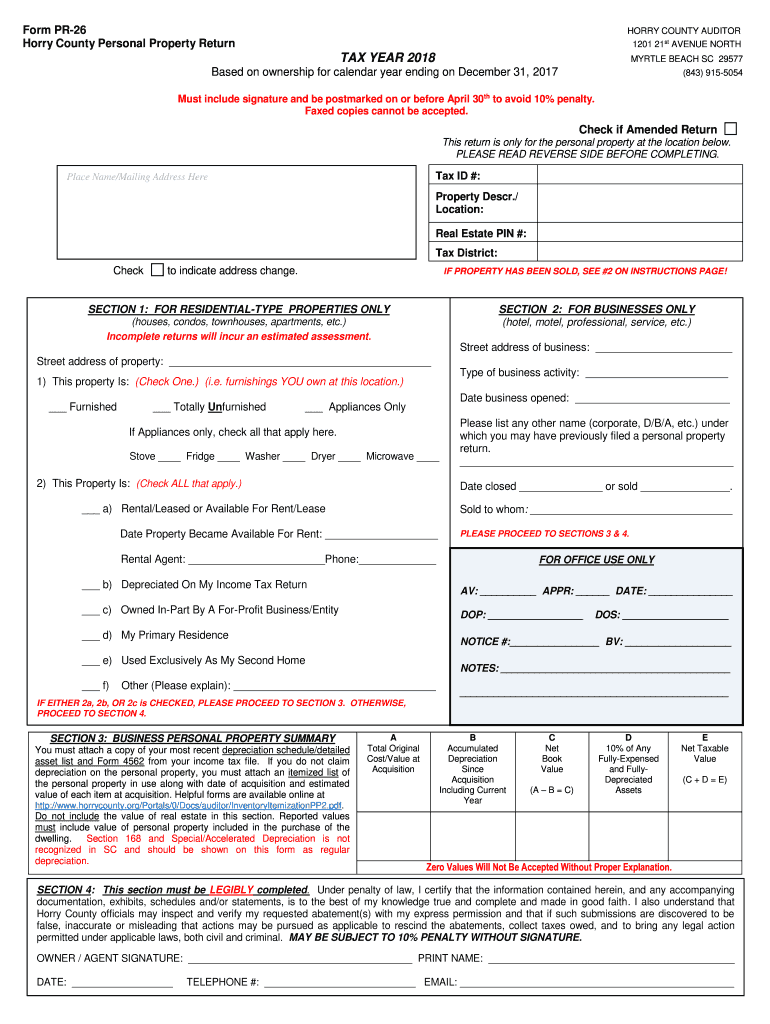
The full amount of tax is paid. Please remit amount due or forward the tax notice to the purchaser if the tax was pro-rated at closing. DO NOT CALL OUR OFFICE OR RETURN THE TAX NOTICE TO NOTIFY US THAT THE PROPERTY HAS BEEN SOLD. Our records will be updated for the following tax year based upon the filing of the purchaser s deed. If there are questions about how to handle payment, contact your closing attorney. 2. You may need to consult with your accountant before completing Section 3 of t.
Loading

Open form follow the instructions

Easily sign the form with your finger

Send filled & signed form or save
How to fill out the SC PR-26 online
The SC PR-26 form is essential for reporting personal property in Horry County for tax purposes. This guide provides step-by-step instructions on how to efficiently complete the form online, ensuring compliance and accuracy in your tax return.
Follow the steps to successfully complete the SC PR-26 form.
- Click the ‘Get Form’ button to access the SC PR-26 and begin the online filling process.
- In the first section, provide the tax ID number and the property description, including the street address and the tax district. Make sure to check the box if there has been an address change.
- Ensure to indicate whether the return is an amended return if applicable. Next, specify whether the personal property is for residential-type properties or businesses. Check all relevant boxes according to your situation.
- For businesses, provide the street address of the business and the type of business activity. Make sure to state when the business opened and if there are any appliances included on the property.
- In Section 3, attach a copy of your most recent depreciation schedule or an itemized list of personal property, including details like the date of acquisition and estimated values. This is crucial for ensuring proper valuation.
- Legibly complete Section 4, providing your signature, printed name, and date. Ensure that the contact details such as phone number and email address are accurate.
- After completing all sections, save your changes. You can then download, print, or share the completed SC PR-26 form, ensuring it is postmarked by April 30th to avoid penalties.
Take control of your personal property reporting by filling out the SC PR-26 online today.
Experience a faster way to fill out and sign forms on the web. Access the most extensive library of templates available.
Related content
Online Registration, Rec Guide, WAC Membership, Sports, Disc Golf, Facility Rentals...
Fonte: Rede CIEVS. Centro de Operações em Emergências – COE/Monkeypox. Dados...
Tipo: laser semicondutor GaAIAs (CD). • Comprimento de onda: 650-662nm. (DVD), 785-795nm...
Get answers to your most pressing questions about US Legal Forms API.
How do I apply for property tax exemption in SC?
To apply for property tax exemption in South Carolina, you must submit an application specific to the type of exemption you seek, such as SC PR-26. This often includes providing proof of residency and any relevant financial documents. It’s important to meet local deadlines and ensure all information is accurate. Utilizing platforms like uslegalforms can guide you through the application process for a smooth experience.
What is considered personal property in South Carolina?
In South Carolina, personal property refers to movable assets like vehicles, equipment, and furniture that are not affixed to real estate. These items are subject to different tax treatments and can significantly impact personal property tax liability. To fully understand what qualifies under the SC PR-26 classification, it’s useful to consult local regulations. This knowledge ensures you have accurate information for your tax planning.
How much is personal property tax in South Carolina?
The amount of personal property tax you owe in South Carolina depends on the assessed value of your personal assets and the local millage rate. Typically, rates can vary by county, affecting your overall tax obligation. It's advisable to check with local tax authorities for precise calculations. Using tools from uslegalforms can streamline your understanding of your financial responsibilities under SC PR-26.
How is South Carolina property tax calculated?
South Carolina calculates property tax by assessing the property's value and applying the appropriate millage rate established by local governments. Residential properties typically have a lower assessment ratio compared to commercial properties, which impacts the overall tax amount. To simplify the process, you can explore platforms like uslegalforms to help with necessary documents and calculations. This ensures you fully benefit from any SC PR-26 classifications you qualify for.
How is personal property tax calculated in South Carolina?
Personal property tax in South Carolina is calculated by multiplying the assessed value of the property by the local millage rate. It's important to understand that different categories of property have different assessment ratios, reflecting their value. For a smooth experience, consider using uslegalforms to assist with any necessary tax forms or calculations. This ensures accuracy and compliance with SC PR-26 regulations.
At what age do you stop paying property taxes in South Carolina?
In South Carolina, once you reach the age of 65, you may qualify for certain property tax exemptions that could reduce or eliminate your property tax burden. However, you must apply for the SC PR-26 classification to take full advantage of these benefits. Always check with local tax authorities for specific eligibility requirements and procedures. It's wise to stay informed about your rights as a property owner.
What counts for personal property tax?
Personal property tax in South Carolina usually covers movable assets like vehicles, boats, and business equipment. These items are taxed based on their assessed value, which reflects their market value. To avoid any miscalculations, it's important to keep an up-to-date inventory of your personal property. The SC PR-26 classification may impact your personal property tax, depending on the nature of the assets.
How do I get a 4% property tax in South Carolina?
To qualify for the 4% property tax rate in South Carolina, you must apply for the legal classification known as SC PR-26. This classification typically applies to owner-occupied residential properties. Ensure you gather all required documentation, such as proof of residency, to support your application. Once approved, you will enjoy significant savings on your property taxes.
What is the difference between a nonresident and a part-year resident?
The difference between a nonresident and a part-year resident lies primarily in the duration of their stay in South Carolina. Nonresidents live outside the state and have not established residency for tax purposes, while part-year residents have lived in the state for part of the tax year, earning income during that period. Understanding your classification can drastically impact your tax responsibilities. Platforms like US Legal Forms can help clarify these distinctions regarding SC PR-26.
Does South Carolina have a 183 day residency rule?
Yes, South Carolina follows a 183-day residency rule. If you are present in the state for 183 days or more during the year, you will likely be considered a resident for tax purposes. This rule is significant when determining your tax obligations. For clarity and assistance in understanding your residency status, refer to resources like US Legal Forms, particularly in the context of SC PR-26.
Use professional pre-built templates to fill in and sign documents online faster. Get access to thousands of forms.
If you believe that this page should be taken down, please follow our DMCA take down process here.
This form is available in several versions. Select the version you need from the drop-down list below.