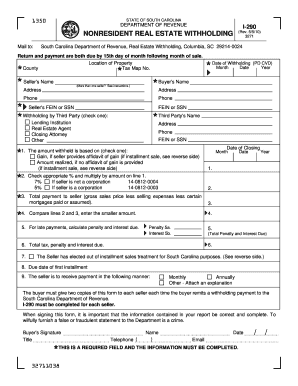
A, SC 29214-0024 Return and payment are both due by 15th day of month following month of sale. Location of Property County Tax Map No. * * Seller's Name Address * * Date of Withholding (PD CVD) Month Date Year * Buyer's Name Address (More than one seller? See instructions.) Phone Phone Seller's FEIN or SSN * Withholding by Third Party (check one): * Lending Institution FEIN or SSN * Third Party's Name Address Real Estate Agent Closing Attorney Other Phone FEIN or SSN Date of Closin.
Open form follow the instructions
Easily sign the form with your finger
Send filled & signed form or save
How to fill out the SC DoR I-290 online
The SC DoR I-290 form is essential for nonresident real estate withholding in South Carolina. This guide provides clear, step-by-step instructions on how to complete the form online effectively.
Follow the steps to fill out the SC DoR I-290 form online.
- Click ‘Get Form’ button to obtain the form and open it in the editor.
- Begin with the location of the property section. Enter the county and tax map number accurately, as this information identifies the property involved in the sale.
- Provide the seller's information, including their name and address. Ensure that all required fields marked with an asterisk are correctly filled out.
- Indicate the date of withholding, specifying the month, day, and year when the payment will be made.
- Complete the buyer's details, including their name, address, and contact phone number, as well as the buyer's Federal Employer Identification Number (FEIN) or Social Security Number (SSN).
- Specify whether withholding will be conducted by a third party and select the appropriate option from lender, real estate agent, or closing attorney, remembering to provide their FEIN or SSN.
- On line 1, record the amount withheld based on the seller's gain or the amount realized from the property sale, referencing the appropriate affidavit if provided.
- Follow by checking the right box on line 2 and performing any necessary calculations.
- List the total payment due to the seller by deducting selling expenses and any mortgages from the gross sales price on line 3.
- Review any penalties or interest due and complete line 5 if applicable.
- Ensure all entries on the form are accurate, then sign and date the form in the buyer's signature section.
- Once completed, you can save changes, download, print, or share the form as needed.
Complete your SC DoR I-290 form online today!
Experience a faster way to fill out and sign forms on the web. Access the most extensive library of templates available.
Related content
Jul 17, 2023 — Anyone making payment to a nonresident seller for the purchase of real...
Jan 9, 2020 — This document is a guide to South Carolina tax incentives for economic...
AVISO DE SEGURANÇA. Apenas pessoal qualificado deve instalar e realizar a manutenção no...
Get answers to your most pressing questions about US Legal Forms API.
How to get SC residency?
To obtain South Carolina residency, start by moving to the state and establishing a physical presence for at least 12 months. You should also secure a South Carolina driver's license, register to vote, and file state taxes, showcasing your intent to reside. The SC DoR I-290 outlines specifics on the documentation needed for establishing residency. Using UsLegalForms can simplify your experience by providing the necessary forms and guidance throughout your residency application process.
How do I get a SC tax exemption certificate?
To obtain a South Carolina tax exemption certificate, you need to complete an application process through the South Carolina Department of Revenue. This typically involves filling out the necessary forms and providing documentation that supports your eligibility for tax exemption. Utilizing the SC DoR I-290 can help guide you through the specific requirements to ensure you submit a complete application successfully. Streamlining this process helps you receive your tax exemptions efficiently.
What qualifies you as a resident of South Carolina?
To be considered a resident of South Carolina, you must physically reside in the state for at least one calendar year and intend to make it your permanent home. Additionally, maintaining a residence, securing employment in the state, and registering for state taxes also support your residency claim. The SC DoR I-290 provides clear criteria to ensure you meet all necessary qualifications. Understanding these requirements can streamline your transition to residency.
How long does it take to establish residency in South Carolina?
Establishing residency in South Carolina typically requires a minimum of 12 months of continuous physical presence within the state. During this period, you must demonstrate intent to live in South Carolina, which can include obtaining a driver's license, registering to vote, or securing employment. Remember, establishing residency is crucial for various benefits, including tax exemptions. For guidance on this process, consider referring to the SC DoR I-290 documentation.
How to fill out a withholding exemption form?
To fill out a withholding exemption form, begin by providing your personal information, including your name, address, and Social Security number. Be clear about your exemptions, using tools like the SC DoR I-290 for guidance. Accurate completion ensures your employer withholds the correct amount from your paycheck.
What is included in federal tax return?
Your federal tax return includes income from various sources such as wages, capital gains, and dividends. It also captures deductions, credits, and taxable pensions. Reviewing your return can provide insights into how to approach your SC DoR I-290 filings.
What is a state tax addback?
A state tax addback refers to specific amounts added to your taxable income for state purposes after calculating federal income. These addbacks help ensure compliance with state tax laws, particularly in South Carolina. Understanding the implications can simplify your SC DoR I-290 process.
What are the tax advantages of South Carolina?
South Carolina offers several tax advantages, including lower income tax rates and generous deductions for retirees. Additionally, the state provides credits for certain business investments. Utilizing resources like the SC DoR I-290 can help you maximize these benefits.
What items are included in taxable income?
Taxable income generally includes wages, interest, dividends, and business earnings. For South Carolina, some income may be treated differently due to specific state tax laws. Always consult your SC DoR I-290 information to understand what applies to your situation.
What items are added back to your federal taxable income for South Carolina purposes?
When calculating your South Carolina taxable income, certain items are added back to your federal taxable income. These may include specific deductions or non-taxable income that South Carolina regulations require to be reported. To ensure accuracy, refer to the SC DoR I-290 guidelines.
Use professional pre-built templates to fill in and sign documents online faster. Get access to thousands of forms.
If you believe that this page should be taken down, please follow our DMCA take down process here.
This form is available in several versions. Select the version you need from the drop-down list below.