Island Credits from RI Schedule CR, line 10................................... Contributions reduce your refund RI checkoff contributions from page 2, RI Checkoff Schedule, line 33....... or increase your balance due. .............. USE/SALES tax due from page 12, RI Schedule U, line 4 or line 8, whichever applies............................. 16 TOTAL RI TAX AND CHECKOFF CONTRIBUTIONS. Add lines 13a, 13b, 14 and 15............................. PAYMENTS 17a RI 2015 i nc om e tax wi thhel d fr o.

How it works
  • Open form

    Open form follow the instructions

  • Easily sign form

    Easily sign the form with your finger

  • Share form

    Send filled & signed form or save

How to fill out the RI DoT RI-1040NR online

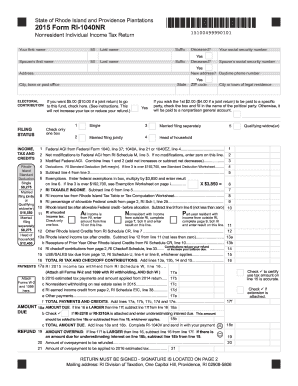
Filling out the RI DoT RI-1040NR, the Nonresident Individual Income Tax Return, can be straightforward with the right guidance. This guide provides clear, step-by-step instructions to help you complete the form online efficiently and accurately.

Follow the steps to complete your RI DoT RI-1040NR online.

  1. Click ‘Get Form’ button to obtain the form and open it for editing.
  2. Begin by entering your personal information, including your first name, middle initial, and last name. Indicate if you or your spouse is deceased by checking the appropriate boxes.
  3. Input your social security number and your spouse’s social security number, if applicable. If your address has changed, provide your new address details including city, state, and ZIP code.
  4. Next, consider making a $5.00 ($10.00 if filing jointly) contribution to the designated fund by checking the box if you wish. This contribution will not affect your overall tax or refund.
  5. Determine your filing status by checking one of the boxes. The options include single, married filing jointly, married filing separately, and head of household.
  6. Proceed to report your Federal Adjusted Gross Income (AGI) from your Federal Form 1040 or 1040A. This is to be entered on line 1 of the form.
  7. Calculate and input any net modifications to your Federal AGI from the RI Schedule M in line 2.
  8. Calculate your modified Federal AGI by combining the amounts from lines 1 and 2 and enter it on line 3.
  9. Apply the Rhode Island Standard Deduction based on your filing status, which can be found in the table provided. Input this amount on line 4.
  10. Next, subtract the deduction amount from your modified Federal AGI calculated in line 3, and enter the result on line 5.
  11. Compute your exemptions by entering your federal exemption amounts on line 6, multiplying them by $3,850.
  12. Calculate your Rhode Island Taxable Income by subtracting line 6 from line 5 and reporting it on line 7.
  13. Consult the Rhode Island Tax Table or Tax Computation Worksheet to determine the income tax amount to enter on line 8.
  14. Complete the remaining sections, including any allowable federal credits and total payments.
  15. Finally, review your entries for accuracy. Once verified, you can save changes, download, print, or share the completed form.

Complete your RI DoT RI-1040NR online today for a smooth tax filing experience.

Get form

Experience a faster way to fill out and sign forms on the web. Access the most extensive library of templates available.

Related content

Personal Income Tax Forms - RI Division of...

Jan 6, 2025 — Available forms include RI-1040 for residents, RI-1040NR for...

Learn more
2009 Instruction 1040A

by U COMPENSATION — You do not have to pay tax on unemployment compensation of up to...

Learn more
Questions & Answers

Get answers to your most pressing questions about US Legal Forms API.

Contact support

What is the non-resident withholding requirement in Rhode Island?

In Rhode Island, non-resident withholding is required on certain types of income. This includes wages, pensions, and distributions from partnerships or S-corporations. Non-residents must be aware of these requirements, as failure to withhold may result in penalties. Filing the RI DoT RI-1040NR correctly helps ensure that all withholding is accounted for and reported to the state.

Whether you need to file the RI DoT RI-1040NR form depends on your income sources and residency status. If you earned income in Rhode Island as a non-resident, you likely must file this return. Keeping track of your earnings from state-based entities will help you determine your filing requirement. Utilizing services like uslegalforms can streamline this process and ensure compliance.

Rhode Island’s residency requirement typically states that you are considered a resident if you maintain a permanent home in the state. Additionally, if you spend 183 days or more in Rhode Island within a year, you may also be classified as a resident. This classification affects your tax responsibilities and whether you need to file a form like the RI DoT RI-1040NR. It is important to determine your residency status to comply with state tax laws.

You should send your RI state tax return to the Rhode Island Division of Taxation. If you are filing a paper return, the address is usually mentioned on the form itself or the state's website. If you are filing electronically, the submission process is straightforward and generally includes guidance on where your return will be processed. Submitting your RI DoT RI-1040NR on time is crucial to avoid any penalties.

To file a non-resident tax return in Rhode Island, you need to complete the RI DoT RI-1040NR form. This form captures all income earned within the state as a non-resident. You can typically file it electronically, or you may choose to send a paper return to the Rhode Island Division of Taxation. Ensure that you gather all necessary documentation to accurately report your income and deductions.

Many states, including Rhode Island, require nonresident withholding to ensure that taxes are collected from individuals who earn income from that state but do not live there. Specifically, states like Vermont, New York, and Massachusetts also have similar requirements. Be sure to check the tax laws in each state you work in or earn income from, as this can affect your tax filings. Using tools that help with RI DoT RI-1040NR can simplify the process of non-resident withholding.

A RI estate tax return must be filed by the personal representative of an estate if the total value of the estate exceeds Rhode Island’s estate tax exemption threshold. This includes both residents and non-residents who own property or assets in Rhode Island. Filing correctly ensures compliance and helps in the proper distribution of estate assets.

A 1040 tax return form is a standard form used by individuals in the United States to report their annual income to the IRS. Depending on your situation, you may file different variations of the 1040 form. Non-residents in Rhode Island will particularly need to be aware of the RI DoT RI-1040NR to report income earned from Rhode Island sources.

To file a non-resident tax return in Rhode Island, you should complete form RI DoT RI-1040NR, specifically designed for non-residents earning income within the state. Gather all necessary documents, including your W-2s and any 1099 forms. Following the form’s instructions and submitting by the deadline will help you fulfill your tax filing requirements.

RI personal income tax refers to the state tax levied on individual income in Rhode Island. This tax applies to wages, salaries, and other forms of income earned within the state. Depending on your residency status, you may need to file either the standard RI 1040 or the non-resident form RI DoT RI-1040NR.

Get This Form Now!

Use professional pre-built templates to fill in and sign documents online faster. Get access to thousands of forms.

If you believe that this page should be taken down, please follow our DMCA take down process here.

RI DoT RI-1040NR Form

This form is available in several versions. Select the version you need from the drop-down list below.

Get RI DoT RI-1040NR