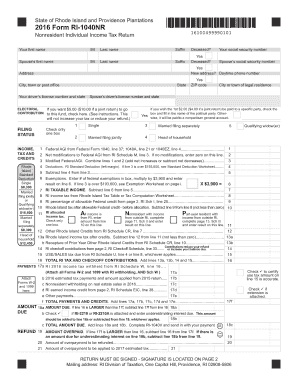
Uffix Deceased? Your social security number Suffix Yes Deceased? Spouse s social security number Yes New address? Daytime phone number Address City, town or post office State Your driver s license number and state will not increase your tax or reduce your refund.) INCOME, TAX AND CREDITS Rhode Island Standard Deduction Single $8,300 Married filing jointly or Qualifying widow(er) $16,600 Married filing separately $8,300 Head of household $12,450 City or town of legal residence Sp.
Open form follow the instructions
Easily sign the form with your finger
Send filled & signed form or save
How to fill out the RI DoT RI-1040NR online
The RI DoT RI-1040NR is the Nonresident Individual Income Tax Return used by individuals who earn income in Rhode Island but do not reside in the state. This guide will provide step-by-step instructions to assist users in accurately completing the form online.
Follow the steps to successfully file your RI-1040NR online.
- Click ‘Get Form’ button to obtain the form and open it for editing.
- Enter your first name, middle initial, last name, and suffix (if applicable) in the corresponding fields. Include your spouse’s details if you are filing jointly.
- Provide your social security number and your spouse’s social security number if applicable. Check the box if either of you is deceased.
- Fill out your new address, daytime phone number, and driver’s license number along with the state of issuance.
- Select your filing status by checking only one box that corresponds to your situation (single, married filing jointly, married filing separately, or head of household).
- Complete the income section by entering your Federal Adjusted Gross Income (AGI) from relevant Federal tax forms.
- Make any necessary modifications to your Federal AGI based on RI Schedule M and combine these figures.
- Enter the Rhode Island Standard Deduction based on your filing status. If your modified AGI exceeds certain thresholds, refer to the Standard Deduction Worksheet.
- Calculate your taxable income by subtracting exemptions from your total income.
- Determine the Rhode Island income tax using the tax table or tax computation worksheet and provide any applicable credits.
- If you have other Rhode Island credits or payments, enter these amounts in the appropriate fields.
- Review the total amount due or refund entitlement. If applicable, check the box indicating if the underestimating interest due is attached.
- Finally, sign the return, providing the date and any necessary preparer's information.
- Once completed, you can save the changes, download, print, or share the form as needed.
Complete your forms online today for a smooth filing experience!
Experience a faster way to fill out and sign forms on the web. Access the most extensive library of templates available.
Related content
Jan 6, 2025 — Available forms include RI-1040 for residents, RI-1040NR for...
by U COMPENSATION — You do not have to pay tax on unemployment compensation of up to...
Get answers to your most pressing questions about US Legal Forms API.
What is the 1040H form for Rhode Island?
The 1040H form in Rhode Island is specifically designed for taxpayers wishing to apply for a homeowner's credit. This form supports eligible homeowners in receiving tax benefits that assist with property tax burden. Completing the 1040H correctly can lead to financial relief, especially when combined with other forms like the RI DoT RI-1040NR. To simplify the filing process, consider using platforms such as uslegalforms.
How do I avoid the Rhode Island estate tax?
To avoid the Rhode Island estate tax, you can strategize around your estate planning early on. This may include setting up trusts, making gifts during your lifetime, and being strategic about how you title your assets. Understanding the estate tax exemptions can also aid in effective planning. Utilizing expert resources like those available on uslegalforms can help ensure you navigate these regulations successfully.
What is the property tax relief for seniors in Rhode Island?
Rhode Island offers property tax relief programs aimed at seniors, helping to ease the financial burden associated with property tax payments. Depending on eligibility, seniors may qualify for exemptions or credits that can lower their property taxes. This relief can be vital for maintaining homeownership during retirement. For more information and assistance with required forms, including the RI DoT RI-1040NR, consider uslegalforms for comprehensive guidance.
What is the 1040H tax form?
The 1040H tax form is used in Rhode Island for claiming the homeowner's credit. This form allows qualified taxpayers to receive a credit against their state income tax. To qualify, you must meet certain criteria regarding property ownership and income levels. If you need assistance with tax forms such as the RI DoT RI-1040NR or the 1040H, uslegalforms can provide valuable resources.
How to file a non-resident tax return?
Filing a non-resident tax return in Rhode Island involves submitting the RI DoT RI-1040NR form. You will need to gather documents related to your income earned within the state. Be sure to list any deductions you may be eligible for, as this can reduce your tax liability. Many find platforms like uslegalforms to be helpful in streamlining the filing process and ensuring compliance.
What is the non-resident withholding requirement in Rhode Island?
In Rhode Island, the non-resident withholding requirement mandates that businesses must withhold income tax when making payments to non-residents. This helps ensure that individuals who earn income in the state are paying the appropriate taxes. Typically, the withholding rate is around 5.99% for such payments. To manage this process efficiently, many use the RI DoT RI-1040NR form.
Which states require nonresident withholding?
Various states across the U.S. implement nonresident withholding, particularly those with income tax laws. Each state has its guidelines determining the necessity of withholding for non-resident income. It’s vital to research the specific requirements of states where you earn income to ensure compliance. For more thorough guidance, utilize resources like US Legal Forms when dealing with the RI DoT RI-1040NR.
What is the threshold for non-resident withholding?
The threshold for non-resident withholding in Rhode Island is based on the type of income earned. Specific amounts may trigger withholding requirements, ensuring that the state collects taxes from non-residents appropriately. Keeping track of your income sources can help clarify if withholding applies. For assistance, consider checking out tools available through US Legal Forms that pertain to the RI DoT RI-1040NR.
What is the pass through withholding in Rhode Island?
Pass-through withholding in Rhode Island applies to certain entities, allowing them to withhold taxes on behalf of individuals or non-residents. This process ensures tax compliance without burdening the individual to make estimated payments throughout the year. Understanding this withholding type is important for businesses working with non-residents. For more information, explore resources related to the RI DoT RI-1040NR.
What is the residency requirement for Rhode Island?
The residency requirement for Rhode Island primarily involves living in the state for more than 183 days during the taxable year. Additionally, establishing a permanent home and demonstrating intent to remain in Rhode Island plays an essential role. If you are uncertain about where you stand, resources like US Legal Forms can help clarify how the RI DoT RI-1040NR applies to your situation.
Use professional pre-built templates to fill in and sign documents online faster. Get access to thousands of forms.
If you believe that this page should be taken down, please follow our DMCA take down process here.
This form is available in several versions. Select the version you need from the drop-down list below.