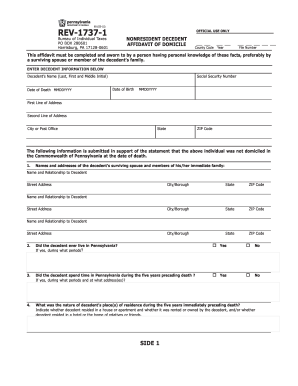
Vit must be completed and sworn to by a person having personal knowledge of these facts, preferably by a surviving spouse or member of the decedent s family. ENTER DECEDENT INFORMATION BELOW START Decedent s Name (Last, First and Middle Initial) Social Security Number Date of Death MMDDYYYY MM/DD/YYYY Date of Birth MM/DD/YYYY MMDDYYYY First Line of Address Second Line of Address City or Post Office State ZIP Code The following information is submitted in support of the statemen.
Loading
Open form follow the instructions
Easily sign the form with your finger
Send filled & signed form or save
How to fill out the PA REV-1737-1 online
The PA REV-1737-1 form is an affidavit of domicile for nonresident decedents, essential for determining the tax obligations of individuals who have passed away. This guide provides step-by-step instructions to effectively complete the form online, ensuring compliance and accuracy.
Follow the steps to successfully complete the PA REV-1737-1 online.
- Click the ‘Get Form’ button to access the PA REV-1737-1 form and open it in the editor.
- Begin by entering the decedent's information, including their name in the format of Last, First, Middle Initial, along with their Social Security Number, date of birth, and date of death.
- Provide the decedent's address by filling out the first and second lines, city or post office, state, and ZIP code.
- List the names and addresses of the decedent's surviving spouse and immediate family members, detailing their relationship to the decedent.
- Indicate whether the decedent ever lived in Pennsylvania and provide details on the duration if answered 'Yes.'
- Specify if the decedent spent time in Pennsylvania in the five years preceding death and elaborate on the periods and addresses if applicable.
- Describe the nature of the decedent's residences during the five years prior to death, noting rental or ownership status.
- State whether the decedent was employed during this period, and list employers if 'Yes.'
- Indicate if the decedent left a will. If so, mention where it was admitted to probate and attach a copy along with a certificate of issuance of letters testamentary.
- If no will was left, indicate whether an administrator has been appointed for the estate, and provide details about court appointments.
- Answer questions regarding any legal documents executed by the decedent that described residency in Pennsylvania.
- Detail any taxes paid to various governmental entities during the last five years.
- Identify the regional office of the Internal Revenue Service where the decedent filed federal income tax returns.
- Indicate any property owned by the decedent in Pennsylvania at the time of death, providing descriptions of such property.
- List any business activities the decedent was engaged in during the last five years, including employer details not covered previously.
- Estimate the gross value of the decedent's estate, excluding specific properties.
- Complete the personal signature of the individual filling out the form, including their name and relationship to the decedent, and affirm the truthfulness of the information provided.
- Once all sections have been completed, save the changes, and you will have the option to download, print, or share the form.
Begin filling out your PA REV-1737-1 form online today.
Experience a faster way to fill out and sign forms on the web. Access the most extensive library of templates available.
Related content
This affidavit must be completed and sworn to by a person having personal knowledge of...
Aug 3, 1996 — ... PA 1-800-362-2050, OUTSIDE PA AND. WITHIN LOCAL HARRISBURG AREA (717)...
This reference guide provides information about the Simple Network Management Protocol...
Get answers to your most pressing questions about US Legal Forms API.
How do I file an amended PA tax return?
To file an amended PA tax return, use Form REV-1500, marking it as an amended return. Submit this form along with any supporting documents to the Pennsylvania Department of Revenue, ideally as soon as any discrepancies are discovered. Timely submission of this amendment allows for proper adjustments and reduces the risk of penalties. Make sure to follow the PA REV-1737-1 guidelines for successful processing.
How do I write a personal check to the IRS?
To write a personal check to the IRS, write it payable to 'United States Treasury.' Include your social security number, the tax year, and the related form on the memo line for proper processing. It's advisable to use a pen and keep a copy for your records as proof of payment. This ensures clarity and accuracy in your tax dealings with the federal authorities.
Who do I make a tax check payable to?
For any tax check in Pennsylvania, make it payable to the 'Pennsylvania Department of Revenue.' Ensure you include your file number or social security number on the memo line to properly allocate your payment. This practice minimizes the risk of payment misallocation, streamlining your tax management efficiently under the framework of PA REV-1737-1.
How do I file a final sales tax return in PA?
To file a final sales tax return in Pennsylvania, you must complete Form PA-500, indicating that it is a final return. Ensure all tax payments are made, and any inventory is reported accurately. Submission can be done online or by mail; however, electronic filing is often smoother. This timely filing allows you to settle your tax obligations correctly under PA REV-1737-1 guidelines.
How do I file a Pennsylvania inheritance tax return?
To file a Pennsylvania inheritance tax return, you'll need to complete Form REV-1500. Submit this form within nine months of the date of death to avoid penalties. You can file the return on paper or electronically through the PA Department of Revenue. This process is vital to ensure compliance with state laws and to manage any associated tax responsibilities effectively.
How do I write a check to the PA Department of Revenue?
When writing a check to the PA Department of Revenue, start by filling in the date and the amount in words and numbers. Make the check payable to 'Pennsylvania Department of Revenue,' and include your tax identification number in the memo section for clarity. Properly following these steps ensures that your payment is processed efficiently, avoiding confusion or errors in your tax file related to PA REV-1737-1.
Who do I write my PA tax check to?
You should write your PA tax check to the 'Pennsylvania Department of Revenue.' Ensure that you include the correct reference or account number on the check to avoid any processing delays. It's important to mention the year or specific tax type to which the payment applies. This way, your payment will be posted accurately, helping you avoid penalties.
Who needs to file a PA inheritance tax return?
Any individual or entity that inherits property subject to PA inheritance tax must file a return. This includes beneficiaries, executors, and administrators of the estate. According to PA REV-1737-1, if the estate's value exceeds a certain threshold, filing is mandatory. It is important to familiarize yourself with these regulations to ensure compliance and avoid potential penalties.
Does a trust avoid Pennsylvania inheritance tax?
Establishing a trust does not automatically exempt you from Pennsylvania inheritance tax; however, it can help manage how and when assets are taxed. By carefully structuring a trust per PA REV-1737-1 guidelines, you can potentially lessen the tax impact on your heirs. It is crucial to work with a qualified estate planning professional who understands these nuances, as they can assist in creating a trust that meets your specific needs while addressing inheritance tax considerations.
How to minimize inheritance tax in PA?
Minimizing inheritance tax in Pennsylvania involves careful planning and informed decision-making. Strategies such as using irrevocable trusts, gifting assets, or taking advantage of the exemptions outlined in PA REV-1737-1 can help lessen the tax impact. Additionally, staying updated with the state's inheritance tax laws will empower you to make the best choices for your estate. Engaging with a knowledgeable attorney could further enhance your tax strategy.
Use professional pre-built templates to fill in and sign documents online faster. Get access to thousands of forms.
If you believe that this page should be taken down, please follow our DMCA take down process here.
This form is available in several versions. Select the version you need from the drop-down list below.