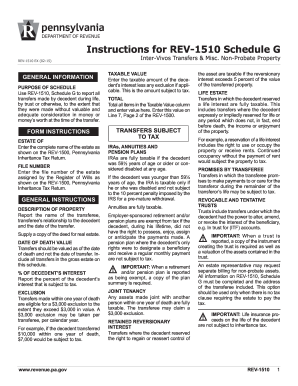
Se, to the extent that they were made without valuable and adequate consideration in money or money s worth at the time of the transfer. FORM INSTRUCTIONS ESTATE OF Enter the complete name of the estate as shown on the REV-1500, Pennsylvania Inheritance Tax Return. FILE NUMBER Enter the file number of the estate assigned by the Register of Wills as shown on the REV-1500, Pennsylvania Inheritance Tax Return. GENERAL INSTRUCTIONS DESCRIPTION OF PROPERTY Report the name of the transferee, trans.
Open form follow the instructions
Easily sign the form with your finger
Send filled & signed form or save
How to fill out the PA REV-1510 EX online
The PA REV-1510 EX form is essential for reporting transfers made by the decedent, ensuring compliance with Pennsylvania inheritance tax requirements. This guide provides a clear and step-by-step approach to filling out this form online accurately and efficiently.
Follow the steps to complete the form correctly.
- Click the ‘Get Form’ button to access the form and open it in the chosen digital format.
- Enter the complete name of the estate as it appears on the REV-1500, Pennsylvania Inheritance Tax Return.
- Input the file number of the estate as assigned by the Register of Wills, found on the REV-1500, Pennsylvania Inheritance Tax Return.
- Describe the property by reporting the name of the transferee, their relationship to the decedent, and the date of the transfer. Ensure you include a copy of the deed for any real estate.
- Indicate the value of the transfers as of the date of death, not the transfer date, and include all relevant transfers in your calculation.
- Detail the percentage of the decedent’s interest that is subject to tax.
- If applicable, apply the $3,000 exclusion for transfers made within one year of death, ensuring the amount is correctly calculated and documented.
- Enter the taxable amount of the decedent’s interest after exclusions, as this is the sum that will be subject to tax.
- Total all items in the Taxable Value column and record this total in the designated area. This value should be transferred to Line 7, Page 2 of the REV-1500.
- Upon completion, review the form for accuracy, then save changes, download, print, or share the form as needed.
Complete your PA REV-1510 EX online now to ensure proper handling of your inheritance tax obligations.
Experience a faster way to fill out and sign forms on the web. Access the most extensive library of templates available.
Related content
REV-1500 IN (EX) 08-24 ... If the estate is required to complete REV-1510 Schedule G...
BETA está orientada para textos escritos em Castelhano, mas também inclui materiais de...
Cuidados com as partes elétricas. Desligue o fogão da tomada sempre que fizer a limpeza...
Get answers to your most pressing questions about US Legal Forms API.
How do I write a check to the PA Department of Revenue?
When writing a check to the Pennsylvania Department of Revenue, write it out to 'Pennsylvania Department of Revenue.' Include your identification number or social security number in the memo line to ensure proper credit. It's important to use a blue or black ink pen to maintain clarity. Make sure to check the current payment instructions on the PA REV-1510 EX to avoid any delays in processing.
What is the maximum amount you can inherit without paying taxes?
In Pennsylvania, the maximum amount you can inherit without facing tax liability is $3,500 for inheritances from a parent. However, different rules apply based on the relationship to the deceased. Surviving spouses and charities are exempt from inheritance taxes altogether. To ensure you're informed correctly about your situation, reference the PA REV-1510 EX form on our platform for clarity on tax exemptions.
How do I file a final sales tax return in PA?
Filing a final sales tax return in Pennsylvania requires you to complete Form PA-40 for individuals or the appropriate business return if applicable. Ensure you report all sales and any exempt sales correctly before submitting anything. After filling out your return, you can submit it electronically or by mail. For additional assistance with documentation and filing options, the PA REV-1510 EX can serve as a helpful resource.
What qualifies you as exempt on taxes?
To qualify for a tax exemption in Pennsylvania, one must meet specific criteria defined by state laws. Common qualifications include being a senior citizen, a veteran, or demonstrating financial need. Additionally, certain types of properties, like those owned by nonprofits, may be exempt from property taxes. Understanding these rules is crucial for proper planning and optimal tax management.
Who is exempt from paying property taxes in Pennsylvania?
In Pennsylvania, specific groups may qualify for property tax exemptions, including veterans, active-duty military members, and certain low-income seniors. Each county has unique criteria for exemptions, so it is vital to review local guidelines. Programs may also exist to reduce the taxes owed for qualifying homeowners. Generally, staying informed will help you maximize any available benefits.
What is the best way to avoid inheritance tax in PA?
To effectively avoid inheritance tax in Pennsylvania, consider strategies like gifting assets before death. The PA REV-1510 EX outlines specific exemptions that can apply to your estate planning. Working with an estate planner can help you structure your assets in a way that minimizes taxes. Additionally, utilizing trusts can protect your heirs from unnecessary tax burdens.
At what age do seniors stop paying property taxes in PA?
In Pennsylvania, there is no specific age at which seniors stop paying property taxes, but some programs provide tax relief for older adults. Certain exemptions or discounts are available for residents over 65, which can ease the financial burden. For qualifying seniors, programs like the Property Tax and Rent Rebate Program can assist greatly. It is essential to check local regulations to understand your options.
Who needs to file a PA inheritance tax return?
In Pennsylvania, anyone who inherits property or assets worth more than $3,500 must file a PA inheritance tax return, also known as PA REV-1510 EX. This includes both direct heirs and beneficiaries of estates. If you receive a bequest from a deceased person, you are responsible for submitting this form. By understanding your responsibilities, you can ensure compliance and avoid penalties.
Where can I download PA tax forms?
You can download Pennsylvania tax forms directly from the Pennsylvania Department of Revenue's official website. Additionally, the PA REV-1510 EX can direct you to specific forms related to tax lien certificates and other tax-related documents. Utilizing a service like US Legal Forms ensures you have access to up-to-date forms and comprehensive guidance.
How to avoid inheritance tax in PA?
To minimize or avoid inheritance tax in Pennsylvania, consider various estate planning strategies such as gifting assets and setting up trusts. Consulting the PA REV-1510 EX can provide insights into legal avenues to protect your wealth. Engaging with professionals familiar with Pennsylvania tax laws can also assist you in optimizing your estate’s financial outcomes.
Use professional pre-built templates to fill in and sign documents online faster. Get access to thousands of forms.
If you believe that this page should be taken down, please follow our DMCA take down process here.
This form is available in several versions. Select the version you need from the drop-down list below.