Loading
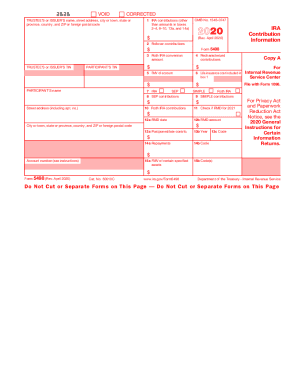
Get Irs 5498 2020-2026
This website is not affiliated with IRS
How it works
-

Open form follow the instructions
-

Easily sign the form with your finger
-

Send filled & signed form or save
How to fill out the IRS 5498 online
Filling out the IRS Form 5498 is essential for reporting contributions and the fair market value of your individual retirement account (IRA). This guide will provide you with clear, step-by-step instructions for completing the form online to ensure accurate submission.
Follow the steps to successfully complete the IRS 5498.
- Click ‘Get Form’ button to obtain the form and open it in the editor.
- Enter the trustee’s or issuer’s name, street address, city or town, state or province, country, and ZIP or foreign postal code in the designated fields.
- Fill in the Participant’s name and their taxpayer identification number (TIN). For privacy, only the last four digits of the TIN may be visible.
- Complete Box 1 by entering the total IRA contributions you made for 2020 and through April 15, 2021. Remember that these may be deductible, depending on your situation.
- In Box 2, specify any rollover contributions you have made during the year that fall under the guidelines provided.
- For Box 3, provide the amount converted to a Roth IRA from your traditional IRA, SEP IRA, or SIMPLE IRA.
- Document any recharacterized contributions in Box 4 if applicable.
- In Box 5, indicate the fair market value (FMV) of your account assets as of year-end.
- Enter any life insurance costs allocable to your account in Box 6 if relevant.
- Complete Boxes 7 through 15 according to the specific types of contributions and investments you have made.
- Review all entries for accuracy. Once verified, you can save changes, download, print, or share the completed form as needed.
Start completing your IRS 5498 online today to stay compliant and informed about your retirement contributions.
You do not report the fair market value of your IRA directly on your tax return. This information is detailed in the IRS 5498 form, which your financial institution files. However, keeping track of this value is important for understanding your retirement savings. Use this information for informed financial planning and tax purposes.